
EARL La Robe des Champs
A 2-year rotation on potatoes in conservation agriculture
Nicolas Hallegouet, Roland Hallegouet

.jpg)
Nicolas and Roland Hallegouet are potato producers practicing conservation agriculture in Finistère. In 1999, Nicolas settled on his father's farm using conventional tillage. Roland joined him in 2016. The farm size is small: 30 hectares, so profitability must be ensured to compensate for the limited land. Nicolas therefore produces potatoes for consumption, early potatoes, and sells them directly, which is the farm's main outlet.
In 2002, due to the heavy workload, Nicolas decided to switch to simplified soil work. Since then, the Hallegouet brothers have evolved their system to meet their goals of efficiency in labor time and soil quality conservation. The two brothers aim to maintain good soil life by promoting microorganisms and earthworms despite the necessary soil work for potato production. We will thus see how Nicolas and Roland Hallegouet implemented an agroecological and productive agricultural system to achieve their goal.
Characteristics
| Farm name | EARL la Robe des Champs |
|---|---|
| Operators | Nicolas and Roland Hallegouet |
| Location | 29490 Guipavas Finistère |
| Utilized Agricultural Area (UAA) | 33 HA |
| Land proximity | 85% of land within 3km of the farm |
| Human Work Unit (FTE) | 2 FTE |
| Soil | Humiferous sandy loam
<15% clay 50-60% silt |
| Main | Winter Wheat, early and consumption Potato |
| Labels | No label, as they find it not very profitable for the producer,
considering the administrative burden involved. |
| Marketing method |
|
| Commitments | Member of groups TCS 29 and Sols d'Armoric |
Specificities
- Small area: 30 ha
- Industrial crop and soil conservation
- Short rotation
- Spontaneous cover of Chenopodium
- High organic matter content
Transition steps
- 1999: Nicolas settles on 30 ha with conventional tillage.
- 2002: due to workload caused by direct sales: Nicolas stops tillage and approaches the chamber of agriculture for training; he joins a group: TCS 29.
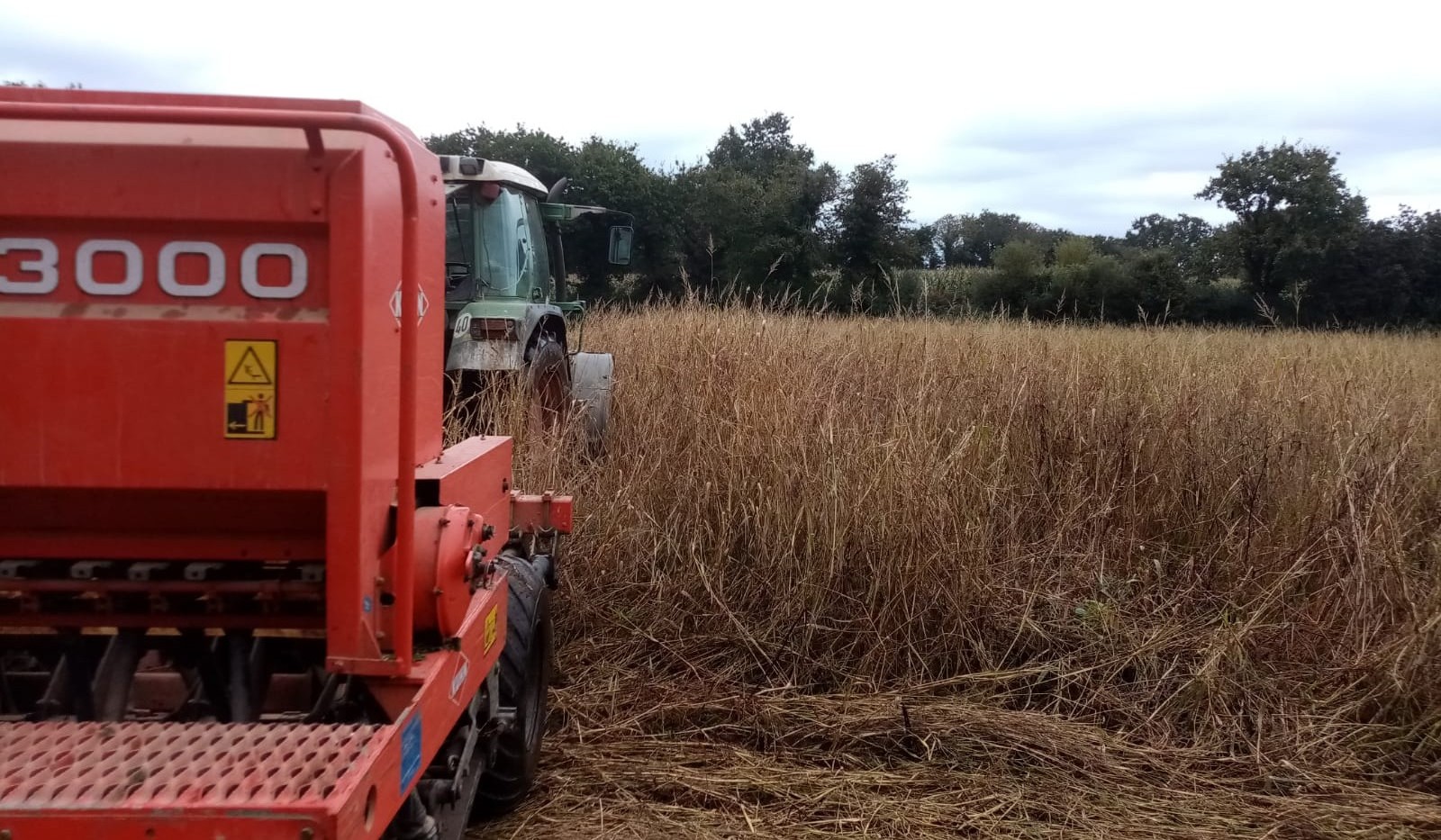
- 2009: purchase of a no-till seeder (kuhn sd 3000).
- 2013: attempt at permanent Alfalfa cover, without positive conclusion.
- 2016: Roland, his brother, settles.
- 2019: Implementation of permanent clover cover with wheat over 2-3 years.
Overall objectives
- Simplify work organization to save time for direct sales.
- Have profitable crops.
- Maintain good soil life by promoting microorganisms and earthworms despite the necessary soil work for potato production. Following a compensation strategy with cover crops.
- Produce carbon to enrich the soil (thus no reduction in nitrogen fertilizers for now).
Pedoclimatic context of the farm
| Pedoclimatic context | |
| Soil texture | Humiferous sandy loam
< 15% clay 50-60% silt |
| Organic matter content[1] (stable over 20 years) | 3-6% |
| Potassium (no input for 20 years) | 5% |
| Soil pH | 5.8-6 |
| Earthworms per ha | 1.5-2.5 tonnes |
| Average annual rainfall (mm) | 1000 (source: Hallegouet) |
| Average maximum temperature | 23°C (source: Hallegouet) |
| Average minimum temperature | 11°C (source: Hallegouet) |
An oceanic climate
The farm EARL La Robe des Champs benefits from a mild and temperate oceanic climate, largely influenced by the proximity of the English Channel. This maritime influence maintains moderate temperatures throughout the year, with averages between 10 and 12°C in winter and 20 to 25°C in summer. Annual precipitation is around 1000 mm, distributed relatively evenly over the year. However, there is some seasonality, with generally dry springs, while winters are mild, humid, and relatively rainy.
Shallow soils
The farm's soils are predominantly sandy loam, with an average depth of 22 cm. This soil type, although humiferous, is prone to crusting, notably due to its low clay content. The operators regularly apply magnesium to address this issue. These inputs help stabilize soil structure by creating “a link between organic matter” and minerals, thus promoting better biological activity.
A pH in progression phase
The soil pH is in a recovery phase, currently between 5.8 and 6. The operators aim to gradually bring it between 6 and 7, to improve soil fertility and nutrient efficiency. To do this, an input is made every two years of calcium carbonate in the form of dolomite, to reach 48% saturation of the clay-humus complex (CHC).
A homogeneous parcel distribution
The farm consists of 21 parcels, with an average size of 1.57 hectares each. These parcels can be grouped into two main soil types: valley bottom areas, richer in silts (over 60%) but with a lower organic matter content (3%), and other parcels with a more balanced texture. The proximity of the parcels is a major asset, with 85% of the land located within 300 meters of the main building and none more than 1.5 km away.
The operators also face significant urban pressure limiting expansion.
Soil approach based on physico-chemical element balance
The amendment strategy is done at the rotation scale; the key to a productive soil lies in a solid physico-chemical balance even before working on its biology. As explained, “a productive agricultural soil is not a forest soil.” Unlike a forest soil, where dry matter production is limited to about 5 tons per hectare per year in a temperate climate, an agricultural soil must generate between 20 and 25 tons of dry matter. This requires significant mineralization, notably of nitrogen, to support this high productivity.
This chemical balance, especially between calcium and magnesium, plays a fundamental role in soil structure. “The right calcium-magnesium balance results in very soft and crumbly soil,” a state that favors both soil biological life and crop health. Thanks to regular magnesium and calcium amendment inputs, Nicolas and Roland have observed a marked decrease in soil pathogens such as rhizoctonia and wireworm.
The operators work with a multifactorial approach, also integrating interactions between fungi, bacteria, carbon, nitrogen, and the balances of air and water in the soil. Nicolas has been working for some time to develop bacteria and fungi by spraying GAÏAGO solutions (microorganisms). This global vision allows them to manage pathogens while increasing the soil's water reserve capacity. The goal is to reach a calcium level of 68% of the CEC to notably reduce pest problems and especially increase the soil's water reserve capacity.
Optimization of soil analyses
To correct deficits, analyses are carried out every 2-3 years but without mixing samples from better zones with weaker ones to rebalance weaker areas. That is, soil analyses on parcels are done by zones and not by parcels, because “If we want to gain profitability per hectare, we absolutely must improve the zones with more difficulties.” and this is where pests are most present.
Feeding the soil: crop monitoring
Crop rotation
Rotation description

As shown in the diagram above, Nicolas and Roland Hallegouet have implemented 3 different rotations depending on the parcels:
Short rotation (2 years): Early potato and wheat
This quick rotation is dedicated to early potatoes, planted between January and February, then harvested in May. After harvest, a spontaneous cover naturally develops (knotweed, mainly chenopodium, summer grasses) after a pass of Canadian hoes. In October, wheat is sown directly into this cover. The goal is to maximize plant density and ensure good soil structuring after the pass. This rotation allows early marketing and rapid valorization of crops.
Intermediate rotation (3 years): Seasonal potato and wheat
In this rotation, potatoes are planted later, in March-April, and harvested at the end of summer. After harvest, wheat is sown with white clover, a second wheat is sown the following year in the clover (which has been chemically regulated). This rotation aims to optimize soil fertility by integrating a white clover cover under the wheat, which improves soil structure and life. The clover is destroyed before the third year, before sowing an oat cover in preparation for potatoes. The goal is to have maximum surface coverage and significant root work. The high density of (150-180 kg/ha) limits tillering and thus facilitates degradation during destruction in February.
Long rotation (4 years): Conservation potato and three successive wheats
After potato harvest, similarly to rotation 2, wheat is sown in October and followed by two other successive wheats.
-
 Spontaneous cover: regrowth of weeds after a pass of Canadian hoes on potatoes: mainly chenopodium accompanied by knotweed and grasses.
 -
 Wheat sowing in the spontaneous cover which is very carbon-rich and had time to produce seeds to replenish the soil stock. No glyphosate was used; plants just reached senescence.
 -
 Sowing of wheat and white clover simultaneously after potatoes on October 20, 2024
 -
 Emergence of the second wheat in the permanent white clover cover on October 28, 2024
 -
 First wheat on December 6, 2024 after potatoes. No crusting despite significant cumulative rainfall
 -
 First wheat on January 20, 2025. The clover is well sheltered by the wheat.
 -

-
 Screened beds ready for planting on April 1, 2025. After 3 years of wheat associated with clover, the soil is true humus
 -
 Early potatoes on April 20, 2025. Perfect control of Rhizoctonia solani, stems are white without any necrosis.
 -
 The clover regains vigor after harvest


.jpg)
Management of IFT and amendments
Currently, the fertilization program has not been modified, even with the presence of permanent clover in the cropping system. Regarding amendments, calcium carbonate inputs are applied on the surface, directly on the clover cover, to avoid excess calcium that could suffocate roots. Moreover, the operators do not use specific applications to calculate fertilization needs but favor an approach based on experience and soil observation.
Regarding IFT (Treatment Frequency Indicators), a gradual decrease is observed in the long rotation between the first and third wheat, as soil health improvement allows progressive reduction of treatments. However, despite an attempt to stop fungicides on wheat, local climatic conditions, marked by high humidity linked to the oceanic climate, forced the operators to resume their use.
| Overview of IFT by crops 2024 | |||||
| Crop | Scenario | Herbicides | Fungicides | Insecticides | Total IFT |
| Wheat | No.1 | 2.33 | 0.91 | 0.33 | 3.57 |
| No.2 | 2.33 | 1.16 | 0 | 3.49 | |
| No.3 | 2.33 | 0.66 | 0 | 2.99 | |
| Potatoes | Early | 1.66 | 0 | 0 | 1.66 |
| Conservation | 2.86 | 5.00 | 0 | 9.33 | |
Establishment and Management of Permanent Clover
The establishment of a permanent white clover cover crop requires a certain adaptation period. The first years of learning were marked by significant adjustments, “we sometimes harvested 30 quintals of wheat instead of 80.” Clover takes 6 months to establish, which is very long, so it must be part of a long-term plan to be valued. This slowness requires limiting herbicide treatments, especially the first year, so as not to compromise its development. However, from the second year onwards, the clover is sufficiently rooted to withstand more substantial herbicide programs.
Farmers use adapted varieties, such as dwarf clover varieties: "Huia and Aberace", known for their root aggressiveness, which promotes durable and effective establishment. They also observe that the beneficial effect of clover strengthens over time. For example, the third wheat crops in the rotation always yield better results than the second ones, thanks to the progressive improvement of soils induced by clover.
-
 Wheat under clover cover at harvest
 -
 Permanent clover cover just after harvest
 -
 Permanent clover a few weeks after harvest
.jpg)
.jpg)
.jpg)
The regulation of clover is evolving; initially, there was only chemical regulation, but for the past year they have been mowing the stubble and clover after harvest with a rotary harrow to mix straw residues with the clover and accelerate their decomposition. This practice limits the side effects of glyphosate, known to slow down straw degradation. Thus, when glyphosate is applied in October, most of the straw has already disappeared.
It should be noted, however, that the clover's reaction to a given herbicide dose varies considerably depending on whether it is in dormancy (low reactivity) or in stem elongation stage (very sensitive).
A summary on clover establishment
Ultimately, the clover cover has the advantage of improving soil structure and thus its erosion, notably thanks to the stolons (photo below) of clover. This good texture maintains good fertility and better water management despite potato cultivation. It also contributes to pest control since slugs stay on the clover instead of moving to the wheat. While the presence of legumes in the rotation has undeniable impacts on overall soil fertility, farmers do not yet see nitrogen effects on the associated crop. However, its establishment requires adaptation of practices to avoid competition with the main crop for water and nutrients. The right choice of species and destruction methods is necessary.
Clover management does not require particularly additional work since it is mainly done chemically and does not offset the time saved by stopping tillage.
.jpg)
Modification of sowing dates
With permanent clover, autumn sowings are advanced by three weeks, while spring sowings are delayed by fifteen days. Indeed, the soil warms up more slowly in spring and crops need to accumulate their required temperature sums to grow.
Pest Pressure Management on Crops
Slugs: Low pressure because they find enough food in the clovers present as cover, which prevents damage to wheat.
Wireworm: Managed through optimized chemical soil balance.
Weeds: Generally well controlled by the cover crop.
Observed Impact of New Practices
Monitoring carried out on the farm EARL La Robe des Champs has revealed several positive developments linked to the implemented practices.
- The count of earthworms (anecic), performed every two years, showed an increase in their population, indicating improved soil biological activity (factor 4). Even though potato production causes an annual loss of about one ton of earthworms, starting from an estimated 2.5 tons per hectare.
- One notable effect of the new practices is greater pH regularity, allowing better chemical stability of the soil.
- Improvement of water infiltration and storage capacity is another major impact. This evolution offers wider weather windows, enabling more flexible management of agricultural interventions.
- Slurry spreading in a second wheat under clover cover can thus be done without affecting soil structure. Finally, for early potatoes, with better drained soils, planting can be anticipated by one month, which is advantageous for marketing.
Biodiversity on the Farm
The EARL La Robe des Champs farm benefits from rich biodiversity due to the presence of 4.5 km of hedgerows. There is a great diversity of fungi, carabids, and spiders, contributing to natural pest regulation and soil health maintenance. This biodiversity strengthens the resilience of the agricultural system while reducing disease and harmful insect pressure.
"Plant biodiversity relies on the diversity of flora and trees species in the hedgerows. Animal biodiversity is based on a biomass between 10 and 12 tons per ha, not counting all the birds that come to feed in winter while bringing phosphorus through their droppings."
Valorization and Supply Management
All productions from the EARL La Robe des Champs farm are sold directly to ensure better valorization. Potatoes are all graded at harvest and stored in one-ton palox at 8 to 12 degrees. As for seed potatoes, to maintain certification they are purchased every year. However, for wheat seed, they have a grain sorter to produce their own seed.
Sales Organization
Potato
EARL La Robe des Champs favors a direct sale system, with marketing mainly oriented towards local catering. About 80% of sales go to around forty restaurateurs, supplemented by three farm shops, a drive-through, and four fishmongers. This choice is explained by the need to best valorize production on a small land area. However, the farm faces strong competition, notably from producers in the Hauts-de-France region and imports of some products from China, as well as a general decline in consumption, especially among young people.
Feed Wheat
All wheat is also sold directly to a nearby pig producer.
Equipment
Currently, for sowing and planting work, Nicolas and Roland use a KUHN SD 3000 seeder, a Canadian equipped with straight tines, a planter, and a seed cleaner, owned by them. These are their main equipment.
Harvests and sowings are done individually, allowing better control of each process step. However, slurry spreading is done by an ETA (Agricultural Work Company), while the fertilizer spreader is in a CUMA (Cooperative for the Use of Agricultural Equipment), allowing cost sharing.
.jpg)
.jpg)
Work Organization
There are two FTEs (Full-Time Equivalent) on the farm, including one person dedicated full-time to marketing. The farmers aim to limit working time to 50 hours per week over five days, making weekend work very rare. This organization also allows each to have five weeks of vacation per year.
The farmers are also involved in a trial group “TCS 29”, a dynamic collective promoting practice exchange and support in technical evolutions. Although distance can sometimes be a barrier, this participation has allowed them to confirm their choices and continuously improve their working methods.
Farm Autonomy
Seeds: The farm favors farm-saved seed for feed wheat, promoting local adaptation and cost reduction. However, for potatoes, seed tubers are purchased externally to have certified plants. Finally, the establishment of spontaneous cover requires only one pass of Canadian tine and thus incurs no seed cost.
Fertilization: Pig slurry comes from a nearby producer, limiting fertilization costs.
Work organization: Working time on crops is optimized by no-till, but they call on external help only for slurry spreading.
Marketing: Since all production is sold directly, the farmers have the freedom to set their own prices.
Economic independence: The farm does not wish to depend on CAP subsidies (it is not eligible due to short rotations), preferring freedom for innovation and sustainable profitability.
Advice for Transition
- It is essential to “be part of an exchange group” to share experiences, benefit from advice, and avoid some mistakes thanks to feedback from other farmers.
- Take time to train.
- To start this type of practice, begin by chemically balancing your soil.
Future Developments: Areas for Improvement
The future goal is to optimize pest breaks by improving straw degradation, then adjust carbon/nitrogen (C/N) ratios to ensure continuous soil nutrition. Farmers aim to approach 68% calcium to achieve good chemical balance to allow better pest management and pathogen control while strengthening the soil water retention capacity.
Finally, this year, a new program with the zero residues company was launched aiming to replace part of synthetic chemistry with organic control, to continuously improve the system.
Limiting Factors
In wheat, pedoclimatic factors limit yield. Solar radiation is sometimes limited in June during grain filling because the climate is not continental enough. Moreover, wheat performs better in deep soils than in shallow soils.
Economy
Feed wheat yields vary greatly due to adjustments still needed.
- Potatoes: 40-45 t/ha
- Feed Wheat: 30-95 qtx/ha
"These can greatly improve. Establishing a permanent cover associated with cereals takes many years, as acquiring know-how is necessary to manage the cover well; only multiplying experiences allows this learning. One must be very persevering…"
Economic results are good thanks to very low production costs:
- Gross Margin Potato: €15,000/ha
- Gross Margin Wheat: €750/ha
- EBITDA[2] > €100,000
However, the farm was heavily impacted by restaurant closures following Covid-19, with consequences over three consecutive years. This factor must be considered when interpreting these 2022 results. The 2024 figures are strongly improving.
Sources
- Interview with Nicolas and Roland Hallegouet on 12/16/2024
- Photos: Nicolas Hallegouet
- Slideshow Nicolas Hallegouet 2024
