

Use of pollinators as biocontrol agent vectors

The use of bees and bumblebees in biological control in agriculture could increase crop yields by 30% and reduce synthetic pesticide applications by 98% while being safe for these pollinators [1][2]. This is an alternative to spray technology. In this context, bees are used both to pollinate and to apply biological control products to crops to control diseases of flowers or leaves.
Origin of the practice and principle

In the early 1990s, this new sustainable control method using insects pollinators as vectors of biological control agents was proposed [4] [5].
An entomovector is an insect pollinator used as a vector to disperse an authorized substance against pests and plant diseases. The insect is generally a bee or a bumblebee, but can be any type of insect that carries pollen from plant to plant [6][7].
The main practice consists of using bees or bumblebees against several types of pests such as insects, fungi or bacteria.
This control strategy is environmentally friendly, precise and meets the pollination requirement [8][9][10][11]. It is an innovative crop protection method for organic and conventional agricultural systems.
Description of the technique

This control method is possible due to the interaction between the following elements:
- The crop.
- The pest (disease or herbivore).
- The pollinator (vector).
- The biological control agent (in powder form).
- The hives.
When bees leave the hive, they pass through a powder inoculum containing a biological control agent which is deposited in a dispenser fixed in front of the hives. By walking through the dispenser, bees are coated with the biocontrol agent on their bodies and legs and carry it to the crops [13][5]. When bees land to collect nectar or pollen, they shake to release the inoculum. The biological agent is thus deposited on the flower where it acts as a preventive measure against certain pathogens.
The proper functioning of the technique therefore requires the installation of a biopesticide dispenser in powder form available on the market [8][6][14][15].

Details on the technique

The biocontrol product can be a virus, a bacterium or a fungus with a specific powder formulation adapted to the chosen entomovector.
The choice of vector species is based on a combination taking into account:
- The native pollinator species of the concerned region.
- The plant species to be treated.
- The robustness of the vector species.
For example, flower color can influence pollinator attraction and allow selecting the most suitable vector species [6][11][7].
It is important to remember that, like any other technique, a large number of other aspects must be considered, especially regarding integrated pest management. It is necessary to consider the infected field area by the disease in order to implement an adequate integrated control strategy [2][17][14][18]. Moreover, another interesting point is that bees and bumblebees can disperse several biocontrol agents simultaneously [6][14].
Implementation and use
This technique is considered not only as a pathogen management prospect, but also as a reliable pest control method.
The most common application nowadays is on strawberry plants against grey mold caused by Botrytis cinerea [14][19][10][11][5][7]. To treat this disease, it is possible to use entomopathogenic fungi such as Gliocladium catenulatum [5][10][14][20][11][7].
This technology can also be used with other plant species such as sunflowers, apples, tomatoes, almonds, Canola, pears, cherries, grapes and blueberries [8][21].
Some examples of pollinator / biocontrol agent use on certain pathogens and pests:
| Crop | Pathogen/Pest | Biocontrol agent |
| ● Strawberry
● Raspberry ● Tomato |
Botrytis cinerea (Grey mold) | ● Gliocladium catenulatum (Prestop)
● Gliocladium roseum ● Trichoderma harzianum ● Beauveria bassiana (White muscardine) ● Aureobasidium pullulans (Black yeast) |
| ● Coffee | Monilinia vaccinii-corymbosa (Sclerotinia rot) | ● Bacillus subtilis |
| ● Coffee
● Canola |
Lygus lineolaris (Tarnished plant bug) | ● Beauveria bassiana (White muscardine) |
| ● Sunflower | Cochylis hospes (Sunflower moth) | ● Bacillus thuringiensis var. kurstaki |
| ● Pome fruits
● Rosaceae |
Erwinia amylovora (Fire blight) | ● Pseudomonas fluorescens
● Bacillus subtilis |
| ● Maize
● Tomato ● Cotton |
Helicoverpa zea (Corn earworm) | ● Heliothis nuclear polyhedrosis virus (NPV) |
| ● Tomato
● Bell pepper |
Trialeurodes vaporariorum (Greenhouse whitefly) | ● Beauveria bassiana
● Clonostachys rosea |
| ● Canola | Ceutorhynchus assimilis (Canola pod weevil) | ● Metarhizium anisopliae |
| ● Canola | Meligethes aeneus (Canola pollen beetle) | ● Metarhizium anisopliae |
| ● Sunflower
● Canola ● Carrot ● Beans |
Sclerotinia sclerotiorum (White mold) | ● Trichoderma spp |
Effectiveness depends on disease pressure and can range from 50% to 75% disease reduction depending on the biocontrol agent and the pathogen/pest [4][7][10][11][18][22].
Equipment and costs
- Hive.
- Dispenser.
- Pollinator agent (bees or bumblebees).
- Biocontrol agent: Example: CR-7 with Vectorite, Verdera B4, Prestop Mix
- Costs depend on the size of the field and the type of crop to be treated. Although honeybee hives can still be rented, bumblebee hives are now available for purchase from specialized companies such as Biobest inc. and Koppert inc [23]. Depending on growing conditions, approximate costs are 150 to 300 euros per hive.
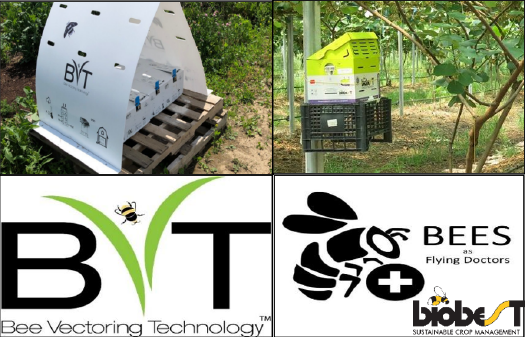
Hives sold by companies Bee Vectoring Technologies (BVT) and Biobest (Flying doctor)

Spatial scale and implementation technique
Bees are capable of transmitting biological control agents up to 200m from the hives. According to some studies, 4 hives can cover 12.5 hectares of crops evenly [24]. However, it is recommended to follow the recommendations of usage sheets giving one hive per 1000m² of crop [8].
Thus, the larger the plot, the higher the number of hives needed. The system perpetuates itself autonomously by primary and secondary dispersion of the biocontrol agent in the field [13]. Depending on the number of bees, the hive distribution system will require refilling every 24 to 72 hours by the farmer [13].
Application of the technique
 Effect over a large geographical area.
Suitable for all climates and soil types.
Easily generalizable to all types of fields and greenhouses.
Effective under high and low disease pressure (preventive and curative) [20][16].
Various types of pollinators available: Coleoptera, Diptera, Lepidoptera, Hymenoptera [6][11].
Implementation period
BVT and Flying Doctor systems use hives that generally last 10 weeks, allowing control during this period[8]. Since flowers are the main site of infection for phytopathogens and harmful insects [8][10][13][23], this technique forms an effective control tool during crop flowering and fruit development.
Agronomic, economic and social criteria
Agronomic and environmental
Environmentally friendly and safer practice for the environment and human health, while capable of increasing crop quantity and quality [8].
The technology not only reduces pesticide applications, but also improves pollination [8].
Economic
Much lower product doses than conventional agriculture are required (it takes 4kg of synthetic pesticides sprayed to achieve the same results as 0.02kg of BVT-CR7 products [8][16]), resulting in effective and economically competitive control.
Increasing plant yield increases farmer income [8][16].
No fuel or repair costs due to equipment wear since the tractor does not go out. [23].
Farmers can receive financial support to facilitate the transition from conventional to organic farming [23].
Social
Simple to implement system, requiring no training.
Reduction of working time.
Helps maintain bee populations.
Advantages and Disadvantages
Advantages
Ecological technique imposing no risk to health and environment, very low residues on fruits.
Reduces synthetic pesticide use.
Requires no water use.
Better yield due to improved natural pollination and provides equivalent/superior control compared to conventional agriculture.
Possibility to add pollen in dispensers to stimulate pollination.
No work interruption for the farmer.
Precise technology allowing to reduce losses associated with spraying.
No mechanical process nor fuel required.
Compatible within an integrated pest management program with other biopesticides.
Does not affect pollination.
Pollinators are active every day and visit flowers as soon as weather conditions allow. This enables continuous and targeted biocontrol.
No special training is required to fill dispensers and requires minimal time.
Possible and feasible use on many pathogens and pests.
Minimizes exposure of non-target organisms.
Disadvantages and limitations
 Best suited for diseases affecting crops through the flower or leaves.
 Cost can be higher than conventional agriculture.
Does not target many plant species at the moment.
The use of powerful synthetic pesticides is not compatible [15].
Only a few biological control agents have shown some effectiveness so far.
Weather conditions such as temperature, light intensity can also affect the effectiveness of dissemination [18][11][24].
More effective in greenhouses than outdoors.
More research still needs to be conducted: long-term effectiveness, long-term risk to bee health, hive placement, large-scale use… [15]
The viability and integrity of hives used in the field can still be improved: they must be tolerant to rain and humidity [23].
Lack of control over pollinator behavior outside greenhouses: avoid other nectar sources than the plants to be treated around the field [25].
Farmers' testimonials
According to interviews with various French farmers, this technology is currently not very well known within the agricultural community. However, many farmers have been very interested in this innovation and plan to follow its development in order to possibly use it in their fields/greenhouses.
- One case of application in France is La Framboiseraie, a small family farm focused on open-field production of small fruits (raspberrys, strawberries, blackberries), fruits (mirabelles, apples) and some vegetables. It has been using the Flying Doctors technology with Prestop® 4B (Biobest) since 2019 [3]. According to Pascal Chatelain, head of the company: "This solution is a real success because it works much better than synthetic references. It allows to no longer apply any treatment against B. cinerea with ultimately better results than before, without fungicide residues and without disrupting the integrated pest management in place. A boon in a context where restrictions on pesticide residues in France but also in Switzerland (country where its production is marketed) are significant." [26].
However, most of the testimonials found come from the United States and other countries.
- "The BVT system multiplied our income by 22 compared to previous years. So it makes us earn more money while increasing yield by 25% and controlling diseases in our crops. The BVT system has been incredible in helping me control diseases on flowers. 2020 is the third year using the BVT system and I am very happy with the results." Winn Morgan, Co-founder of the Major Blueberry League in Georgia.
- "This was our first experience with the BVT system, and we are very satisfied with what we have seen. We are encouraged by the results obtained on our farm in elderberry and we will use the BVT system next year." John Bennett, Owner of Alman Sunbelt Blueberries in Georgia.
- "Really impressive, I have been using BVT for 5 years, I recommend BVT 100% to other producers." Dave. P, Producer in Ontario for 30 years.
- "The BVT Vectorhive system worked well for us this season. Even with fewer spray applications, we saw fewer diseases, stronger and healthier plants, with better set and bigger fruits. Despite a slow start to the season, our fields treated by Vectorite-carrying bees with CR-7 outperformed similar fields with the same variety that did not use the BVT product." Roy Jones, Owner of Jones Farm in Alabama.
Regulation
- The application of Prestop® 4B by pollinating bumblebees (Flying Doctor technology) has been authorized to combat gray mold in strawberry and raspberry crops since 2013 in Belgium, since 2015 in the Netherlands and since 2016 in France (MA, marketing authorization, no. 2150847, under greenhouses and tunnels) [27][28][29].
- Field and greenhouse trials of BVT technology are currently underway in various European countries and should be completed soon. This technique is commonly used in many European countries (Finland, Estonia, Italy, Switzerland) and in America (Mexico, California, Canada) [27][28] [29].
- In 2019, the United States Environmental Protection Agency and the European Patent Office patented and approved the utility of CR-7 as a plant treatment, thus protecting a key element of the BVT agricultural system [8]. This technology has been validated in 14 European countries (Belgium, Germany, Spain, France, United Kingdom, Greece, Italy, Poland, Portugal, Romania, Serbia, Switzerland, Netherlands and Turkey)[27][28] [29].
Annexes


Sources
- ↑ Stein, K. et al. Bee pollination increases yield quantity and quality of cash crops in Burkina Faso, West Africa. Sci Rep 7, 17691 (2017).
- ↑ 2.0 2.1 Pozo, M. I., Vendeville, J., Mommaerts, V. & Wackers, F. Flying Doctors for a Better Quality in Fruit Production. in Entomovectoring for Precision Biocontrol and Enhanced Pollination of Crops (eds. Smagghe, G., Boecking, O., Maccagnani, B., Mänd, M. & Kevan, P. G.) 263–277 (Springer International Publishing, 2020). doi:10.1007/978-3-030-18917-4_15.
- ↑ 3.0 3.1 https://www.biobestgroup.com/en/biobest/products/biological-disease-control-15998/biofungicides-15999/prestop%C2%AE-4b-4833/
- ↑ 4.0 4.1 Chmiel, J. A., Daisley, B. A., Pitek, A. P., Thompson, G. J. & Reid, G. Understanding the Effects of Sublethal Pesticide Exposure on Honey Bees: A Role for Probiotics as Mediators of Environmental Stress. Front. Ecol. Evol. 8, 22 (2020).
- ↑ 5.0 5.1 5.2 5.3 Hokkanen, H. M. T., Menzler-Hokkanen, I. & Lahdenpera, M.-L. Managing Bees for Delivering Biological Control Agents and Improved Pollination in Berry and Fruit Cultivation. SAR 4, 89 (2015).
- ↑ 6.0 6.1 6.2 6.3 6.4 Kevan, P. G. & Baker, H. G. Insects as Flower Visitors and Pollinators. Annu. Rev. Entomol. 28, 407–453 (1983).
- ↑ 7.0 7.1 7.2 7.3 7.4 Kevan, P. G., Sutton, J. & Shipp, L. Pollinators as vectors of biocontrol agents - the B52 story. in biological control: a global perspective (eds. Vincent, C., Goettel, M. S. & Lazarovits, G.) 319–327 (CABI, 2007). doi:10.1079/9781845932657.0319.
- ↑ 8.00 8.01 8.02 8.03 8.04 8.05 8.06 8.07 8.08 8.09 8.10 8.11 BeeCulture-January2021, The Magazine of American Beekeeping, Mayan Melipona
- ↑ Park, Hong Hyun, Kim, Jeong-Jun, Kim, Kwang Ho & Lee, Sang guei. Dissemination of Bacillus Subtilis by using Bee-vectoring Technology in Cherry Tomato Greenhouses. Korean journal of applied entomology 52, 357–364 (2013)
- ↑ 10.0 10.1 10.2 10.3 10.4 Mazra’Awi, M. S. A., Shipp, J. L., Broadbent, A. B. & Kevan, P. G. Dissemination of Beauveria bassiana by Honey Bees (Hymenoptera: Apidae) for Control of Tarnished Plant Bug (Hemiptera: Miridae) on Canola. ENVIRONMENTAL ENTOMOLOGY 35, 9 (2006).
- ↑ 11.0 11.1 11.2 11.3 11.4 11.5 11.6 Jane, M. M., Mary, W. G., Rebecca, K. & Sheila, O. Managed bees as pollinators and vectors of bio control agent against grey mold disease in strawberry plantations. Afr. J. Agric. Res. 16, 1674–1680 (2020).
- ↑ https://sustainablefoodnews.com/bee-delivered-natural-crop-product-now-penetrates-83-of-u-s-blueberry- market/
- ↑ 13.0 13.1 13.2 13.3 Joshi, N. K., Ngugi, H. K. & Biddinger, D. J. Bee Vectoring: Development of the Japanese Orchard Bee as a Targeted Delivery System of Biological Control Agents for Fire Blight Management. Pathogens 9, 41 (2020).
- ↑ 14.0 14.1 14.2 14.3 14.4 Kapongo, J. P., Shipp, L., Kevan, P. & Sutton, J. C. Co-vectoring of Beauveria bassiana and Clonostachys rosea by bumble bees (Bombus impatiens) for control of insect pests and suppression of grey mould in greenhouse tomato and sweet pepper. Biological Control 46, 508–514 (2008).
- ↑ 15.0 15.1 15.2 Karise, R. et al. Sublethal effects of kaolin and the biopesticides Prestop-Mix and BotaniGard on metabolic rate, water loss and longevity in bumble bees (Bombus terrestris). J Pest Sci 89, 171–178 (2016).
- ↑ 16.0 16.1 16.2 16.3 BVT-OCT-VIC-Presentation, Ashish Malik, CEO, Bee Vectoring Technologies October 1, 2020
- ↑ Pesticides and pollinators. Protecting honeybees and wild pollinators, Beyond Pesticides.
- ↑ 18.0 18.1 18.2 Sawe, T., Eldegard, K., Totland, Ø., Macrice, S. & Nielsen, A. Enhancing pollination is more effective than increased conventional agriculture inputs for improving watermelon yields. Ecol Evol 10, 5343–5353 (2020).
- ↑ Van Delm, T. et al. Control of Botrytis cinerea in strawberries with Gliocladium catenulatum vectored by bumblebees. JBR 5, 23–28 (2015)
- ↑ 20.0 20.1 Van Delm, T. et al. Control of Botrytis cinerea in strawberries with Gliocladium catenulatum vectored by bumblebees. JBR 5, 23–28 (2015).
- ↑ Karise, R. et al. Sublethal effects of kaolin and the biopesticides Prestop-Mix and BotaniGard on metabolic rate, water loss and longevity in bumble bees (Bombus terrestris). J Pest Sci 89, 171–178 (2016).
- ↑ Jyoti, J. L. & Brewer, G. J. Honey Bees (Hymenoptera: Apidae) as Vectors of Bacillus thuringiensis for Control of Banded Sunflower Moth (Lepidoptera: Tortricidae). Environ Entomol 28, 1172–1176 (1999).
- ↑ 23.0 23.1 23.2 23.3 23.4 Reeh, K. W. Commercial Bumble Bees as Vectors of the Microbial Antagonist Clonostachys rosea for Management of Botrytis Blight in Wild Blueberry (Vaccinium angustifolium). 99.
- ↑ 24.0 24.1 Macedo, J. et al. The Potential of Bee Vectoring on Coffee in Brazil. in Entomovectoring for Precision Biocontrol and Enhanced Pollination of Crops (eds. Smagghe, G., Boecking, O., Maccagnani, B., Mänd, M. & Kevan, P. G.) 165–181 (Springer International Publishing, 2020). doi:10.1007/978-3-030-18917-4_10.
- ↑ https://quoidansmonassiette.fr/bicopoll-project-culture-fraise-bio-abeilles-remplacer-pesticides-alternatives/
- ↑ https://www.facebook.com/pg/laframboiseraie/posts/
- ↑ 27.0 27.1 27.2 https://www.newsfilecorp.com/release/58946/Bee-Vectoring-Technologies-Granted-Patent-by-European-Patent-Office-For-Biological-Fungicide-CR7
- ↑ 28.0 28.1 28.2 https://www.beevt.com/industry-news/articles/01042021-bee-vectoring-technologies-delivers-patented-organic-pesticides-with-some-help-from-the-hive
- ↑ 29.0 29.1 29.2 https://www.biobestgroup.com/fr/actualites/flying-doctors%C2%AE-et-prestop%C2%AE-4b-en-framboises-%3A-pollinisation-et-lutte-biologique-contre-le-botrytis
