
No-till seeding under living plant cover

In no-till seeding under living cover (SDCV), cover regulation is key to prevent it from competing too much with the cash crop. From this perspective, there are two main strategies: destroy the cover before establishing the main crop or keep it alive.
Principle
Maintaining the plant cover alive in the cash crop has the advantage of minimizing the risks of repeated annual cover crops in areas without access to irrigation and providing additional agronomic services. Maintaining a diversified root system, both in the cover crop and in the main crop, will for example maximize mycorrhization and the establishment of a diverse rhizosphere.
No-till seeding under living cover can be done, for example, by sowing a crop (often wheat) in well-established sainfoin or alfalfa stands that have been in place for several years (seed producers or forage). The success of this practice then lies in mastering the cover to prevent it from competing with the cash crop.
This technique is currently mainly practiced by non-organic farmers. For good success, herbicide regulation of the cover must be light before wheat sowing to allow the legume to grow and sufficiently early and strong after winter to avoid water and nitrogen competition with the cereal.
Why establish permanent covers?
Taking intercrop climatic hazards into account
The quality of establishment and success of covers depend on intercrop climatic conditions. Indeed, dry weather and warm temperatures are not favorable to optimal cover growth (emergence problems). Permanent covers, established simultaneously with a crop, have the entire crop cycle to develop, which is an interesting solution to ensure cover presence during intercrop and secure the establishment of the following crop in no-till.
Compared to an annual cover, a cover in place at harvest will more easily regrow at the first rains because its root system is already functional. It will also be less sensitive to weed competition because it already "occupies" the ground.
Economic interests
Implementing permanent covers represents an economic interest compared to annual covers. Indeed, once sown, the cover remains in place for several years, on average 3 years.
- Leveling of workload peaks.
- Reduction in fuel use.
- Reduction in mechanization costs in the medium and long term.
The table below from the GIEE MAGELLAN Guide compares the economic interests, especially at establishment, between the two types of covers.
| Annual cover | Permanent cover
(Established with oilseed rape) | |
|---|---|---|
| Cover cost (€/ha) | €35 * (to be renewed
each year) |
€50 to 70
(for 3 years) |
| Additional establishment cost (€/ha) | €30 to 50 (depending on equipment
and type of establishment) |
€0 (established with oilseed rape
so no additional cost) |
| So 65 to 85 €/year | So 16 to 23 €/year over 3 years |
Caution point: Frequent increase in herbicide use in the first years.
Agronomic interests
Weed management
Permanent covers, due to their root system, theoretically leave little room for weeds. Their ability to suppress weeds mainly depends on their capacity to occupy space before weeds are present.
A dense and homogeneous cover is therefore sought during intercrop but also during vegetation in the previous crop to maximize its presence and thus limit weed presence. In this objective, stimulating branching of perennial legumes is recommended to increase their competitiveness against other species. In this case, perform mowing, cutting or grazing.
Plant nutrition
The presence of perennial legumes allows multiple benefits:
- Supply of nitrogen thanks to the formation of nodules (fixation of atmospheric nitrogen by legumes). This nitrogen will be partly available during the crop depending on the species chosen but especially after cover destruction (50 to 150 units N).
- Promotion of mycorrhizal symbiosis which increases the root exploration surface and enhances bioavailability of some elements (phosphorus).
- Stimulation of microbial activity, which increases mineralization of soil organic matter and also the diversity of supplied elements.
Effects on soil organic matter
GIEE MAGELLAN performed simulations with the SIMEOS software to understand the effect of permanent covers on the evolution of organic matter (OM) content in soils.
Input data for the simulation are:
- Rotation Oilseed rape / Wheat / Winter Barley.
- Loam-clay soil – no organic matter inputs on the plot.
- CaCO3: 5g/kg / Organic C: 10%.
- Straw exported except oilseed rape straw.
- Establishment in no-till.
In their simulation context, straw incorporation ensures over 30 years an increase in OM stock in the 0-30 cm horizon. No-till and annual covers provide the best organic matter supply to the soil. OM stock increases from 84 to 96 T/ha. The constraint remains to produce 2 to 3 T of dry matter/year, which is not always achievable in intermediate zones. Using a white clover cover allows an OM gain close to that permitted by straw incorporation.
Effects on soil temperature

GIEE MAGELLAN measured temperature at the surface of bare soil and soil with cover in August 2018.
- At 11:30 am: difference is 7.7°C.
- At 3:30 pm: difference is over 15°C!
This experiment shows the interest of permanent soil cover in buffering environmental variations to maintain a favorable environment for soil microorganisms and roots (soil temperature and moisture).
Other advantages
- Equivalent yields if sowing is done under good conditions.
- Increased structural stability thanks to macroaggregates.
- Improved soil bearing capacity.
- Reduced runoff.
- Reduced risks of Erosion and Soil crusting (better infiltration and reduced splash effect).
- Improved water management (less evaporation due to cover).
Caution points
- Slug control.
- Weed control especially for rhizomatous species.
- Sunflower emergence.
- Adapted seeds and varieties.
Environmental interests
- Increase in soil biological activity in terms of intensity and biodiversity, notably for earthworms and ground beetles.
- Carbon accumulation in the topsoil.
- Top 10 centimeters enriched in P2O5 and K2O.
- Reduced nitrate leaching.
- Reduced energy consumption.
Caution points
- Increased N2O emissions in the first years.
- Decrease of carbon in lower layers.
In practice
- Before establishing the cash crop: the cover is calmed by using glyphosate at half or one-third dose. It is therefore not dead but weakened to allow the cash crop to establish well.
- Early spring or late winter: the cover is regulated at a sufficiently strong dose using hormones.
Although cover regulation in spring depends on climatic conditions, when well managed, it allows yields higher than expected with wheat alone. Monitoring in the CASDAR SDCV project showed that the late release from decomposition of this living cover ensured better nitrogen uptake at the end of the wheat cycle (post-flowering), explaining this positive effect on yields.
Without herbicides, maintaining a living cover in cereals appears delicate. Monitoring of organic plots in the project showed that repeated disking of alfalfa (without plowing) before sowing neither eliminated competition problems with the cereal nor harvest difficulties in low-straw cereal varieties. Establishing covers based on creeping or low-growing legumes (clovers) or wheat sown at wide spacing in a legume regulated by shallow soil work are avenues for future experiments.

Key points of living SDCV
Choice of permanent cover
Cover insertion is considered within a rotation; family diversity, root complementarity, objectives regarding weeds and pests must be taken into account. The choice of living cover must consider several criteria:
- Low competition for water and nitrogen for the following crop
- Presence of pests (notably voles in clover).
- Whatever the cover type, low-dose herbicide use is common to establish the cash crop under good conditions.
The table on page 91 of the MAGELLAN Guide illustrates the positive or negative impact of covers on subsequent crops.
In heterogeneous situations, mixing legumes is interesting to avoid gaps. Thus, alfalfa, adapted to dry areas, can be mixed with red clover which will maintain better in wetter zones.
Seeders adapted to each situation
Seeder choice is an integral part of the technical itinerary. It must be reasoned according to soil type and chosen system. During the transition to no-till seeding under cover, one of the first questions concerns seeder choice. Each seeder has characteristics that must fit the chosen practices.
Here are some points to consider:
Number of hoppers
This criterion is crucial especially when associating different species (with varied seed sizes), adding localized fertilizers or anti-slug products. A minimum of 3 hoppers seems essential (main crop + localized fertilizer + companion plant or anti-slugs).
Tine or disc seeder
The type of seeding element is decisive and will guide the type of no-till seeding under cover performed.
- Tine seeders are the safest because the tine work recreates structure and stimulates mineralization favorable to crop establishment. However, they favor weed germination and are less suited for sowing in twining covers like vetch or fodder pea (upright types preferred).
- Disc seeders are better suited for sowing in covers. Inclined disc seeders seem interesting for sowing in straw.
Furrow closing
Ensure furrow closing is adapted to soil type.
Work comfort
Check accessibility of seeder parts, ease of filling or emptying, seeding rate adjustment, possibilities for associations or sowing at different depths.
For more info on seeder characteristics, see page 101 of the MAGELLAN Guide 2019.
Examples of seeder effects on establishment quality
-
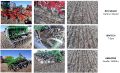 Tine seeders. Photo credit: GIEE MAGELLAN.
 -
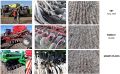 Straight disc seeders. Photo credit: GIEE MAGELLAN.
 -
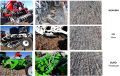 Inclined disc seeders. Photo credit: GIEE MAGELLAN.


Sowing
No-till seeding requires some precautions to avoid penalizing crop population and/or favoring bioaggressors establishment.
Level the soil
The objective of sowing is to position the seed well to ensure rapid and uniform emergence. If the soil is not well leveled, seeds will be sown either too deep or too shallow (or even placed on the surface). Before switching the plot to no-till under cover, check its leveling. If insufficient, pass tools (tines + rollers) to build a good base for starting SDCV.
Sow on a clean soil
The basis of any no-till establishment is sowing on clean soil, free of grasses and/or broadleaf weeds. The first lever to sow on clean soil is to have planned the rotation and mobilized enough agronomic levers to control weed populations on the plot. If weeds are present, especially grasses or perennials, chemical intervention will be mandatory. Indeed, post-sowing herbicide treatments risk being too late on too developed plants.
Possible strategies differ depending on the cover and targeted weeds; for more on this, see page 107 of the MAGELLAN Guide 2019.
Careful sowing
In SDCV, the only operation to establish crops is sowing. It is an important step not to miss to avoid early damage to crop potential. Various parameters must be considered.
Sowing speed
Sowing quality depends on forward speed. The soil being firmer on the surface modifies sowing conditions. Too high speed causes uneven population and soil fluffing which stimulates weed emergence. Aim for a sowing speed between 4 and 6 km/h.
Sowing depth
To allow good rooting, sowing is generally recommended deeper than in more traditional techniques (+1 cm on average). But this depends on species.
| Crops | Recommended
sowing depth |
Remarks |
|---|---|---|
| Oilseed rape | 1 to 2 cm | Prefer shallow sowing
(with seeds well covered by soil) to benefit from soil moisture and precipitation |
| Cereals | 2 to 3 cm | Ensure the seed is well covered by soil. |
| Protein crops /
Corn |
3 to 5 cm | Ensure the seed is well covered by soil. |
Sowing density
Sowing density is crucial in no-till under permanent cover. It serves several functions:
- Ensure crop population to maintain yield.
- Allow wheat to find its place within the permanent cover.
- Limit perennial legume growth in spring. Indeed, with a denser sowing rate, biomass will be sufficient to limit light in the crop. The growth dynamic of the perennial legume will thus be slowed. This is part of the cover regulation strategy.
Fertilizer placement
Using localized fertilizer at sowing is important especially in the first years of no-till for several reasons:
- No-till increases soil organic matter, thus decreasing available nutrients like nitrogen, phosphorus, or sulfur. Soil fertility is not yet sufficient to properly feed the crop, especially during early vegetative stages.
- Applying mineral elements at sowing (phosphorus, sulfur, nitrogen) boosts plant growth and potentially reduces pest impact by shortening sensitive periods (aphids, slugs, leafhoppers, flea beetle), increasing biomass and stimulating continuous plant growth (large crucifer flea beetle, terminal bud weevil).
Elements to apply must be defined based on soil analysis.
- Nitrogen: depending on crops and respecting the Nitrate Directive in force regionally. Interest in stimulating aerial biomass. --> Plan 10 units of nitrogen after 1st September.
- Phosphorus: Interest in stimulating root growth. --> Plan 20 to 30 units of nitrogen.
- Sulfur: Interest in legume nutrition. --> Plan 20 to 30 units of nitrogen.
Different fertilizer forms are available. Choice depends on species, autumn growth conditions, and soil fertility level (element availability or organic matter inputs). For some species, other elements may be interesting to localize (e.g., Zinc on corn).
Sowing direction

To avoid placing seeds in old rows of the previous crop (possible emergence hindrance), it is advised, when field layout allows, to sow the following crop at a slight angle to slightly cross the two sowing rows.
Rolling after sowing
Even if the seeder seems to press the sowing line well, rolling systematically after each seeder pass is strongly recommended.
This rolling has two objectives:
- Increase seed-soil contact, especially by closing the furrow well and pressing the soil.
- Limit soil irregularities, which will reduce slug movements and thus (presumably) damage.
Choosing an appropriate sowing date
Soil conditions, especially moisture and temperature, trigger direct sowing. In no-till, due to absence of soil work and presence of cover, soil warming is slower while soil bearing capacity arrives earlier than in tilled soil. In this context, one must work with soil temperature dynamics to time seeder deployment.

Don't forget: Soil moisture is also very important. To ensure successful emergence, it is advised to wait for a rainfall event, even if cover presence (annual or permanent) maintains moisture in the top soil layers.
Straw management
Straw is an important issue in no-till farming. It is especially problematic for some crops such as oilseed rape.
The presence of straw on the surface creates several problems:
- Straw can be pinched in the furrow during sowing with disc seeders, which penalizes seed placement.
- It causes emergence difficulties, which can negatively affect the final plant population.
- It provides a shelter for many pests such as slugs.
- The decomposition of straw will consume nitrogen in the soil to break down, to the detriment of the crop's nitrogen nutrition.
Solutions exist:
- Export the straw: Exporting straw is the first possible solution to limit negative effects. This technique remains today one of the most effective to secure the establishment of oilseed rape in no-till farming. A global reasoning of carbon and organic matter flows is therefore essential to implement on the farm.
- Use trash wheels on seeders: Installing trash wheels on the seeder, which bring the straw back into the inter-row, helps secure emergence but has little influence on slug risk (straw remains in the inter-row).
- Increase cutting height during the previous harvest then chop after sowing: To limit straw residues that could interfere with the next establishment, one solution is to raise the cutting bar during harvest to have higher stubble heights. This results in less straw on the ground. After sowing, you can chop the straw to cover the soil.
- Change the crop order in the rotation: Changing the crop order in the rotation can be an important lever to eliminate the risk of poor straw management. It consists of following oilseed rape with a crop leaving little or no residues. Example: the succession peas / oilseed rape.
- Sow with a tine seeder: Sowing with a tine seeder (NT or Strip-till) allows clearing the sowing line, aerating the soil, rebuilding structure, and stimulating mineralization (nitrogen supply).
Technical problems still without answers
So far, failures in no-till under cover cropping (NTUC) are often correlated with poor crop establishment (poor seed-soil contact), which is why NTUC opens many research fields still little or not exploited such as: slug management, sunflower and NTUC. System-level research is still needed to reduce herbicide use or even eliminate it, and to optimize cover crop/crop associations within a rotation.
Before getting started
It is never easy to change cropping systems, to make the right choices, especially when working alone. The difficulty is to choose the right agronomic levers adapted to one’s farm and above all to dare to implement them.
Sharing experience helps progress and avoids making wrong choices, so do not hesitate to get support.
To go further
- MAGELLAN Guide - NO-TILL: From annual cover to permanent cover
- No-till under permanent cover Lessons from monitoring in Saône-et-Loire How to implement these techniques on your farm? - Chamber of Agriculture of Saône et Loire
- Cover crops
- Choosing a cover crop
- Sowing a cover crop
- Successful cover cropping
Videos
- No-till under permanent cover - GIEE MAGELLAN
- No-till under clover cover - Julien SENEZ
- No-till & triple-performance agriculture, with Christian Abadie
- No-till under permanent cover, by Daniel Brémond
- No-till & protein autonomy, by Laurent Cornée
Sources
- No-till under cover cropping - Chamber of Agriculture Alpes de Haute Provence
- No-till - From annual cover … to permanent cover - MAGELLAN Guide 2019
- Technical synthesis No-Till under Cover Cropping (NTUC) - OSAE
