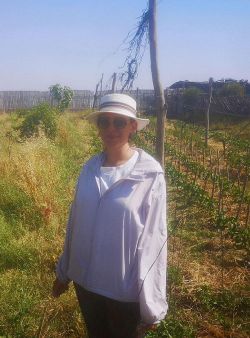
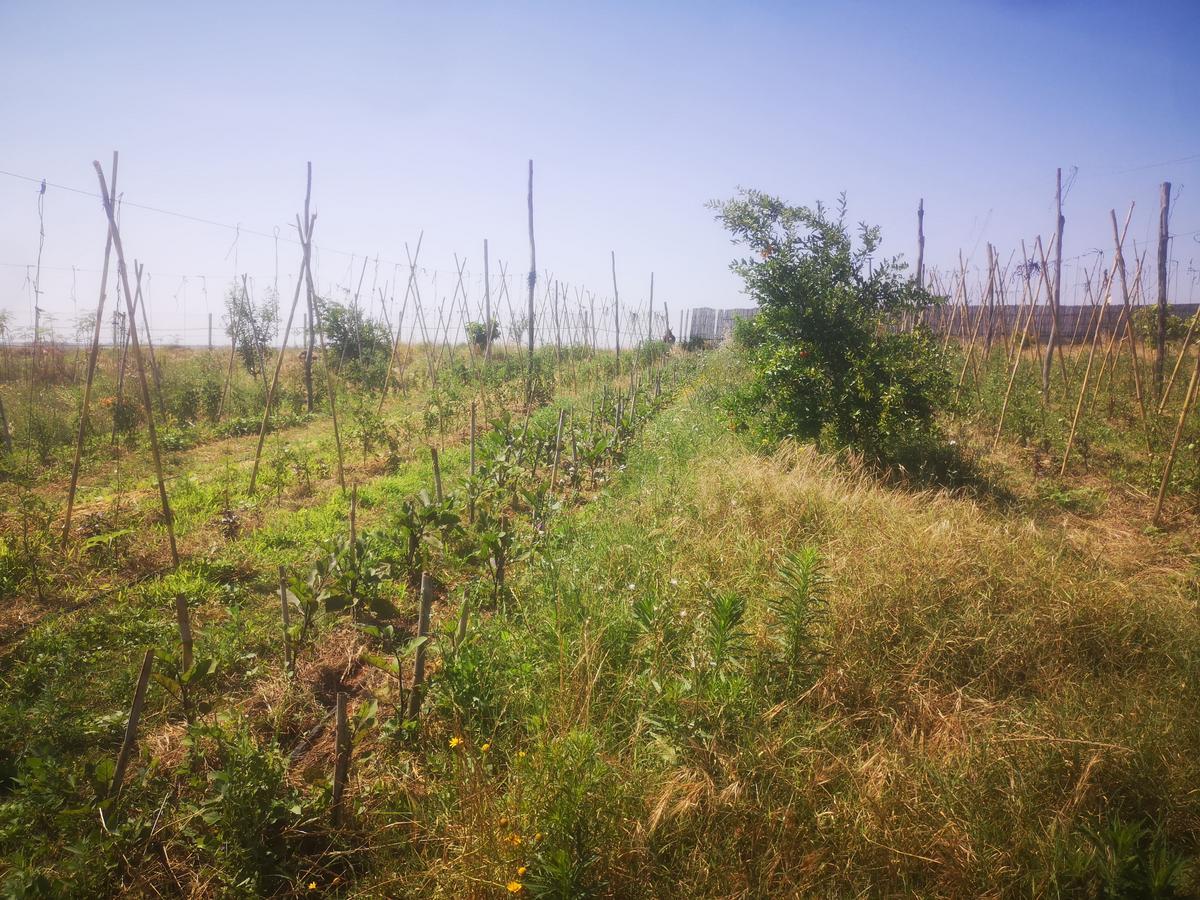
Zhor Lebbar, a farmer in Sidi Allal El Bahraoui, Morocco, cultivates her land and raises poultry according to agroecology principles. Here is a portrait of her farm.
Climate: According to the Köppen-Geiger climate classification, Rabat has a Mediterranean climate with hot summers (Csa). Temperatures generally range between 13 °C and 24 °C throughout the year, with extremes rarely dropping to 5 °C or rising to 39 °C. Average annual precipitation is about 383 mm, spread over 52 rainy days per year.
Labor
6 people including 4 full-time (Zhor and 3 permanent workers, men and women paid equally) and 4 occasional seasonal workers (in April-May and December)
Note: Difficulty in popularizing agroecology, resistance from workers to the idea of keeping the soil covered or leaving vegetables in place, as this concept is not part of the techniques they learned in their agricultural education.
Marketing
Implementation of a direct sales circuit to enhance production: The organic farmers' market in Rabat is already saturated with eight farms present, so Zhor chose to develop direct sales. She offers weekly baskets, with a minimum of 4 to 5 regular orders, reaching up to about twenty during the summer period. The chickens are sold by order along with the baskets.
Additionally, Zhor also has a collaborationwith a hotel located in northern Morocco. Discussions are currently underway to establish a regular delivery system.
Other economic resources include:
Development of farm visits: training, yoga and personal development retreats.
Creation of a herbal tea shop and an agroecological nursery.
Establishment and management of a peasant seed bank.
Plant production
The farm covers a total area of 4.25 ha, divided into three complementary spaces:
2 hectaresin a market garden orchard, organized in growing beds integrated with rows of trees as supports. These trees play a key role in the microclimate and soil fertility.
Shade structure sheltering the azolla culture is also the nursery. 1.5 hectares in a food forest, combining fruit trees with support trees chosen for their ability to produce biomass or improve soil quality (notably nitrogen-fixing species such as some Fabaceae). This system aims to promote natural soil regeneration while diversifying production.
265 m² in a shade structure, which serves as a nursery and shelter for an azolla culture.*
Finally, 0.5 hectares at the entrance are arranged as a farm reception area. Since Zhor practices on-site direct sales, she sought to create a pleasant and shaded space for her customers. She planted fast-growing trees there, acting as support trees, capable of quickly providing shade while contributing to soil improvement.
Animal production
The chicken coop with solar panels on the roof.
Zhor Lebbar has a 2,500 m² chicken coop, installed on a 0.25 hectare plot dedicated to poultry raising. The activity mainly focuses on egg production, and roosters can be sold as broiler chicken. In November 2023, she purchased 50 chicks. Currently, there is almost one rooster per hen, an imbalance she wishes to correct by selling roosters, ideally having one rooster for 5 to 6 hens.
Education, training and life path
Zhor Lebbar is an engineer in ecology and environmental management. Her interest in environmental issues dates back to her childhood, nurtured by an education strongly influenced by her father's awareness of nature preservation. This personal connection to the environment was strengthened throughout her academic and professional journey.
For about ten years, she has dreamed of creating a permaculture farm, combining food production, respect for ecosystems, and knowledge transmission. The acquisition of the land in 2021 marks the realization of this long-matured project.
Farm history
Zhor Lebbar acquired the Mama Ghaïa farm land in August 2021, with the ambition to create a resilient, productive, and welcoming agroecological space. Initially, she entrusted the project management to market gardeners from Casablanca, but the farm's establishment quickly faced difficulties: heavy investments were made in non-priority facilities (semi-buried greenhouse, poorly positioned retention basins), and repeated passage of construction machinery caused severe soil compaction.
On the advice of agroecology specialist Jihad El Malih, she took back direct management of the project in 2023 and dismissed the management personnel while keeping the worker team. With Jihad El Malih's support, she redirected the work towards more suitable choices: gradual planting of support and fruit trees, restructuring of market garden areas, and improvement of soil fertility.
Today, after two years of effort, the farm is beginning to bear fruit. Intercropping, multifunctional hedges, green manure, partial autonomy in animal feed, and short supply chain sales demonstrate a now established, coherent project fully engaged in the agroecological transition.
Motivations and objectives
Zhor Lebbar's project is part of a life philosophy inspired by permaculture, where agriculture becomes a means to respect life and to find one's place as a human within the ecosystem.
Her goal is ambitious: to strive for zero environmental impact, by minimizing inputs, recycling resources available on site, and regenerating ecosystems.
Economically, Zhor seeks to sustain a short supply chain marketing model. Developing partnerships (such as the one planned with a hotel in northern Morocco) is among the avenues explored to ensure the economic stability of the project without compromising its principles.
More ambitious projects, like creating an ecolodge, are considered but temporarily suspended due to budget constraints.
Agronomic aspect
Soil management
Since the departure of former collaborators, Zhor has chosen to avoid any soil tillage. The food forest is thus maintained under spontaneous vegetative cover, without mechanical intervention. Similarly, the market garden beds are not tilled, following an approach focused on preserving soil biological life.
Water management
The farm has two water access points:
one deep borehole of 34 meters, currently in use,
and a traditional well of 7 meters, now dry.
Irrigation is provided exclusively by drip, both for the food forest and the market garden beds. A pump powered by photovoltaic panels lifts water from the borehole, but the system faces difficulties due to irregular power supply. Indeed, the municipality is poorly served by electricity, pushing farms to invest in autonomous solar installations.
Finally, irrigation management remains manual, with one person responsible for opening and closing valves due to lack of an automated system. This complicates fine irrigation regulation and adds a labor constraint.
Spatial organization by gardens
Farm plot layout diagram
The plot extends from East to West.
Note: The blue rectangles are retention basins, the dark green rectangle corresponds to the nursery, the azolla basin is located below.
Reception and living base:
The yoga room
Fast-growing trees were planted (3 m spacing) to create a favorable microclimate for customer reception (shaded area), produce biomass, and increase biodiversity.
Suspended accommodation project: Moroccan customers are demanding (e.g., pool), which is not compatible with the current budget.
Tree rows with 4 market garden beds in the middle.
Fruit trees
Market garden bed and pomegranate tree on the tree line with herbaceous cover on the ground.
From one row to another, tree arrangement differs to avoid trees of the same species facing each other. This limits pest spread. Additionally, a herbaceous layer is planted at the foot of the trees to cover the soil.
Herbaceous covers
They are managed by the "chop and drop" technique, which consists of regularly mowing these plants and leaving them to decompose in place, thus forming a living and nourishing mulch.
Intercropped and aromatic plants: nasturtium, valerian, sweet pea, borage.
Note: Zhor points out that the corn-sunflower-squash-butternut association on the same bed gave good results on her farm.
Three-row hedgerow
Three-row hedgerow
Climbing plants installed on the fence serve to block the view.
The cypresses are used as windbreaks, while fast-growing trees aim to improve soils and generate biomass.
Additionally, a herbaceous layer is planted to cover the soil. It is managed by the "chop and drop" technique, which consists of regularly mowing these plants and leaving them to decompose in place, forming a living and nourishing mulch.
Garden 3: The chicken coop
Garden 3, covering 2,500 m², houses a chicken coop equipped with photovoltaic panels. The installation was designed to optimize shading on the ground while producing the electricity needed to operate the borehole pump.
Garden 4: Food forest
Food forest layout diagram.
Planted in March 2023, the food forest covers 1.5 hectares. Trees are arranged in a triangular pattern, spaced 6 meters apart to promote light, air circulation, and plant diversity. Market garden beds can be installed between tree rows.
The orchard includes 100 fruit trees, distributed among 20 different species (5 trees per species). The goal is to create a self-sustaining edible ecosystem, inspired by natural forest functioning. The first harvests have already begun with guavas, pomegranates, and early peaches.
There are 120 market garden beds.
Olive tree planting project planned in the near future.
Note
Spatial distribution is based on harvest periods; summer trees are closer to the reception area to minimize movement during heat waves.
Tithonia is used as a support plant in the food forest for its high biomass production and ease of cuttings. It is a bioaccumulator plant capable of extracting nutrients like potassium, iron, and boron from the soil, which it stores in its foliage. It thus serves as an excellent lever to improve soil fertility while providing abundant organic matter for chop and drop.
Practice of interest
Azolla cultivation
The basin dedicated to azolla cultivation
Context:
On the advice of Jihad El Malih, her agroecology agricultural advisor, Zhor Lebbar discovered azolla cultivation in 2024. He provided her with an initial sample to reproduce on the farm. The high protein content of this aquatic plant (about 16% fresh weight and up to 30% when dried) and its ease of cultivation convinced Zhor to grow it. Since then, azolla has been integrated into the poultry feed, helping reduce dependence on commercial concentrates.
Objective:
Azolla helps cover a significant part of the protein needs of poultry, thus moving towards a form of protein feed autonomy.
Installation
The basin is under the tropical shelter which also serves as a nursery.
It measures 6 meters by 3, with an average depth of 20 cm. Before installation, the ground was leveled with sand to ensure a stable and homogeneous base. A thick tarp, recovered on the farm, was then laid to ensure waterproofing.
Setup time is 1 day of work for 2 people, the soil being sandy.
The tropical shelter / shade structure
The nursery and azolla cultivation basin under the shade structure.
Azolla cultivation is installed under the shaded nursery greenhouse, a protected space that maintains the humidity necessary for its development. The greenhouse was set up in 2022, using a second-hand metal structure bought for 30,000 MAD. This amount corresponds to all structures that allowed building two greenhouses: a semi-buried greenhouse and a nursery greenhouse. Adding a plastic tarp and a shade cloth deployed in summer brings the total cost of the nursery greenhouse to 40,000 MAD.
Management
Single initial water filling, topped up weekly if the level drops.
Maintenance: stir 5 min/day (if necessary)
Harvest: once a week (10 min/person), azolla is removed from half the basin surface.
Use for poultry feed
Each laying hen consumes on average 80 to 100g of the usual cereal and legume mix per day, to which 12 to 20% azolla is added.
Broiler roosters consume 100 to 120 g per animal, including the cereal-legume mix and azolla. With this balanced and regular diet, a rooster reaches about 2 kg in 4 to 6 months.
In comparison:
In industrial farming, this weight is reached in 45 days.
In extensive farming without precise feed management, it often takes 1 to 2 years to reach 2 kg.
Poultry feed relies on a balance between protein and energy intake:
30% of the ration should contain varied protein sources (e.g., fava bean, sunflower, azolla).
70% of the ration should provide energy (e.g., triticale, corn, wheat bran).
Protein needs vary according to age and type of poultry:
Laying hens: 14 to 16% protein.
Chicks: 20 to 22% protein to support growth.
Storage and drying
Dried azolla can be stored up to one year under good conditions.
Drying method:
Spread azolla in a thin layer on a black tarp.
Let dry for 2 to 3 weeks, depending on climatic conditions.
Inadequate drying leads to rot or browning, making it less palatable for poultry.
Reproduction and basin coverage
Starting from a small initial sample, azolla can cover an entire basin in about 15 days, provided growth conditions are optimal (water, light, temperature).
Interest
Azolla allows savings on grain purchases, which vary between 3.5 and 12 dirhams per kilo depending on species and season. Protein-rich legumes are generally more expensive than cereals, so azolla is an interesting economical alternative for poultry feed.
Autonomous production adapted to the local climate
Azolla stores well up to 1 year once dried.
Advice
Zhor has no particular advice except that, although this cultivation is still little known, it deserves to be tested. Once started, production is simple and poses no particular difficulty. The main obstacle is usually the difficulty in obtaining the initial strain.
Comfrey and soil fertility
Context
On the advice of her agricultural advisor, Jihad El Malih, she discovered this plant used to combat soil compaction. She managed to obtain a rhizome which was then shipped to Morocco.
Objective
Planting comfrey helps improve soil quality at low cost. It helps remedy compaction caused by construction machinery while providing a covering effect limiting couch grass development.
Implementation
Well-developed comfrey in a vegetative cover.
The start was with very damaged roots bought in January 2024, which were then multiplied by vegetative division. Planting of 4 to 5 plants took place in June of the same year, followed by a new division in February 2025, allowing to obtain 50 plants from the mother plant.
Planting is done with spacing of 75 cm to 1.2 m between plants, requiring about 10 minutes of work per plant.
Observation after planting
The soil is better structured and comfrey roots are abundant.
Zhor observed that the presence of comfrey has led to better vigor of the surrounding trees.
There is also a visible reduction of couch grass around the plants.
Comfrey can reach 1.20 m in height under optimal conditions. Here it measures a maximum of 80 to 100 cm because the climate is dry and the soil is too sandy.