
Implementation of ACS to Restore Organic Matter in Soils

Since his arrival on the family farm in 2010, Gaëtan Bouchot, a farmer in Haute-Marne, has implemented various means of Conservation Agriculture (ACS) to restore organic matter (OM) in his soils which then contained less than 1%.
Presentation
- Name: Gaëtan Bouchot.
- Location : Orges, Haute-Marne (52).
- Status : Farmer and ETA.
- Farm : Sole proprietorship.
- UAA : 490 ha.
- FTE : 2.
- Specifications : Conventional (410 ha) and Organic (80 ha).
- Production :
- In ACS : Wheat (165ha), spring barley (SB) (90ha), sunflower (50ha), rapeseed (30ha), winter barley (WB) (22 ha), corn, pea, lentil, buckwheat, meadow. Camelina, bird's-foot trefoil for the 2nd harvest.
- In Organic Farming : Alfalfa (80 ha). 95% of what is produced is destined for methanization for which Gaëtan supplies biomass (rye under living alfalfa cover).
- Soil :
- Type : Mostly clay-limestone. Low potential lands. Mix of soil and stones. These soils are easy for ACS and easy to enrich compared to heavy clays that are difficult to get working.
- pH : 7.5.
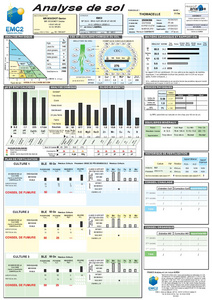
- OM : less than 1% initially, now 1.5% for the latest soils converted, up to 3.5-4% today for the first soils under ACS. Even reaching 6.8% for the best plot, which was the very first plot converted to ACS in 2013. A plot converted in 2015 is at 5.8% in the top 25 cm.
- CEC (Cation Exchange Capacity) : very high.
- Marketing : Storage of a large part of the harvest on the farm for sale to the highest bidder and some contracts with PADV and Soufflet for wheat in ACS.
- Other activities :
- President of the APVA (Association Productions Végétales et Agronomie) of the Haute-Marne Chamber of Agriculture 52.
- Facebook page : Regenerative agriculture experience sharing.
Motivations
Gaëtan's main motivation that drove his shift to ACS is to restore OM to his soil. He enjoys seeing his soils evolve, in terms of roots, composition, porosity. His motto : soil before the plant.
Other more practical reasons also contributed to this transition. When he settled in 2013, cereal prices had started to fall but with the same level of costs, it was not a viable situation for his farm, so changes had to be made in his practices. But according to him, this is not a good reason.
Upon arrival on the family farm, yields between plots were not homogeneous, so there was a problem to solve.
What maintained his motivation was that thanks to his ETA activity, he was able to compare his results with those of 2 farms using different methods. This allowed him to see if he was right or wrong, especially regarding the harvest. He realized he was not doing better, but at least not worse. And in extreme years (drought or rain), there was clearly a better result on his farm. He would not have noticed this without visiting his neighbors. His soils are also more supportive.
History

- 2010 : Gaëtan arrived as a employee on the family farm managed by his grandfather and father, which was 280 ha at the time. Various practices succeeded each other : 30 years of plowing, 10 years of Reduced tillage (Simplified Cultural Techniques) at 20 cm, 20 years of straw burning and 20 years of straw export + rapeseed/wheat rotation for 25 years and then rapeseed/wheat/barley. The OM rate was then below 1%. Some plots showed yield losses of 1 t compared to their neighbors. They then realized there was a problem and that instead of feeding the plants it was better to feed the soils. They were then advised and supported by Antonio Pereira, crop production advisor at the Haute Marne Chamber of Agriculture, who helped them establish large multi-species intercrop covers. They were lucky to have a lot of water during the summer which allowed the cover to develop well. They continued to work the soils lightly.
- 2013 : Establishment of Gaëtan on the farm. They continued the multi-species intercrop covers.
- 2015 :
- Purchase of the no-till seeder to perform no-till under permanent legume cover.
- Extension of rotations.
- 2016 : Increase of UAA to 380ha.
- 2022 : The UAA is 490 ha. The entire farm is under ACS (except 80ha in organic), but he is slightly stepping back on no-till for sunflower because the yield potential is not necessarily there.
Steps to implement ACS

Multi-species intercrop covers
Upon arrival in 2010, there was a problem with resistant black-grass in the plots. He then established two successive spring crops, one of which was spring barley which he weeded with isoproturon (still authorized at the time). But it was mainly the fact of making the black-grass germinate in autumn and early spring and weeding it with glyphosate that allowed him to get rid of it.
In a soil that begins to balance, the germination capacity of black-grass is significantly lower because conditions are no longer favorable.
Once the black-grass problem was solved, he established the multi-species intercrop cover, which he still weeded to eliminate remaining grasses. This helped clean the plots well from cereal regrowth.
The cover composition was : Faba bean (50 kg), pea (30 kg), sunflower (4 kg), phacelia (2 kg), mustard (1.5 kg). They were lucky to have a lot of water during the summer which allowed the cover to develop well. They continued to work the soils lightly.
No-till under permanent legume cover

At first, the cover was composed of dwarf white clover (DWC), but it had 2 drawbacks : its roots remain in the same root horizon as the crops and it does not resist drought, which causes a loss on investment. Gaëtan then implemented a mix of DWC and bird's-foot trefoil whose roots go deeper, it is easily controlled in the crop without much chemistry and it resists drought. Alfalfa is the best legume, but it is harder to manage, requiring more frequent spraying, so he did not establish it.
Today the cover is composed solely of bird's-foot trefoil. But be careful, you have to start with small doses so as not to exceed the crop : 4kg the first year and then 2kg each year. This provides nitrogen continuously. While the soil gets going, it consumes a lot of nitrogen to degrade the materials given, so the first year the nitrogen from legumes does not benefit the crop. It must be well dosed because otherwise, you can end up with excess nitrogen!
Example : A late spring mineralization in a very dry context (which favors yield reduction) will strongly impact the protein content of barley which will no longer qualify for malting and will be downgraded to feed barley. This is especially true for winter barley, less so for spring barley.

Today all his fields after harvest receive a multi-species cover in addition to the legume cover. Legumes are sown at several times: with the multi-species cover and in spring with a harrow before the 1 cm ear stage.
This year the multi-species mix was composed of :
- Fenugreek (3kg/ha).
- Lentil (4kg/ha).
- Alex clover (0.8kg/ha).
- White clover dwarf (1.5 kg/ha).
- Crimson clover (1kg/ha).
- Common vetch (4kg/ha).
- Abyssinian mustard (0.3kg/ha).
- Chinese radish (0.2kg/ha).
- Forage radish (0.1kg/ha).
- Niger (1kg/ha).
- Phacelia (0.5kg/ha).
He adds 50kg of faba bean because it brings a lot of mycorrhizae to the soil which allow huge water retention in soils.
Extension of rotations
It was implemented, but proved complicated in these low potential soils because there were yield losses on protein crops (pea, lentil). Now, he adapts the crop year by year depending on the problem : black-grass, voles, earwigs (which devastated 50 ha of rapeseed and sunflower, the solution was to work the soil a little).

Double harvest
Gaëtan has implemented a double harvest on some plots.
- He sows 8 ha of camelina after spring barley sown in autumn, to be able to harvest it at the same time as winter barley.
- The bird's-foot trefoil : all plots have bird's-foot trefoil in permanent cover and it is used only as permanent cover, but he keeps a 10 ha plot that he harvests to produce seed which he adds a bit every year in all plots.
In both cases, harvest residues are returned to the soil to promote soil biological activity.
Other practices implemented
Wheat monoculture

With the stop of rapeseed due to a problem of large flea beetles, Gaëtan had difficulty finding a new profitable rotation head in his superficial clay-limestone soils. He then chose to do wheat in monoculture but with a permanent legume cover and a multi-species intercrop cover. This is beneficial for diseases and weed control. His plots in wheat monoculture (or straw) are much cleaner than others.
Single nitrogen application
On February 1st all nitrogen (145U) was applied in one pass and preferably under rain for better efficiency. Since droughts come early in his region, if he split the applications, nitrogen would no longer impact yield and there would be too much loss to the atmosphere, so this makes nitrogen more available over the long term in the soil.
He applies liquid sulfur nitrogen (37/12), which makes nitrogen more efficient for the plant. For clay-limestone soils, sulfur helps release the CAH (Clay-Humus Complex) which is saturated with cations. He would like to free up even more space, so he is looking for other solutions like planting plants that release the CAH.
Increasing biodiversity
- This year, Gaëtan planted 250 m of hedgerow with the help of students from a nearby school.
- Implementation of perches : to attract birds of prey and control vole populations. When infestation is too high, he uses the straw harrow or even the roller to break tunnels. These infestations are cyclical, so he cannot say they are linked to the presence of cover crops. He even thinks that damage is worse in no-till without cover than under cover because voles have less food choices.
Difficulties encountered
- The biggest problem encountered is oneself because you have to be able to sleep at night, believe in it, try to understand. When you go from 200kg of fertilizer broadcast to 50kg in the seeding line and that's all you put in the year, you have to be convinced and be well supported.
- Gaëtan was well advised by Antonio Pereira, so he did not encounter many difficulties. He had problems, but more related to himself than to the method. For example, at first, he had sown too much clover dwarf. He corrected this later.
Opportunities encountered
- His father supported him in his approach, which is very important to not be alone and to be encouraged, because the changes implemented are not trivial and yield losses are real. Even if they are compensated by other savings, it must be kept in mind.
- He was well accompanied by his technician, who gave him good advice and also helped him buy his first no-till seeder which was the first Avatar (Horsch brand). He was able to get it at a lower cost because it was a prototype. His father having passed on a very well-equipped farm, he had few investments in equipment to make when he settled.
Assessment
Advantages
- It saves him time. The time he does not spend in the tractor, he spends observing his plots.
- Personal satisfaction of restoring life to his soils. Results are visible very quickly.
- Cost reduction. This method allowed him to maintain his farm. He reduced operational costs by a factor of 1.8 compared to what his father did. His father had €550/ha operational costs and €380/ha mechanization costs in 2010, today operational costs are €320/ha and mechanization costs are €200/ha. But given the current Economic context, this might be less true for someone starting ACS today.
A very explicit example is that in 2016 with his 380 ha, Gaëtan consumed 10,000L less fuel than his father with 280 ha in 2010.
Points of caution
With ACS there is a large unknown because we do not know what will happen in the long term. The soil evolves so it is a continuous learning process. With plowing you know what will happen, here it can be scary.
Relations with other farmers
At first he had 120 ha and had no problems with neighbors, now that he has almost 500 ha, it is more complicated. But he likes to think it is not jealousy. At the beginning, people in the village talked behind his back saying he would ruin the family farm because he was not a farmer (he was a mason in 2010), that he wanted to change methods by limiting fertilizer and pesticide inputs. In the village it was rather "We don't change what works". It was easier for him to talk with farmers far from home.
Now, he receives many farmers sent by Antonio Pereira to visit his farm, as he does many trials at home.
Gaëtan also shares his work on his Facebook page Regenerative agriculture experience sharing.
He also did training for Ver de Terre Production which will soon be online.
Relations with local residents
They are very good, even excellent. He invites schools to discover the farming profession.
He was even told that thanks to the flowered fallow strips he set up near houses and the middle school, beautiful bouquets can be made!
Investments

ACS only cost him significantly last year when he bought his new 12m wide tine seeder. Between his plots and those of his ETA activity, he seeds 1000 ha/year. Moving from his 4m no-till seeder to the 12m one saved him time.
No aid was available the year of this purchase.
What would be done differently if starting over
- Establishment of intercrop covers : Before Gaëtan harvested the crop and sowed the cover a few days later, now he no longer participates in the harvest operation but follows the combine and sows his covers immediately after. Beyond rainfall, the daily amount of light plays an important role in the vegetative development of the cover. A difference of 10 days affects development.
- Depth of cover sowing: Before he sowed the cover at 2-3cm depth, now he will sow it deeper.
The cover is the basis of ACS success!
Tips for Getting Started with ACS

- Talk with people who are already using this method, regardless of the region. Talk with farmers whose context is more challenging than your own (with more drought, for example). This will give an idea of what difficult years might be like.
- Conduct practical trials, not on micro-plots, but on a full field.
- Be monitored and supported, not staying alone is important to avoid mistakes and especially for mental well-being.
- Do not make large investments until you are sure of your project.
- Get proper training. Long videos are good, like those from Ver de Terre Production, even on market gardening. The videos by François Mulet helped him understand soil functioning. The international meetings on living agriculture by Ver de Terre Production also helped him as they were very enriching. He even testified there, the video is available here.
Outlook
- He will try to establish flowering fallows with the support of the association Coup d'Pousse : 4 meters of borders around the rapeseed field and on the wheel tracks which are low productivity areas, and since he will have to do some weed control passes anyway, this will allow him to cut a section of the sprayer boom. The goal is to do without insecticides; he already uses very few but wants to try to eliminate them completely.
- He will also try minette (a legume) as a permanent cover crop.
- Find a solution to excess calcium which saturates the clay-humus complex on all clay-limestone fields.
Final Word
"If every farmer covered their soils as much as possible, the climate could improve positively."
Source
Interview with Gaëtan Bouchot conducted on 27/06/2022.