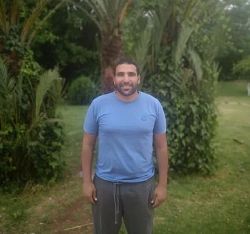
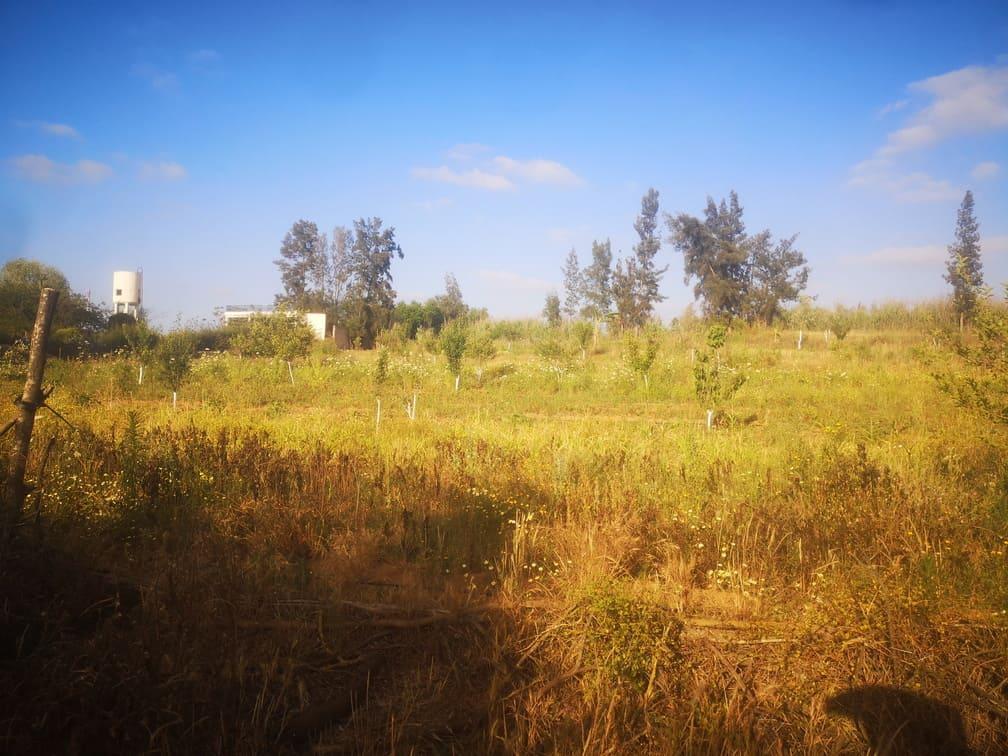
Taha Touijri, a farmer in Sidi Allal El Bahraoui, Morocco, cultivates his land and raises his animals according to agroecology principles. Here is a portrait of his farm.
Cultivated area (UAA): 10.3 ha (excluding 5 ha rented)
Soil texture: Mostly sandy, with a silty-clay plot (valley bottom, former wadi)
Number of people working on the farm (FTE): about 3 full-time equivalents (Taha and 2 equivalents spread over 4 employees).
Altitude: about 240–250 m
Climate: According to the Köppen-Geiger climate classification, the region has a Mediterranean climate with hot summers (Csa). Temperatures generally range between 10 °C and 32 °C, with extremes that can drop to 0 °C (winter) or rise above 40 °C in summer. Average annual precipitation is around 400 mm, concentrated between October and April.
Marketing
Direct sale at the farm and in baskets (10 to 13 baskets weekly).
Future project of a farm restaurant to promote local products.
Plans to eventually organize agricultural or artisanal training (such as one-day wellness workshops) in a building he constructed near his farm restaurant.
Livestock management: free grazing during the day, return to the barn in the evening. Health management based on natural selection (elimination of weak individuals).
Study, training and life path
Taha Touijri has an atypical background, marked by a voluntary conversion to agroecology.
Initial training: economist, with no direct link to agriculture.
Establishment in 2017: took over a 13 ha family land (melk), abandoned for 12–13 years, with only 4000 DH initial investment.
Family opposition: his choice to take over the farm was initially not supported by his family.
First steps in conventional agriculture: use of chemical inputs at the beginning.
Turning point towards agroecology: a striking scene in an input store made him reflect: an angry farmer was denouncing the inefficiency of a pesticide. Taha projected himself in this conflictual relationship with nature and refused to enter this logic. He then decided to turn to agroecology, consistent with his "calm and peaceful" character.
Continuous self-training: learning via the Internet and exchanges with other farmers.
Agronomic aspect
Irrigation
Source: 5 traditional wells, only one used, can irrigate for 4 to 5 hours (or 24 hours at the beginning of the season).
In June: 2 irrigations per month, 4 hours per tree.
Inspring, irrigation is delayed until June (compared to March for neighbors), thanks to good water management.
No exact flow measurement: watering about 30 minutes per sector.
Project of contour ditches to manage runoff water, with the prospect of creating a pond.
Livestock and health management
The sheep flock is selected over several generations for their resistance (no vaccination). He sells the weakest individuals to strengthen the flock.
For cows, he also made a cross between Holstein and a local breed.
Sheep and cows are put outside to graze, early in the morning, brought back to the barn during the hot hours, then outside again in the late afternoon before being brought back again in the late evening.
The ducks and geese should fertilize a future pond for a fertilized water irrigation project
Contour ditch on the sloping plot
Implementation of contour ditches
He has implemented contour ditches on the slopes of his plot to slow down water flow during heavy rains. With the nearby highway works, a wadi was diverted and the water from this wadi now crosses his field. To manage this new flow, he installed additional contour ditches and plans, eventually, to create a pond to store runoff water during intense rainy episodes.
Practice of interest
Orchard with chickens and manure spread by the chickens
Context
Taha Touijri set up a fenced orchard with chickens. He manages fertilization by placing piles of manure that the chickens scatter by scratching.
This method ensures homogeneous fertilization, reduces manual work, and values both the droppings and manure produced on the farm.
Objective
Integrate chickens into the orchard to improve natural fertilization thanks to their droppings and manure dispersion.
Optimize egg laying by recreating an environment adapted to the natural behavior of chickens (scratching, foraging in the soil).
Reduce manual work of manure spreading.
Promote the health and productivity of fruit trees (greener foliage, increased yield).
Orchard fence for chickens
Implementation
Fenced enclosure in the orchard (1,500 to 2,000 m²) hosting about 100 chickens.
Fence construction:
2 weeks of work for 4 people.
3 m high netting (cost ≈ 3,000 DH), iron wire (100 DH/50 m), stakes made on the farm.
Manure application:3.2 m3 trailer attached to a tractor. The system consists of placing piles of manure in the lemon orchard about one 3.2 m3 trailer load for 4 to 5 trees.
The chickens come to scratch and naturally disperse it. Once the manure is partially spread but still concentrated, the farmer reforms a pile a little further in the plot. This cycle is repeated two to three times until the manure is completely spread.
Practical organization:
Chickens fed with grains, vegetables, and fruit leftovers.
Easy movement by throwing grains (when he needs to get the chickens out of the enclosure or make them come back).
No henhouse: chickens sleep in the trees and lay eggs in the grass.
Daily check of the waterer (≈20 min/day).
Observed results
Poultry production:
Significantly improved laying (almost all hens lay).
Eggs rarely damaged or eaten thanks to the enclosure.
Fruit production:
Greener and healthier foliage in the orchard area with chickens.
Fruit production nearly doubled (especially on lemon trees), according to the farmer.