
Crop associations and rapeseed in Hauts-de-France

Intercropping covers, species associations or permanent covers are practices that allow to cover the soil. Soil cover is much more than a regulatory obligation; it is an effective lever to protect the soil from erosion and nitrate leaching.
Description
Soil cover is defined as the occupation of the soil surface by vegetation, absence of bare soil. Cover crops are intercrop covers, between the harvest of the previous crop and the next crop, the production crops. Crop associations allow better inter-row coverage, and covers allow better coverage of the inter-row as well as the intercrop period. The benefits of soil cover concern the 3 types of soil fertility: physical fertility, chemical fertility and biological fertility.

Physical fertility
Soil cover improves soil structure and its cohesion through root exploration and the production of natural glue, glomalin. It helps to limit runoff risk and protects the surface
from erosion. Moreover, a cover in place reduces the impact of raindrops (splash effect) and limits the
phenomenon of surface crusting.
Chemical fertility
Depending on the species, cover plants allow to recycle and fix mineral elements. Whether cash crops, associated or not, or intercrops, they allow to absorb nitrates.
- Crucifers and cereals are the most effective. Upon destruction, they can return nitrogen in organic form and carbon to the following crop and soil, thus contributing to organic matter production.
- Legumes have the added advantage of fixing atmospheric nitrogen. Phosphorus is one of the main elements for plant growth and development. The assimilable form is phosphate.
- Sunflower, buckwheat and mustard are particularly active in capturing phosphorus. Similarly, potassium is particularly well captured and thus returned by crucifers. Finally, sulfur can be made available by microbial enzymatic activity stimulated by crucifers.
Biological fertility
Soil cover helps to limit temperature fluctuations and retain soil moisture. This buffering capacity between soil and air protects soil biological life. It provides the soil with the nutrients and mineral elements necessary for its nutrition. Moreover, species diversity leads to a diversity of micro-organisms and soil microfauna.
- Fight against soil erosion and runoff.
- Promotes soil structuring through root exploration.
- Reduces drought impact by retaining soil moisture.
- Limits significant temperature fluctuations.
- Allows recycling and fixing mineral elements.
- Provides organic matter and food to the soil.
- Helps manage and limit weed infestation in fields.
Associated rapeseed: only advantages?

Species associations are a lever to:
- Optimize soil cover to promote soil biological life, combat runoff and leaching, and help control weed infestation.
- Promote natural regulation processes to reduce or substitute the use of phytosanitary products.
In the case of rapeseed associated with legumes, the crop and companion plant cover are sown simultaneously. Rapeseed is very sensitive to competition for water and light, from emergence to the 4-leaf stage, corresponding to about 400°C days. From this stage, rapeseed enters an active growth phase and is less sensitive to competition. Legumes have a slower establishment than rapeseed, with growth starting from 500 to 700°C days, which limits competition.
Nitrogen thanks to legumes
Legumes such as faba bean, peas, clovers, etc. are plants capable of fixing atmospheric nitrogen thanks to their nodules, the site of symbiotic activity with a bacteria of the genus Rhizobium leguminosarum. They are very interesting in associations because once destroyed by frost or chemically, they return the nitrogen captured to the system. The nitrogen they return after destruction is directly available for the main crop.
- In trials, the average biomass of associated faba beans is 1,133 g/m2, the amount of nitrogen trapped estimated by the MERCI method is 75 units. Its destruction allows a potential nitrogen return of 32 units for rapeseed.
- For a mixture of Alexandrian clover and fenugreek, the average biomass produced over 3 campaigns is 720 g/m2. It captured 35 units of nitrogen and potentially returned 15 units.
Depending on plant habit, nitrogen return to the soil is faster or slower. Indeed, a plant with a spreading habit produces biomass close to the soil. Once destroyed, its biomass quickly contacts the soil and thus soil decomposer microorganisms that degrade the green matter and allow nitrogen return to the soil. Due to its erect habit, faba bean even when destroyed is not directly in contact with the soil and is thus less accessible to soil microorganisms. Decomposition is faster when legume biomass is quickly in contact with the soil as with vetches and lentil.
Reducing pest pressure
Associations with rapeseed are mainly implemented to manage the risk of flea beetle either by diluting rapeseed in a large biomass or by olfactory repulsion.
In the network trials of agricultural chambers in Hauts-de-France, a decrease in flea beetle larvae in rapeseed plants was observed in 63% of cases compared to rapeseed alone.
The associations with the best results are: coriander, tagetes, faba bean, natrix, fenugreek and chickpea.


And on rapeseed yield, what impacts?
In terms of yield, when comparing associated rapeseed yield to rapeseed alone: the associated yield is higher in 80% of cases.

The average yield gain over 5 trial campaigns is 3.9 q/ha in favor of associated rapeseeds. An average gain of 5.0 q/ha is observed for the association with faba bean alone, reaching a maximum gain of 12 q observed in 2020 for rapeseed associated with TIFFANY faba bean.

The choice of association and sowing density are important.
- The reliable choices are: faba bean, fenugreek and buckwheat, whose destruction by cold is rapid and early.
- lupin, chickpea and aromatic species such as dill and coriander show interest with precautions. Indeed, coriander is very interesting for risk management of flea beetle but is not destroyed by climatic conditions and matures at rapeseed harvest. Impurity rates can then be very high, exceeding 10%.
- clovers, bird's-foot trefoil and minette are interesting as permanent covers. However, this requires finding the right balance between maintaining the associated cover and regulating it to secure rapeseed yield.
The choice of species should be made according to soil type, the crops in the rotation, the objectives sought and the context of the farm. The composition of the associated cover must be reasoned and not improvised.
Although all legumes are possible, a significant advantage of faba bean, fenugreek and Alexandrian clover is observed for the various services sought: good soil cover, satisfactory biomass production, interesting nitrogen return after destruction, pest disruption and a positive effect on soil structuring.
How to succeed with associated rapeseed?
- Sowing date: Due to the slow establishment of legumes, it is necessary to advance the sowing date of the association before August 15. If the associated cover is well developed, the risk of elongation decreases due to competition from the association against rapeseed. Rapeseed will not be too developed before winter and can pass the cold period safely.
- Sowing density: Rapeseed should be sown at the usual density practiced on the farm. For companion plants, the following table gives indicative densities of some legumes for pure sowing. When making mixtures of different species, the pure density of each species should be divided by the number of species in the mixture. For erect species like faba bean, the density of 12 plants/m2 can be maintained in mixture. These species compete fairly weakly with rapeseed. For other associated species, positive effects are maximized when plant density is quite high. Choosing a reduced spacing sowing favors soil cover and strengthens the interest of the association.
| Associated legume | Recommended sowing rate |
|---|---|
| Fenugreek | 25 kg/ha or 65 plants/m2 |
| Faba bean | 80 kg/ha or 12-15 plants/m2 |
| Grass pea | 20 kg/ha or 10 plants/m2 |
| Lentil | 25 kg/ha or 65 plants/m2 |
| Pea | 20 kg/ha or 17 plants/m2 |
| Alexandrian clover | 5-10 kg/ha or 120 gr/m2 |
| Vetch | 10 kg/ha or 15 plants/m2 |
- For small seeds like vetch, fenugreek, lentil or clovers, it is possible to sow the association and rapeseed mixed regardless of the drill. Rapeseed and companion plants will thus be sown on the same line for a greater positive effect.
- For larger seed size like faba bean and pea, it is not possible to sow rapeseed and companion plant mixed due to poor seed distribution risk. Two possibilities in this case:
- sow in two passes: first the companion plant at depth, then rapeseed.
- use a double hopper drill.
If the choice is a mixture of more than 3 species besides rapeseed, the risk of seed separation decreases. Mixed sowing in the drill becomes feasible.
Competition at winter entry
At winter entry, in measurements made over 3 trial campaigns in the GIEE Direct Sowing Future 60 on screening species to associate, associated rapeseed is less developed than rapeseed alone in 81% of cases.
Trials also show that associated rapeseed biomass at winter entry is 24% lower than rapeseed alone regardless of associated species (legumes or not).

The total cover biomass (rapeseed and companion plant) is in all cases higher than rapeseed alone.

Optimize your technical itinerary

Reduction of chemical inputs allows to maximize economic and environmental gains of associations. Indeed, it is about finding the right balance between risk management and maintaining balance within the association.
Insecticide
It has been observed in various trials that crop associations allow to reduce pest risk. Moreover, crop diversity leads to insect diversity and thus promotes crop auxiliaries.
In the case of associated rapeseed, it is recommended to not use insecticides, systematically, if associations are well developed.
Weed control
The goal is not to destroy the association but to ensure effective weed control.
- Against grasses, the classic strategy in rapeseed alone can be applied.
- Against dicotyledons, the strategy should be adapted according to companion plants. Faba bean is the most resistant species to weed control. clovers, lentil and vetch are more sensitive to various herbicides. Product selectivity must be checked on these species.
To destroy the companion plant, catch-up solutions exist at winter entry or exit but must be adapted to the situation and not systematic.
Nitrogen fertilization
It is advised to reduce the nitrogen balance dose by 30 units if the legume is well developed. The reduction will be compensated by the destruction of the associated legume. The nitrogen dose reduction should not be done at the last application but gradually to avoid penalizing rapeseed development and nitrogen nutrition.
Associated rapeseed trials of the GIEE: Direct Sowing Future 60
Trials conducted in strips and set up on plots at Jouy-sous-Thelle in CA for over 10 years.
Objective
Screening of species to associate with rapeseed to find a potential alternative to faba bean and manage flea beetle risk either by diluting rapeseed in a large biomass or by olfactory repulsion.
Evaluation on different criteria
- Ability to emerge and develop during rapeseed sowing window
- Effect on biomass at rapeseed winter entry and exit
- Impact on presence of flea beetle larvae
- Presence at harvest
- Yield and quality of rapeseed
Multi-year results over 5 trial campaigns with the following characteristics
- The 2018-2019 campaign went well for rapeseed: emergence and development were good.
- The start of the 2019-2020 campaign was difficult. Lack of precipitation led to poor rapeseed emergence and reseeding was necessary. Phacelia sown at 10kg/ha completely competed with rapeseed from autumn. Permanent covers associations strongly competed with rapeseed at winter exit, causing yield losses.
- The 2020-2021, 2021-2022 and 2022-2023 campaigns went well and similarly. Only sainfoin in 2020 and fennel in 2021 did not emerge, giving results similar to the control. A snow episode in April 2022 almost compromised the trial, causing very high lodging rates of flowering rapeseed. However, rapeseed recovered and although yields were below expected potential that year, they were satisfactory compared to previous years.
| Rapeseed alone | Rapeseed + faba bean association | Rapeseed + fenugreek / Alexandrian clover association | |
|---|---|---|---|
| Recommended sowing date | August 15 | 10 days earlier than classic sowing August 5 | |
| Sowing density | 2 kg/ha – 40 gr/m2 | 2 kg/ha – 40 gr/m2 | 2 kg/ha – 40 gr/m2 |
| Sowing density of association | - | 80 kg – 15 gr/m2 | 10 kg – 35 gr/m2 + 5 kg/ha – 120 gr/m2 |
| Seed cost overrun | + €92/ha if seed purchase | + €71/ha | |
| Impact on sowing operation | Double hopper or two passes + €35/ha | Mixed sowing with rapeseed | |
| Weed control | Post-sowing/pre-emergence: COLZOR TRIO 3.5l / Winter entry: KERB FLO 1.875l | Double post-emergence application: NOVALL 0.7l / Winter entry: KERB FLO 1.875l | Double post-emergence application: NOVALL 0.7l / Winter entry: KERB FLO 1.875l |
| Destruction of association if needed | LONTREL 100 0.8l + ACTIROBB / €38/ha | LONTREL 100 0.8l + ACTIROBB / €38/ha | |
| Weed control cost | €135/ha | €108/ha | €108/ha |
| Growth regulator if needed | 1 pass 6-8 leaves / METCOSTAR 90 0.4l / €12.5/ha | - | - |
| Insecticide | 2 passes → €10/ha | - | - |
| Average biomass over 3 trial campaigns at winter entry | 1 kg/ha | 0.760 kg/ha + 1.130 kg/ha | 0.760 kg/ha + 0.720 kg/ha |
| Average biomass over 3 trial campaigns at winter exit | 0.540 kg/ha | 0.495 kg/ha | 0.495 kg/ha |
| Potential nitrogen return by association | - | 30 units | 15 units |
| Fertilization of rapeseed | 165 units | 170 units – 30 units → 140 units | 170 units – 15 units → 155 units |
| Cost of nitrogen fertilization split in two applications | €255/ha | €217/ha | €240/ha |
| Average yield over 5 trial campaigns | 38.1 q/ha | 38.1 +5 = 43.1 q/ha | 38.1 + 3.9 = 42 q/ha |
| Results for technical itinerary items impacted by association (€/ha) | |||
| Harvest | €1,714.5/ha | €1,939 | €1,890/ha |
| Sowing | - €127 | - €71 | |
| Weed control | - €135 | - €108 | - €108 |
| Destruction of association | - €38 | - €38 | |
| Growth regulator | - €12.5 | ||
| Insecticide | - €10 | ||
| Fertilization | - €255 | - €217 | - €240 |
| Total | €1,302/ha | €1,450/ha | €1,433/ha |
| Association gain compared to rapeseed alone | + €148/ha | + €131/ha | |
Taking into account the overruns and gains of the association on the different items of the rapeseed technical itinerary as well as the average data from 5 trial campaigns conducted by the GIEE Direct Sowing Future 60, it is observed that the impact of associations is positive compared to rapeseed grown alone in both simulated situations: association with faba bean alone and association with fenugreek and Alexandrian clover.
Associating with perennial legumes
Case of Rapeseed – Clovers – Wheat
The associations of rapeseed with perennial legumes are directly linked to no-till under cover. The idea is to establish a cover crop under the rapeseed that we will try to preserve as long as possible. Unlike associations with frost-sensitive legumes, little benefit is expected for the rapeseed. The clovers produce little biomass in autumn and are not destroyed during winter, which does not release nitrogen usable for the rapeseed. Similarly, their low biomass in autumn does not provide sufficient soil cover to have a positive impact on weed control or insects. In our trials, rapeseed yield measurements have always been identical in situations with or without perennial legumes. The benefits are to be sought during the intercrop period (biomass production, soil cover) and in the following crop (improvement of soil structure, nitrogen release).
Year 1: Successfully establishing the legume in rapeseed
This technique is easier to implement with low-growing legumes in order to limit competition with the crop. Most often, clovers are used, particularly dwarf white clovers, which present little risk of competition. Red clover or Crimson clover, as well as bird's-foot trefoil, are also possible but may require regulation in the crop following rapeseed to limit their growth.
The weed control of rapeseed must be adapted to be selective of legumes. The recommendations valid for associations with frost-sensitive legumes also apply here. The most proven solution is a double application of products based on metazachlor + quinmerac (NOVALL, ALABAMA, ANITOP). For NOVALL, for example, 0.8 l/ha can be applied pre-emergence followed by 0.8 l/ha post-emergence.
All these species have small seeds, so they can be sown mixed in the hopper with rapeseed. Broadcast sowing has also worked well in our trials, including in no-till contexts, although the small thousand kernel weight limits spreading width. A Delimbe distributor directly on the seeder that seeds across the width of the tool is better suited than a fertilizer spreader. The recommended seeding rates are close to the pure species seeding rate:
- About 3 kg/ha for white clover
- 8 kg/ha for bird's-foot trefoil
- 15 kg/ha for red clover
Trials have been conducted with different varietal types of white clover without observing major differences in behavior. Even with a forage white clover with stronger growth, wheat is sufficiently competitive not to be significantly affected.
The legume's development at harvest depends quite a bit on the rapeseed potential. The best successes are under rapeseed with a potential below 40 or even 45 qx/ha. Beyond that, clover development is really limited. They are always present at harvest but very stunted, and cannot limit rapeseed regrowth. One can then end up with a cover half composed of rapeseed regrowth and legumes.
Year 2: Capitalizing on the existing cover

Between harvest and rapeseed establishment, the legume cover produces between 1.5 tDM/ha and 3 tDM/ha depending on species and year. This cover can perfectly be exported as fodder before wheat harvest. However, the presence of rapeseed stalks raises questions in animal feed due to the presence of Sclerotinia. When harvest is planned, farmers often prefer to mow the cover at rapeseed harvest to destroy the stalks. The following crop, usually wheat, will be directly sown into the existing cover. This often requires regulating the cover at wheat sowing to facilitate establishment. Most often, a mixture of 2 l/ha of glyphosate with 3 to 5 g/ha of metsulfuron-methyl is used. Glyphosate allows managing grass regrowth and rapeseed regrowth, metsulfuron limits cover biomass without completely destroying it.
When the cover is well established, it is sometimes tempting to skip weed control relying on clover to suppress weeds. We have found that this is rarely sufficient to obtain a perfectly clean field. In most situations, some regrown grasses remain that must be controlled. In trials, there is 13 u (ranging from 0 to 20 u difference) more residual nitrogen in clover strips. The Beauvoir trial in 2017 did not show significant differences in residuals and nitrogen dynamics depending on the cover destruction date, nor when the cover was exported.
- Various trial campaigns showed that in most situations in Nord-Pas de Calais, when wheat is fertilized, white clover has almost disappeared at harvest. As soon as nitrogen fertilization exceeds 100 u, wheat is competitive enough to suppress white clover.
- In a 2017 trial with bird's-foot trefoil presence, it maintained itself in the crop and required regulation.
- In both situations with red clover, it had completely disappeared by the end of winter. For a typical regional wheat, it does not seem relevant to try to preserve it in wheat; it is very likely to disappear suppressed by the cereal. Therefore, it does not seem relevant to adapt wheat weed control to try to preserve the cover. Autumn herbicides are quite selective of clovers. Only relatively high doses of DFF caused clover destruction in the three 2019 trials. Destruction at sowing (15 g of ALLIÉ) did not provide more nitrogen than the modality where the cover was not chemically destroyed (but still disappeared due to wheat competition).
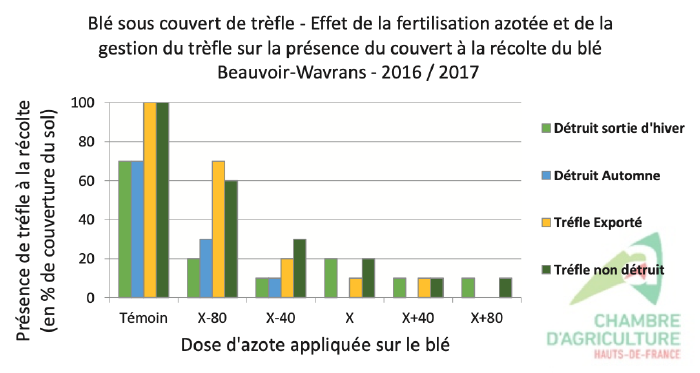

On average over 5 trials and 3 different campaigns, at dose X (calculated taking into account the residual difference, thus on average 13 u lower for the associated clover), a +3.5 q/ha increase is measured in treatments associated with clover. The difference is positive in 4 out of 5 trials.
Unsurprisingly, the measured difference between clover strips and bare soil is greater when fertilization is low. In the unfertilized control, it is even 12 qx higher with clover. The nitrogen supplied by the cover is then best utilized. The supply by the cover can be estimated at about 40 u. The higher the nitrogen dose applied, the smaller the difference, but it still favors clover covers. Even in non-limiting nitrogen contexts, the clover cover provides a benefit. Less important than in nitrogen-limited situations but still significant. The clover cover thus has secondary benefits other than nitrogen supply. For example, it may have a beneficial effect on structure by allowing better rooting.
In most trials, the nitrogen dose response curve in associations with clover appears normal. It does not seem particularly shifted toward lower doses. It is preferable to stick to the usual calculation of dose X, taking into account the slightly higher residual. Thus, a dose X reduced by about 20 u.


Economic and environmental aspects
In summary, association with clover has little impact on rapeseed:
- There is no yield difference.
- Its technical itinerary is also little modified, except for weed control adaptation. The latter can marginally save a few euros/ha and IFT/ha but remains limited.
- On wheat, the main difference is the addition of cover regulation (Glyphosate 2 l + ALLIÉ 5 g), i.e. 0.75 IFT more and about €20 to €25/ha. This extra cost is offset by the reduction of dose X calculated by about 10 to 15 u. Finally, at dose X, a yield increase of 3.5 q/ha is observed, about €80 more per hectare. Then the seed cost must be deducted (about €20/ha for white clover, about €50 to €60 for bird's-foot trefoil or red clover). Thus, after all deductions, there is a small increase in margin per hectare of about €50 to €60 per hectare in the most favorable case.
| Wheat alone | Wheat under clover cover | |
|---|---|---|
| Impact on sowing operation: recommended sowing method | According to farmer practices | No-till |
| Extra seed cost year n -1 (Sowing in rapeseed) | +€20/ha | |
| Cover regulation | Glyphosate 2 l + ALLIÉ 5 g +€20/ha + 0.75 IFT | |
| Wheat fertilization | Dose X | Dose X - 15 u / - €22.5 |
| Average yield over 5 trial campaigns | +3.5 qx/ha i.e. +€80/ha | |
| Impact on wheat margin of the association on average over 3 trial campaigns | + €62.5/ha | |
Timeline

Associate a gain for the cropping system!
Crop associations must be adapted to different climate, soil situations, and within the rotation.
Agronomic, environmental, and economic gains are real.
Associating crops allows increasing species diversity and multiplying the positive effects of each crop. Increasingly frequent in our cropping systems, the multiple benefits of associations are better identified. The development of conservation agriculture and especially the implementation of its main pillar, soil cover, has maximized the rise of crop associations.
Other associations are also interesting and reference acquisition is ongoing on cereal / protein crop associations with a double harvest objective or on associations with other perennial species such as alfalfa aiming at longer-term cover conservation.
See also
- Associating rapeseed with frost-sensitive service plants
- Successful associated rapeseed in conservation agriculture, with Antonio Pereira
- ASSOCIATED RAPESEED With faba bean, easy organization and proven results @CA17TV
- Sowing associated rapeseed
Sources
La version initiale de cet article a été rédigée par Jérôme Lecuyer, Sophie Wieruszeski et Virginie Metery.
