"Ha" is not declared as a valid unit of measurement for this property.
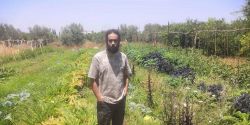
Adil Dach, a farmer in Sidi Allal Lamsadder, Morocco, cultivates his land and raises his animals according to agroecology principles. Here is the portrait of his farm.
Climate: According to the Köppen-Geiger climate classification, Rabat has a Mediterranean climate with hot summers (Csa). Temperatures generally range between 13 °C and 24 °C throughout the year, with extremes rarely dropping to 5 °C or rising to 39 °C. Average annual precipitation is about 383 mm, spread over 52 rainy days per year.
Farm history
Adil currently manages two rented farms. He settled with his family on the first farm in 2022, under a lease renewed in 2024, guaranteeing him occupancy of the land until 2028. While this situation provides some stability, Adil also points out its limitations: he is notably prohibited from planting new trees, which hinders some long-term projects.
The first farm, called Muzuna, is registered as an educational farm. This is a first in Morocco: he initiated the creation of the educational farm status, which did not previously exist in the country's legal framework. This allowed him to position his farm as a place of knowledge transfer, in addition to its production function.
The second farm, which he has just rented, opens new perspectives. He plans to develop both market gardening and poultry farming there.
Labor
Two people work on the farm:
Adil works part-time on the farm and part-time as a manager of an IT company.
A full-time employee manages daily operations but will be assigned to the second farm in the coming weeks. Adil will need to recruit a new worker.
Marketing
Adil develops a marketing activity exclusively in short supply chain, with products sold directly to customers, without intermediaries. All plant production (vegetable garden, orchard, alfalfa) is intended for family consumption. There is currently no sale of vegetables or fruits.
Products sold are:
Eggs: about 100 eggs per week, depending on customer orders
Chicks: 250 chicks produced and sold per month
Roosters: a batch of 10 to 15 roosters per month
Last February, Adil organized his first training on agroecological poultry farming, gathering 25 participants. Building on this experience, he wishes to organize a second session but is waiting to have enough registrants to schedule it.
The rest of the land is occupied by an orchard mainly composed of olive trees (about 5000 m²).
Animal production
He currently raises:
4 ducks
6 sheep
1 pair of peacocks
4 female turkeys + 1 male
60-70 hens (excluding chicks)
Henhouse made with wood and tarp for waterproofing.
The hens are free-ranging during the day and enclosed in henhouses at night. The two henhouses together occupy a total area of 260 m² (10 + 13) × 5 m with a target density of 4 to 6 hens per m². They are built with a wooden structure covered with tarps.
Note He notes that wooden structures pose problems due to the presence of ticks, which shelter in the crevices. He is therefore forced to regularly treat the hens. For his future project of 5,000 hens, he plans to build concrete buildings to avoid this type of health issue.
Motivation and objective
At the scale of Mouzouna Farm, Adil primarily seeks a living place close to nature, where his family can live in a healthy environment. He wants to produce enough to meet his family's food needs while developing chicken farming. His goal is to gradually increase the number of poultry to reach 250 hens. However, beyond 100 animals, state authorization becomes necessary, complicating procedures, especially within organic farming production.
On the second farm, which he has just rented, he plans to start a farm with more than 500 hens, aiming to gradually reach nearly 1,000 poultry while developing one hectare in market gardening.
At the same time, Adil plans, in the long term, to acquire a third plot, specifically dedicated to a larger-scale farm, with a target capacity of5,000 hens. He is currently looking for a suitable location for this ambitious project.
For now, he enjoys balancing farm management with his IT business. He finds a certain balance alternating between office work and agricultural activities. He does not plan to abandon the IT sector to devote himself exclusively to farming.
Agronomic aspect
Plant production
Alfalfa cover crop irrigated by sprinkler.
Use of alfalfa cover crops irrigated by sprinkler.
Azolla production (floating nitrogen-fixing algae) used as nutritional supplement for chickens, an innovative practice of interest in the context of seeking protein self-sufficiency in poultry farming (see section on practice of interest).
Implementation of associations of crops in market gardening, to diversify production and improve crop resilience.
Vegetable garden with chili and cabbage in the foreground and zucchini and tomato in the background.Presence of spontaneous cover crops in the orchard, contributing to biodiversity and soil protection.
A project is underway to set up a new vegetable garden space in a Mandala garden.
Animal production
Incubator with a capacity of 250 chicks.
Incubation and chick rearing
Adil uses an incubator with a capacity of 250 eggs, equipped with an automatic egg rotation system so that the eggs receive heat on the entire shell.
The incubation cycle lasts 21 days, to which he adds 2 extra days to allow late hatchers.
Roller system allowing eggs to be turned so they receive heat on the entire shell. Once the chicks hatch, he implements an original method to ensure natural care: he makes the incubator hatching coincide with the end of a natural brooding by one or more mother hens. When the mother's eggs hatch, he discreetly integrates the incubator chicks into the group. The hen, not perceiving the difference, adopts all the chicks and cares for them naturally.
Use of automatic drinkers
To optimize poultry watering, Adil has set up a system of automatic drinkers
Each small individual drinker costs 12 MAD
They are connected to a 50-liter recovery drum, placed at height and recovered from the farm.
The system uses pipes about 1 meter each, costing 8 MAD per meter.
Small automatic drinker for poultry.
The device works with a pipe connected to a cup. When the poultry drinks, its beak presses the cup, mechanically activating a valve and allowing water to flow. The system closes automatically once the pressure is released. This device saves time and provides better regularity in water access for the animals.
Practice of interest, Azolla cultivation
Context
Azolla is a small floating aquatic fern known for its rapid growth and high protein content. Easy to cultivate in shallow ponds, it requires few inputs and naturally develops under shaded conditions with slightly moving water. Thanks to its high protein content (6% fresh weight and up to 30% dry weight), it represents an interesting alternative to supplement poultry feed autonomously and economically. When integrated into the hens' diet, Azolla can cover up to 30% of theirnutritional needs, thus reducing dependence on commercial concentrates and costs related to grain purchases.
Initially, he started Azolla cultivation in a large pond of 7 x 5 meters, from plants purchased from a farm located in Chefchaouen. He became interested in its potential after discovering this plant in a Facebook post. Its high protein content and ease of cultivation convinced him to experiment.
Setup of the Azolla culture pond
Earthworks and tarp installation
Large pond for Azolla cultivation.
Pond depth: 40 cm over the entire surface
Work time: 5 days for 2 people
Tarp installation: 1 day for 2 people
Tarp quality: Medium quality (bought cheaply at 8 MAD for a strip of 8 m x 1 m) To compensate, two layers of tarp were superimposed.
Shade cloth (used to block light because azolla does not like direct sunlight)
Metal greenhouse structure
Shade cloth for Azolla cultivation.
Made with a welder, over 2 days. Adil recommends staying on site during the work to ensure dimensions are respected, which are not always well followed otherwise.
Structure
11 arches, spaced every 2.5 m
Labor cost: 500 MAD
Metal cost: 1,500 MAD
Woven shading fabric:
Width: 7 m (with 1 m margin on each side of the pond)
Length: 23 m
Maximum height: 1.2 m
For shading, he used a woven fabric made from a roll of 200 meters by 2 meters, purchased for 1,200 MAD. The shade cloth was sewn manually by joining several strips together.
Work time: 3 days for 1 person
Thread used: 3 spools of 100 m, at 10 MAD per spool
Distribution of ponds under the shade cloth.
The shelter houses 4 ponds measuring 7 m by 2.5 m and a large pond 7 meters long by 5 wide.
Dimensions and distribution of Azolla culture ponds under the shade cloth
Note Adil tested cultivation with and without soil added at the bottom: in the case of the large pond, Adil added 5 cm of soil at the bottom and 15 cm of water. In the small ponds, he has only 20 cm of water; according to him, this does not significantly change anything, but adding soil takes a day to set up.
Fertilization of azolla ponds: several attempts and an ideal method
First attempt: manure bags in the water
Initially, Adil placed 30 kg manure bags directly in the ponds. He noticed that azolla became greener around the bags, but the effect remained localized: there was no real impact on the entire pond.
Second method: manure infusion (juice)
Barrel containing a manure bag and water to fertilize the Azolla culture.
He then experimented with a new method: he let manure bags macerate in a barrel filled with water, then poured this nitrogen-enriched water into the ponds. Result: the effect on azolla was visible over the entire pond surface, confirming better nutrient diffusion. However, this method proved tedious, as manure juice had to be added every two weeks, requiring time and energy.
Third method: integration of ducks
Finally, Adil found a simpler and more sustainable solution: he let ducks wade freely in the ponds during the day.
Contrary to his fears, ducks consume very little azolla, but their droppings in the water sufficiently fertilize the pond.
Effects observed with the last method:
Azolla leaves are larger
Roots reach up to 6 cm, compared to 2 cm previously.
Production is about 10% higher.
After harvest, pond recolonization is faster when ducks are present or manure juice is added (thanks to fertilizing elements already present in the water)
Production and rationing for poultry farming
Average azolla productivity
In normal period: 250 g/m²/day
In winter: about half less
To compensate for the winter drop, he uses a transparent plastic tarp to cover the pond, which increases water temperature and speeds up azolla production. Cost of transparent tarp: 200 MAD for the entire surface.
Azolla ration in hen feed
Adil distributes two meals per day to his poultry (morning and evening):
Mix of azolla and grain in a basket.
Each ration consists of:
3.5 kg of a grain mix
1 kg of fresh azolla (freshly harvested)
Total daily feed: 9 kg (7 kg of grains, 2 kg of fresh azolla).
Hand harvesting azolla in one of the small ponds Azolla harvesting is quick, maximum 5 minutes in their case, and can be done by hand or with a net.
The mix, done manually in a large plastic basket, is given immediately to the hens.
For all hens and turkeys (rooster, hens, and chicks included) this represents on average 90% grain and 10% azolla.
Grain is purchased from a local seller.
Pond maintenance
Azolla pond maintenance includes several occasional or regular operations:
1. Repairs
Pond tarp leaks: One of the ponds recently had a hole in the tarp, requiring repair. This is one of the main technical hazards related to cultivation in tarped ponds.
Structural problems: The central pillars supporting the greenhouse arches can fall due to wind, as they are not anchored in the ground. This requires regular repositioning.
2. Regular maintenance
About once a month, water must be added to the ponds to maintain a constant level due to natural evaporation or absorption by Azolla.
Advice for setting up an azolla culture pond
Based on his experience, Adil shares several practical recommendations to improve pond installation and their environment:
1. Structure height: "If I had to do it again, I would make the structure taller." He points out that a structure too low forces bending at each harvest, making the work physically tiring in the long term.
2. Tarp quality: He recommends investing in a quality tarp, especially geomembrane type, to avoid leaks in the ponds. The cheap tarps used in his installation proved fragile and require repairs.
3. Pond dimensions: He is satisfied with the current pond dimensions, which suit the desired production well.
Overall improvement idea for the structure:
He imagines a new more functional design:
A larger and wider greenhouse (12 m wide)
A central aisle to facilitate circulation and harvesting
Ponds placed on each side of the aisle
Duck henhouse directly adjacent, to facilitate access to ponds and integration of their droppings into the ponds for fertilization.
Install nursery culture tables above the azolla ponds to set up a small nursery above the ponds.