
Combating Slugs in Large-Scale Crops

Slugs represent, along with birds, the major predation risk for the sunflower crop. It is possible to implement many techniques to limit attacks and damage caused by these pests.
Which slugs?
Two slug species are distinguished:

- The grey slug (Deroceras reticulatum) which moves on the soil surface.
- Greyish to yellowish brown color, with elongated spots.
- White mucus, respiratory opening at the rear of the shield.
- Size: up to 70 mm extended.

- The black slug (Arion hortensis), less mobile, usually found in the soil and less frequently on the surface. These slugs are quite difficult to destroy.
- Slate black color.
- Foot (underside) yellow.
- Yellow mucus.
- 40 mm extended.
These two species have mainly nocturnal activity. In overcast and humid weather during the day, they are also active. In France, 80% of attacked fields are infested by grey slugs[1].
Risk period
Période de présence :
| J | F | M | A | M | J | J | A | S | O | N | D |
Slugs show a development peak in spring. Besides their physiological characteristics, slug development strongly depends on climatic conditions[1]:
- Climate: soil moisture is the main factor conditioning their activity. Drought forces them to take refuge in soil crevices or under plant residues.
- Soil: clay and cloddy soils favor slugs, conversely, they are rare in sandy soils.
- Rotation: rotations based on rapeseed, legumes (faba bean, clover, pea...), sunflower and cereals favor slugs: rapeseed being the riskiest preceding crop. Regrowth and crops between main crops provide food and moisture favorable to slugs.
- Soil tillage: cloddy, blown preparations provide slugs with shelters. Conservation of organic matter on the surface increases risk, especially with superficial preparations and no-till.
You can determine the slug risk level on your fields in less than a minute by answering this questionnaire, published by the De Sangosse group.
Symptoms on sunflower
Slugs generally attack plants from the emergence stage up to 3 leaves. Beyond that, damage may persist until heading but has less impact on plant health. Under very humid and favorable conditions for slugs, some attacks can occur just after sowing on seeds easily accessible to mollusks[1].

Attacks are distributed in hotspots more or less extensive across the field.
On the plant, slug attacks are observed in different ways:
- At emergence, gaps can be seen: seeds on the surface or poorly buried have been attacked by slugs.
- After emergence, leaves are tattered and holed, sometimes cut. This leads to wilting and death of seedlings. Slugs also consume cotyledons or young leaves almost completely.

Early damage is the most detrimental, as attacked plants are lost or permanently impaired and cotyledons are too severely eaten to allow good growth. Conversely, developed plants quickly become less sensitive to slug feeding[1].
Warning, early attacks by click beetle larvae can be confused with those of slugs; do not confuse the different symptoms visible on plants[1]:
| Species | Symptoms |
|---|---|
| Slug | Leaves torn and holed at all levels |
| Click beetle | Leaves gnawed between veins, puckered |
| Crane fly | Plant and leaves cut off, leaves shredded at all levels |
Method for observing pressure level
As soon as the previous crop is harvested, it is essential to observe the presence of slugs in the fields to possibly adapt soil tillage before sowing sunflower, which is a highly palatable crop particularly sensitive to slug attacks.

To identify their presence, several options exist:
- Direct observation of active slugs on the moist soil surface, before it gets too light.
- Trapping: place a shelter on the soil surface (plastic-coated cardboard, tile, plastic saucer, board, ...) or a real slug trap developed by INRAE and available from phytosanitary companies.
Recommended observation protocol
- Preferably use real slug traps
- Place 4 traps (to cover an area of 1 square meter) at least 10 meters apart and at least 10 m from the edge
- Before placing traps, moisten them to saturation by pre-soaking
- Do not water the soil at the time of trap placement to have a risk view as it is at trap placement
- Place traps the evening before the survey, preferably in the evening to avoid drying during the day, with the aluminum side visible above the trap
- Do not place bait
- Collect traps the next morning before heat
- Move traps a few meters and re-moisten before each new assessment
- Count the number of slugs present
Pressure level
At the end of the surveys, it is possible to estimate the pressure level of the bioaggressor:
Low: 1 slug or less per m²
Medium: 2 to 3 slugs per m²
High: 4 slugs or more per m²
Pressure levels are indicative and do not reflect an exact severity of infestation at a given time or subsequent damage. Other factors related to the crop and symptom or infestation dynamics intervene.
A tool to facilitate slug counting
The LIMACAPT is an autonomous and connected sensor for detection and counting of slugs in the field. Autonomous, this tool allows automated counting of slugs by an infrared camera. An algorithm identifies and counts each slug present once and only once on the monitored square meter in the field. This count is then communicated each morning to the farmer's smartphone.
For more information, see this link.
Control methods
Agronomic and agroecological levers
Intercrop management
Long rotations
Long rotations with spring crops limit establishment of slugs which are disturbed multiple times (stubble cultivation, soil tillage, spring resumption).
Soil tillage
Any soil tillage (plowing and stubble cultivation, especially in dry conditions) helps limit slug populations. Various mechanical actions during the intercrop period help fight mollusk development:
- Perform stubble cultivation just after harvesting the previous crop to eliminate eggs and young slugs by exposing them to drought.
- Perform a second (or even third) stubble cultivation to destroy regrowth and new weed emergence which are food sources for slugs, and to keep the soil surface dry.
- Plowing buries slugs deeper rather than destroying them. It helps delay attack on the crop planted immediately after plowing.
- Perform a fine seedbed preparation to break clods which are slug habitats.
- Rolling the soil destroys shelters and temporarily limits their surface activity. Plowing can disturb slugs, but rolling, done between sowing and emergence on suitable soils, is the most effective.
- Mechanical actions done at the right time (hilling, hoeing) can disperse egg clutches and thus disrupt slug activity or decimate their populations.
In the case of sunflowers grown in No-till farming, it is possible to replace plowing with shallower soil work. The important thing is to produce fine soil and mix the soil with straw and small straw from the previous crop; soil work can be done as follows[2]:
- It must be done in full at 7-8 cm minimum depth.
- In clay soil, it must be done before winter.
- In loamy soil, it can precede sowing.
- The use of single-seed disc seeders with equipment adapted to no-till (rotary debris removers, for example) is essential to improve seedbed quality. Along with an effective chopper-distributor of straw on the combine harvester, soil work in the previous autumn on clay soil (less than 10 cm deep) is essential.
Cover crops
The establishment of an intermediate crop provides food and moisture favorable to slugs. If an intermediate crop is to be established, prefer less palatable crops (mustard, phacelia). Conversely, rapeseed and rye are very palatable for both slug types and thus favor population development.
The practice of cover crops seems increasingly interesting, although not obvious at first glance:
- By maximizing biomass synthesis in intercrops, it allows drying of the water profile. This creates a drier climate less favorable to slugs.
- Maintaining a food source on the surface allows the development of a numerous and diverse predatory fauna (carabids, rove beetles, spiders…) which can control possible attacks during the development of the following crop[3].
Cover crops established in the intercrop before sunflower must be destroyed at least two months before the planned sowing date so that residues degrade by sowing time. It is better to favor covers based on cold-sensitive legumes.
Sow later
Delaying sunflower sowing to sow in warmed (about 8°C) and well-drained soil allows faster emergence and thus limits damage. This technique increases drought risk but fields managed with CA better retain soil moisture and thus limit this risk.
To decide on sowing, recall that corn and sunflower need a cumulative temperature of about 90° days base 6°C between sowing and emergence. It is possible to average minimum and maximum soil temperatures (take temperature at 8:00 and 14:00) and subtract 6 °C. Then accumulate daily average temperatures according to forecasted temperatures. It is recommended to sow when the temperature sum reaches 90° days within 10 to 15 days maximum.
Combined sowing and no-till under cover crops
This technique consists of sowing sunflower in palatable cover crops to lure slugs which will preferentially attack the cover rather than the main crop. For example, late destroyed rapeseed regrowth attracts slugs that no longer attack the developing crop. It is also possible to sow another species (barley for example) simultaneously with sunflower. This combined sowing multiplies the number of seedlings available to slugs, thus reducing damage on sunflower.
Fertilize young plants
Localized fertilization at sowing could also be interesting. Firstly, fertilizer allows a faster crop start. Moreover, this fertilization, by modifying the environment (presence of mineral salts: ammonia, chloride…), could repel slugs and other pests from the furrow, but also earthworms, which is less desirable.
Maintain a diverse auxiliary fauna
There are many predators of slugs: birds, beetles from the families Carabids and Staphylinids, nematodes, flies, small mammals, amphibians...
Predatory beetles play a role in regulating slug populations. Adult and larval activity of Carabids mainly occurs at soil level, preying on eggs and young slugs.
By consuming slugs throughout the year, from egg to adult stage, this group plays an essential role in keeping populations below damage thresholds: gastropods are better regulated when the specific richness of auxiliaries is high.
Note that on crops sensitive during rainy periods, even if some adult slug predators are numerous, risk may remain high. But when many eggs are consumed upstream, adult slug population levels are lower and better controlled by predators[4].
Agroecological measures favorable to auxiliaries are numerous:
- Field fragmentation,
- Crop diversity on the farm,
- Establishment of refuge zones (grassy strips) near crops,
- Shallow plowing,
- Choice of phytosanitary products with favorable ecotoxicological profiles.
Managing predatory fauna is not limited to the field but must integrate the territory: by providing shelter and food to wildlife, cover crops, hedges and grassy strips enable the establishment of birds and mammals effective against all pests[3].
In case of severe attacks, it is necessary to combine cultural and chemical control.
Phytosanitary control
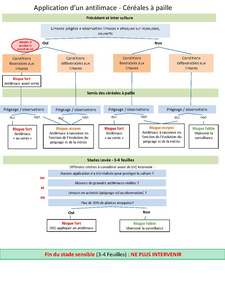
Phytosanitary control protects the crop, but it is not sufficient to reduce populations. This control is applied when slug pressure on the crop is high and when agronomic practices have not been sufficient to limit population development.
Before sowing
In case of confirmed high risk (due to very favorable conditions for slugs during intercrop and following observations or trapping): perform an application of anti-slug pellets at least 15 days before sowing. This delay allows full product effectiveness before it is incorporated into the soil. In any case, this application cannot replace the one recommended at sowing[1].
At sowing
- Under favorable conditions and confirmed slug presence, treatment applied in full, 4 to 5 days after sowing is most effective: it reduces plant loss by about one third. At this stage, slugs only have pellets to feed on, as the seed is hardly accessible and still hard before imbibition.[1]
- If pellets have disappeared (due to consumption or disintegration), treatment renewal is necessary. Same if the number of pellets remaining on the soil does not ensure sufficient crop protection[5].
- Renewing treatment at first damage slightly improves protection.
Most often, grey slugs predominate, pellets should be spread on the surface.
If black slugs dominate, it is advised to apply pellets in the seed row, while also applying some on the surface.
The effective duration of a pellet is at least 15 days. Effectiveness is reduced if pellets are hard to access (stuck to soil). After heavy rains, pellets may stick to soil, so reapplication is advised[1].
After emergence
After emergence, treatments are less effective because pellet palatability competes with that of plants.
If no prior application was made to protect the crop, or if anti-slug pellets have disappeared, treat if [1]:
- Slug activity is visible (by trapping or direct observation)
- More than 30% of plants are attacked or if some hotspots are completely destroyed
Beyond the 3-4 leaf stage, the crop's compensatory ability is strong and further intervention is unlikely to be profitable.
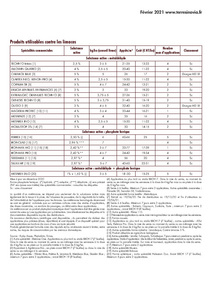
Choice of slug control
Slug control is ensured by 2 active substances:
These two molecules are consumed by slugs mainly through associated baits, made up of various ingredients highly attractive to mollusks. When a dose range is recommended, higher doses should be reserved for the highest risks. Do not reduce the number of pellets/m² below the recommended doses. It is preferable to favor a medium dose renewed twice, rather than treating once with a high dose[1].
Find all products usable against slugs (updated February 2021) in this document.
Respect good practices
The application of slug control must respect a non-treated zone (NTZ) of at least 5 meters at the edge of any water point, even if dry. Whatever the active substance, do not apply pellets on grass strips or any other permanent vegetated device intended to protect water resources or biodiversity[6].
The maximum dose of metaldehyde application per hectare per year is 700 grams of active substance, all products combined.
The active substance dose must be adapted to the pressure and applied respecting good spreading practices. Compliance with good practices continues after spreading, by cleaning the spreader away from any water point and disposing of empty packaging through the collection channels of the Adivalor network[7].
Decision support tools
To help farmers identify risk phases, the De Sangosse Observatory publishes weekly local maps of slug activity intensity. To receive alerts, it is possible to download the Ciblage app or connect to the observatory.
Arvalis - Plant Institute has also published a decision grid for application, available here.
Sources
- Managing slugs in agriculture with Marion Puysservert
- https://www.agrifind.fr/alertes/tournesol/tournesol-limace
- ↑ 1.00 1.01 1.02 1.03 1.04 1.05 1.06 1.07 1.08 1.09 ARVALIS - Plant Institute, online, Slugs
- ↑ Agricultural Perspectives, July-August 2013, No. 402, Difficult to oversimplify in sunflower
- ↑ 3.0 3.1 SIMPLIFIED CULTURAL TECHNIQUES. No. 30. Slugs: Finding the balance
- ↑ National BSV Note, Slugs: monitor, prevent risks and favor integrated control methods
- ↑ De Sangosse Group, Anti-Slug Targeting
- ↑ Groupe De Sangosse, Slug targeting, Good agricultural practices.
- ↑ JULIEN C., 2019, Slug treatments: respect good practices, Wikiagri
Downloads
Appendices
Défavorise les bioagresseurs suivants