Planting and subsequent care (protection, mulching, pruning, maintenance) should not be neglected. Planting is a time-consuming act; replacing trees that did not survive is time-consuming and represents an additional cost (mortality can exceed 50%). Investing in quality equipment is a guarantee of success.
Before planting trees, it is important to define the position of future tree rows, either manually using aligned stakes positioned as markers, or with the use of GPS.
They must be of first choice and certified both sanitary and genetically. Suppliers must be regularly inspected by the Plant Protection Service.
Young seedlings (1 to 2 years) must be well-formed (the root hair must be abundant and not show spiraling or root balling, the aerial system must be stocky and well balanced), aged 2 to 3 years maximum, bushy types must have at least 3 or 4 shoots. Deciduous are supplied “bare root”, evergreens preferably in pots.
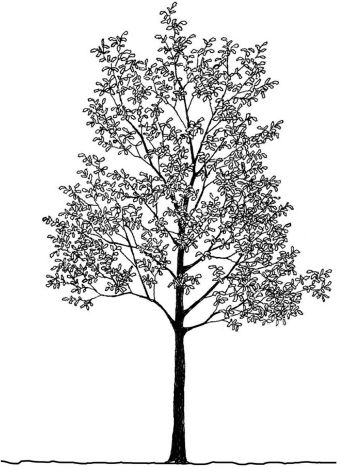
A BaliveauBaliveaux (trees selected as sufficiently straight and vigorous to become a fine future tree, a high forest tree) must be formed trees, aged 3 to 5 years, with a height of 1.50 to 2.50 m maximum. They must have a formed crown, developed from the middle (at the highest) of the main trunk. Their root system must be proportionally strong (minimum 30 cm), progressively branched, well distributed, not spiraled. It must have abundant and fresh root hairs and as few abrasions as possible. Stocky stems must have good overall straightness. The trunk and branches must show no cracking or significant wounds, any leaves must be free of parasites or necrosis. The collar must be thick (3 to 5 cm circumference).
Planting
Soil Preparation
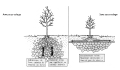
Good soil preparation is essential for good establishment and optimal development. It allows quick mulching and facilitates planting. Proper soil work should result in a permeable structure over a maximum depth (minimum 60 cm).
For hedges, the soil must be prepared over 1.50 m wide, preferably in autumn before planting trees in winter or early spring:
In case of mulching with film, open it in a cross about 20 cm per side.
Clear a hole sized to the roots with a spade, avoiding enlarging the mulch opening as much as possible.
Prune the seedling (stems and roots).
Place the seedling vertically with roots well spread and oriented downward. Roots must not be compacted on the sides or bottom of the hole.
To fill the hole and cover the roots, bring fine soil just below the mulch to create a “basin” around the seedling. This will allow water to reach the seedling more easily.
Place the collar slightly below soil level, under the mulch, and fold the sides of the opening over it.
Firmly tamp the soil several times by hand, then with the heel, while continuing to form the basin that will collect rainwater.
Add gravel around the seedling, or fine soil, to hold the mulch and prevent rodents from getting under it. The most frequent recommendation for hedge planting is spacing of 90 cm between seedlings.
It is preferable to plant in winter, during the vegetative rest period and under favorable climatic conditions: avoid days of frost, strong winds or overly wet weather.
Some planting rules to promote tree establishment:
The seedling must be vertical and roots well spread and oriented downward.
The collar must be slightly below soil level.
Roots must be covered with fine soil.
The area around the seedling must be compacted forming a basin to collect rainwater.
Monitoring plantations is a guarantee of success. Done during the first three years, it allows replacement of dead seedlings and pruning of trees and hedges.
Vegetative reproduction: Most deciduous trees can multiply by vegetative reproduction:
Coppicing: regeneration of the tree from the base of the stump after cutting.
Suckering: a new tree forms from a bud on a shallow root.
Layering: a new tree forms from a low buried branch that has produced roots. Layering can be artificially encouraged: lateral branches 1 to 4 years old can be bent and incised and held in a shallow furrow with staples.
Mulch can be applied over a surface of 1 m² around young trees to limit herbaceous competition and conserve soil moisture. Whatever the type used, mulch must be spread over a minimum width of 20 cm on each side of the seedling. The goal of this mulch is to provide a favorable environment for the establishment and growth of young seedlings.
Mulching has various functions:
maintains constant moisture
warms the soil
preserves a stable soil structure
reduces competition with herbaceous plants
contributes to feeding the soil when of plant origin.
Roll-out or laid mulches
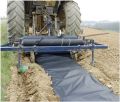
Roll-out of biodegradable or biocompostable film with a tractor-drawn unroller.
BioFilm Sylva 80 µ, certified “OK BIODEGRADABLE SOIL” by Vinçotte, biopolymer based on vegetable oil (guaranteed GMO-free), laid before planting, collars to be planned at the base of each seedling.
CELLOBIO biocompostable film mulch - compliant with standard 13432, width 1.10 m (wider films exist), laid before planting, collars to be planned at the base of each seedling.
Mulch in plant fibers: Biodegradable non-woven WEEDCONTROL AS Brown. Composition 100% PLA, width 1 m or 2 m, 150 g/m2, to be fixed with beveled steel staples (20*20*20 cm, diameter 4 mm, spaced about every 1.5 m). THORENAP® mulch: Felt of 100% plant carded fibers: 70% jute, 30% hemp, 1000 g/m² and 1400 g/m², available in roll for laying with an unroller or as individual mulch mats (from 30*30 cm to 100*100 cm, favoring a minimum of 60*60 cm). Fixing with staples or buried edges.
Straw mulching is about 25 cm thick with a density ranging from 15 to 20 kg per square meter. The width of the mulch depends on the type of hedge (single, double, triple, etc.). Mulch must cover a minimum width of 20 to 30 cm on each side of the seedling and up to about 50 or 60 cm on each side. Plan to supplement in case of rapid degradation during the first 3 years after planting.
Chipped wood comes from a mix of various hardwoods, in chips about 3 cm. The quantity must be determined in cubic meters (m3).
Chip mulch is about 15 cm thick or 0.15 m or 100 L per tree.
The width of the mulch depends on the type of hedge (single, double, etc.). Mulch must cover a minimum width of 20 cm on each side of the seedling and up to about 50 cm on each side.
Electric fence with tape, classic, high tensile, offset... plan several wires for game.
Mistakes to Avoid
After reviewing planting and layout rules, here are some practical cases where techniques and choice of equipment do not guarantee success in the short and medium term.
The stake holding the tree does not allow proper establishment because it does not “absorb” movements caused by the wind. Moreover, this type of fastening can damage the bark. Note that plantations with trees of this size (too large) are relatively rare.
Poorly planted seedling: collar and roots are not in the soil. The edge of the sleeve is folded but this fold should be at the top, not towards the soil. The thin metal stake does not hold the protective sleeve and the seedling is not mulched.
Use protection with moderation! In some cases it is essential to protect young seedlings, but too much protection is also harmful and unnecessary.
Be careful not to underestimate wind force and game pressure when choosing and installing protection kits. The stakes chosen here are too thin, sometimes made of unsuitable material, and do not properly protect seedlings (do not hold sleeves).
Thin metal stake that does not hold the protective sleeve and the seedling is not mulched.
Thin stakes that will deteriorate quickly, protections will not be maintained.
Stakes too thin, no mulching, protection not fixed.
Poorly prepared soil (too roughly). Mulch poorly held on the ground which will not resist wildlife passage and weather. No protection: no stake or sleeve, no fence around the plot: bamboos are of little use, not even to locate seedlings because their color does not allow it.
Seedlings are not mulched, stakes too thin. Planted seedlings are too old and large.
Regulations & Financial Aid
Distance Rules
Planting of trees, shrubs, and bushes can be done near the neighboring property boundary respecting local rules provided by existing specific regulations or constant and recognized local customs. To find out about local rules, contact your town hall. If you want to plant a tree on the property boundary and no specific local rule applies, the distances to respect from the neighboring land vary according to the height of your planting:
For planting 2 m or less high, the minimum distance from the property boundary is 0.5 m.
For planting over 2 m high: the minimum distance from the property boundary is 2 m.
Distance is measured from the middle of the tree trunk and planting height is measured from the ground to the top of the tree.
Planting near power lines
Distances to respect depend both on the type of line and the height of the trees (article L 322-5 of the Forestry Code).
Planting near underground networks
Generally, it is advised to keep a distance of at least 3 m between plantations and underground networks. This distance can be reduced depending on the species planted (and its root development), the type of network and its depth.
Maintenance Rules
Shared Plantings
Owners of a shared planting (hedge or tree) can each maintain it up to the limit of their property.
Branches
Each owner is responsible for cutting branches of trees, shrubs, and bushes on their land. Branches extending over the neighboring property also. A person can compel their neighbor to cut branches extending over their property, but cannot cut them themselves.
Intra-field Agroforestry: Aligned or Scattered Trees
Regulations distinguish between scattered “fruit trees” and scattered forest species trees. The former are an agricultural production and are thus eligible for CAP aid. The latter are eligible under certain conditions:
On arable land or permanent crops: scattered forest species trees are eligible up to 100 trees/ha, regardless of arrangement, except in groves. Beyond 100 trees/ha, the entire plot is no longer eligible.
On meadows and permanent pastures: so-called forest scattered trees are partly eligible applying the pro-rata rule on residual non-agricultural elements (see the Eligibility of Agricultural Areas for CAP Aid fact sheet published by the ministry[1]).
Aid and subsidies
Subsidies are established to facilitate the replanting of trees in the territory. These aids can come from several sources: European, national, regional, departmental, inter-municipal/municipal, or private funding (foundations, patrons, companies).
The regions, departments, and municipalities have different sensitivities to this issue and not all grant subsidies. These take the form of aid measures, calls for tenders, and programs. Each aid is intended for specific beneficiaries (farmers, municipalities, ...) and has detailed regulations. The eligibility terms are more or less strict depending on the aid. Most subsidies have selection criteria, so each submitted project is not
automatically accepted. It will be necessary to choose the subsidy most suited to the project, the project leader, and to maximize the number of necessary criteria to be selected. Most are retroactive and require an advance of funds and the complete execution of planting work before payment. Sometimes, counterparties to the subsidy are also requested (panels and displays naming the subsidizer and the amount of aid, nature or planting activities, ...).
Planting accompanied by a subsidy has result obligations. It represents a commitment to the subsidizer.
Subsidies are not equal in terms of amounts and payment modalities. They almost never fully cover the total planting costs and exclude certain expense items.
Having the planter financially participate is a way to make them responsible for their plantings by encouraging them to take care of and preserve the trees after the legal duration imposed by the subsidy!





 Soil Preparation
 Subsoiling


 Biodegradable Biofilm
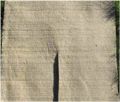 Mulch in plant fibers
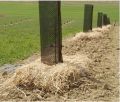 Straw Mulching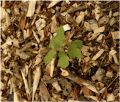


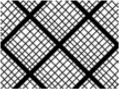 4-ply climatic sleeve mesh


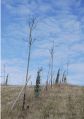 The stake holding the tree does not allow proper establishment because it does not “absorb” movements caused by the wind. Moreover, this type of fastening can damage the bark. Note that plantations with trees of this size (too large) are relatively rare.
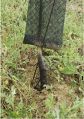 Poorly planted seedling: collar and roots are not in the soil. The edge of the sleeve is folded but this fold should be at the top, not towards the soil. The thin metal stake does not hold the protective sleeve and the seedling is not mulched.
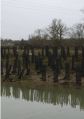 Use protection with moderation! In some cases it is essential to protect young seedlings, but too much protection is also harmful and unnecessary.


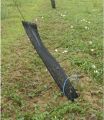 Thin metal stake that does not hold the protective sleeve and the seedling is not mulched.
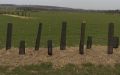 Thin stakes that will deteriorate quickly, protections will not be maintained.
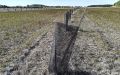 Stakes too thin, no mulching, protection not fixed.


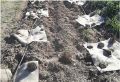 Poorly prepared soil (too roughly). Mulch poorly held on the ground which will not resist wildlife passage and weather. No protection: no stake or sleeve, no fence around the plot: bamboos are of little use, not even to locate seedlings because their color does not allow it.
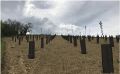 Seedlings are not mulched, stakes too thin. Planted seedlings are too old and large.
.jpg)