Transition to ACS in mixed farming and livestock

The GAEC Houdan is a farm engaged in polyculture livestock located in Châtillon-sur-Seine (Côte d'Or). It began its transition to Conservation Agriculture (CA) 20 years ago and is now certified in Organic Farming (OF). Thomas Houdan shares here his experience and advice.
Implementation context
Reasons for the transition
- Ecological and agronomic: Desire to produce "more naturally": to have production less harmful to the environment.
The organic matter content was 3% in 2005 (minimum limit to be able to produce successfully).
- Economic: Reduce production costs.
Discovery of CA
- Many reflections and trials carried out by ourselves led us to think about these practices and to meet scientists such as Frédéric Thomas.
We attended many trainings (Switzerland, Belgium, southern France).
Trainings attended
Training of Thomas Houdan: BTS ACSE (Analysis, Management and Strategy of the Agricultural Enterprise).
Advisory organizations/people for CA: Franco-Swiss association Adria, Frédéric Thomas.
Stages of the transition to CA
- 2003: Meeting with Frédéric Thomas, reflection to stop ploughing. Sale of the plough in 2004.
- We have always conducted trials aiming to improve. Trials on small strips on different plots (soil, climate, ... are different).
- 2005: Purchase of the first RTT seeder (the only tool that really changed on the farm).
- 2016-2017: Creation of a working group of 10-15 farmers (Châtillon area): obligation to conduct CA trials to advance the group. This allowed us to find contracts, somewhat different markets than usual because we had more power being 10-15.
- 2018: Start of conversion to OF.
- 2021: Officially in OF.
Reasons for this conversion: mainly ecological, but the switch to organic farming was driven by the fear that conversion subsidies would decrease and also by the ban on glyphosate (used for destroying some cover crops).
Practices implemented
Crops and associations

Rotations
- Triticale (associated), wheat (associated), rye, buckwheat are the 4 main crops we grow.
- For these four crops, we produce our farm seeds and perform germination tests (germination quality) to determine seeding density/ha.
- Generally 2 years of wheat or triticale mixed with clover or alfalfa.
The choice of legume depends on the land: priority to clover because it is easier to destroy.
In fields where clover cannot be grown (too cold, soil quality, etc.): sowing of alfalfa (great plant but difficult to destroy, which poses more problems in organic farming).
- Buckwheat (in pure culture) has a cleaning action due to its allelopathic effect. It can be grown two years in a row if it is very clean after the first year. If the buckwheat is weedy, one can grow a year of rye afterward. Its harvest takes place in mid-October and wheat sowing is done 2 weeks later.
Trials conducted:
- Rye: 1st year of trial, no high yield. Sanitary crop used for its cleaning power (if strong presence of weeds). It does not need many resources to grow.
- Trial with camelina.
Associated crops and permanent soil cover
- Clover / wheat or alfalfa / wheat: grazed by sheep, alfalfa and clover regrow.
We sowed 5 kg/ha of clover but it is too much, normally it should be rather 2.5 or 3 kg/ha (and about the same for alfalfa).
Clover and alfalfa are present all year, so the soil is never bare.
- Mixtures are very interesting and allow a certain soil balance.

Changes when switching to organic
- Abandonment of barley cultivation in Organic: results are not satisfactory in organic farming.
- Abandonment of lentil cultivation in Organic: because harvesting takes a lot of time, and because this crop requires many passes (at least 4-5) with hoe and spring-tooth harrow for weeding.
Reminder of conventional practices
- Use of cover crops, destroyed mechanically and chemically when we were conventional. For example, we could sow a cover crop of fava bean and mustard with wheat regrowth then destroy it with a disc tool or herbicide then sow. In organic farming, we no longer do this because we have permanent soil cover.
- No-till seeding / simplified sowing just after harvest.
Stopping ploughing and shallow tillage
No no-till but very shallow tillage, no more than 5 cm deep (except with the rotary harrow which is little used).
Note: We always pass over the same spots in the fields. We work in 6, 12 and 36 m widths to always pass over the same places.
Farm seeds

Bread wheat: farm seeds in a mixture of 16 varieties
Buckwheat: farm seeds, not many variety choices
Rye: pure farm seeds
Triticale: farm mixture
Process for choosing wheat varieties:
- Use of wheat variety mixtures
- To add a new variety: sow seeds individually, i.e. "pure", without mixtures.
- Marking plots, weighing to calculate yields, noting everything and taking photos as in trial centers.
- If the variety fits, add it to the base wheat variety mixture.
We have 16 wheat varieties in our mixture sown each year. We try to add one each time and let natural selection do its work: everything is harvested and reseeded.
Over time, farm seeds adapt to our soils which leads to faster emergence and allows to fight against weeds more easily. We also observe that our old wheat varieties tiller more and more over time.
Grazing of wheat by ewes
- We currently have 80 ewes.
- In 2018, destruction of cover crop such as sorghum / mustard with wheat regrowth by sheep.
Implementation of cereal grazing

- Start of cereal grazing in late autumn
- As long as the tillering plateau is not impacted, the cereal regrows.
Note: buckwheat and rye are not grazeable species.
- Trials on the grazing rate were conducted (image opposite): The right part was barely grazed. The upper part was grazed twice as long and finally the left part (very bare soil) was grazed twice as long again.
The best yields are obtained on the plot where the wheat is no longer really visible and where the soil surface is visible.
- Stopping cereal grazing at vegetative regrowth (end of winter).
Advantages observed from this practice
- Very useful for weed management and to contribute to the fertilization of fields.
- Creates stress on wheat: it defends and strengthens itself.
- Promotes tillering: better yields: 10 q/ha more in grazed plots compared to ungrazed.
- Allows sheep to be outside all year (they even graze on frost).
Discovery of the practice and training
During an end-of-BTS internship on a farm, in 2017. A shepherd came to graze at the internship supervisor's farm.
Trainings attended with Pâturesens.
Other information on sheep farming management

- Sale of lambs through a cooperative (slaughtered within a maximum 2-hour drive).
- We also have an 8 ha plot sown in permanent pasture: ewes are put there when they are no longer in the wheat. We sometimes make hay with the associated crop fields (wheat/triticale-clover/alfalfa), after harvest.
- Our goal in the coming years is to sell our sheep flock and simply have a shepherd bring his sheep (400).
Equipment
Seeder and tools

Today we have invested in a seeder but homemade solutions are very good to avoid large investments at the start (example: investment for homemade tank at the front and piping €8000 versus purchase of a no-till seeder €35-40,000). We had made a no-till seeder with a tank at the front of the tractor, with a blower to project grain into tubes passing under or beside the tractor, combined with a disc tool (image opposite) or a tine tool depending on needs.
- 2008: Purchase of the first no-till seeder, a Sulky Unidrill
- 2012: Purchase of Amazon Cayenna seeder
- 3 tractors
- one spring-tooth harrow almost never used
- one rotary harrow
- one disc tool to destroy stubble after harvest (allows better mineralization by burying plant material)
- one harrow for straw (to speed up straw decomposition)
The most used tool today is the disc tool (the harrow).
Grain sorter
- We have our own facility to sort and store grains.
- 2005: purchase of grain sorter at €20,000 (today a sorter would cost €30,000, if we want an equivalent). For a complete installation with storage, the cost would be €80,000.
Return on investment was quick (less than 5 years) with grain sales at higher prices.
CUMA?
We do not purchase equipment through CUMA. However, we have a co-ownership for the rotary harrow with a farmer friend.
We prefer to ensure having well-maintained equipment ready to use at any time and not have to spend a morning fixing a tool because it was not repaired before use.
Our choice is more related to a social than an economic issue.

Perspectives / evolution
- 2023: Reception of a Horsch tine tool to simplify soil work
Results
For us, it took between 4 and 6 years to see improvements.
Environmental
- Increase in organic matter content: in 1999 = 2.78%, in 2013 = 3.2% and in 2020 = 8.1%.
At first the organic matter content rises very little then suddenly increases rapidly and we can gain 1 to 2% in a very short time. This change in OM content is felt in the field.
Note: It is possible to reach up to 12% in France, but on loamy and deeper soils.
- Carbon balance (carried out by Soil Capital): before transition it was 200 t/year positive balance, in 2020 at 1000 t/year then 2200 t/year in 2021. We achieve a storage of 5.75 t/ha of carbon versus -0.25 t/ha average in Côte d'Or (carbon loss).
- We no longer have flooding problems in fields since switching to CA, water is filtered directly. Fields are very easy to work.
Social
- As soils are very easy to work, there is much less jolting which limits back problems.
- No change in working time but very different work: much less time in tractors but much time thinking, informing oneself, trying, meeting people.
- Social recognition
Economic
Yield
- The first 4 to 5 years were difficult: the switch from full ploughing to no-till suddenly caused an imbalance, added to a difficult climatic period (drought).
- Since then, EBE has grown positively year after year.
- In bad years, we get better results than in conventional. In good years, we have worse results because conventional systems are designed to exploit potential in ideal conditions.
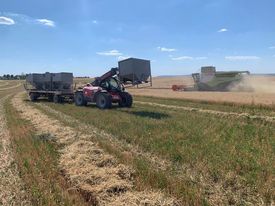
Harvest of trials (cereal + clover): clover visible which could be used for hay. Photo credit: Thomas Houdan.

Production costs
- The average EBE of the farm over the last 13 years is €480/ha versus €320/ha for the CER north Côte d'Or average (Organic and conventional combined).
- €200 of operational costs on average over 13 years, versus €459 for the CER average.
- Much less costs related to inputs (also during the conventional period).
Note: Take into account conversion to Organic since 2018.
- Expected yield before organic conversion: 80 q/ha wheat.
Financial aids?
We find carbon storage premiums but there are no subsidies or labels to value practices carried out in CA.
Summary
What was not anticipated
- This year the clover seeding density was too high plus rain every 3-4 days, resulting in clover overtaking wheat.
- We conducted crop trials: lentils and camelina but could not harvest them. They grow well south of Dijon but not here due to insufficient sunlight.
Our resources in case of doubts/questions
- Discussion with scientists, informed people (Frédéric Thomas).
- A training organization in Switzerland: Adria.
- Neighbors practicing CA.
.jpg)
When did we consider our transition completed?
We could consider our transition finished a long time ago since we started 20 years ago. Conservation agriculture offers many possibilities, it is difficult to reach its maximum potential.
Perhaps one can estimate the transition finished when economic results increase, apprehension fades and workload is reduced.
Advice for those wanting to convert to CA

Key steps
- Go meet those who use these practices: exchange and observe their work.
- On CA networks (CA association, BASE for example and Facebook groups) and by word of mouth.
- Go elsewhere, also in different regions, because you can find things you hadn't thought of in places with different constraints. Do not hesitate to go to regions with difficult soils to cultivate.
- You really have to discuss to see if it might suit you, motivate yourself. It is mentally difficult, you really have to be motivated to do it and seek to improve every year.
- Work with an independent technician to detach yourself from cooperatives. Not to be dependent on one cooperative to be more autonomous and work with several to create competition (even if it is not necessarily easy for everyone).
- Produce farm seeds with old varieties: less yield but more hardiness and resistance.
- Purchase a seeder. Do not invest too much in the no-till seeder: it is not necessarily the most essential. Buy a no-till seeder last if you can afford it. It is possible to do without: we used to put a tank at the front and a straw harrow at the back to sow. It is possible to broadcast seed (with the fertilizer seeder) and pass a shallow tine tool to cover seeds.
- Do trials and be precise (mark plots, test on strips, weigh, etc.). To gain self-confidence and better master the technique.
- Listen to yourself and be confident (do not listen too much to others), do not have apprehension.
- Have a small financial base to start.
- Take trainings (most of which are reimbursed).
Sources
Interview of Thomas Houdan conducted on 12/02/2021.