
Organic conservation agriculture in Geneva: lessons from experience
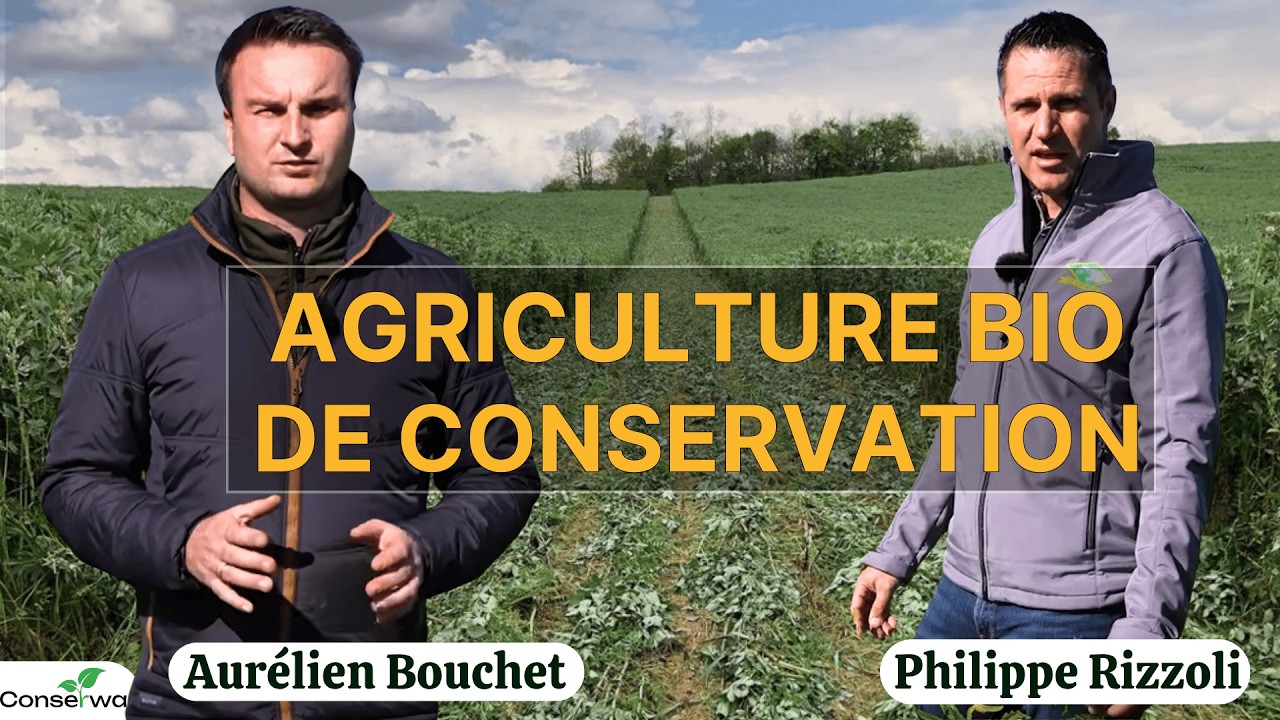
Aurélien Bouchet is an agronomist at Agrigenève. Together with Philippe Rizzoli, a farmer in the canton, he shares their trials in organic conservation agriculture.
Organic conservation agriculture in Geneva: lessons from experience
This webinar, organised by the Centre National d'Agroécologie, highlights work carried out in Switzerland on organic conservation agriculture (ABC). Aurélien Bouchet, arable crops adviser at Agrigève/Agrivulg, and Philippe Rizzoli, a mixed crop-livestock farmer in Genthod, share four years of experience, combining agronomic successes and technical challenges.
The Geneva farming context
Geneva is characterised by a very small peri-urban territory (about 11,000 hectares). The climate is changing, with wetter winters and drier summers, increasing the need for soil resilience. The soils, mostly clay loams, show significant differences in structure. A critical point highlighted is the relatively low organic matter content (10 % of the clay content on average), reflecting a past marked by the end of livestock farming and intensive cropping practices.
Rotation as a management lever
Rotation is the cornerstone of organic conservation agriculture, particularly for managing weed infestation (black-grass, ryegrass).
- The strategy: Include two successive spring crops to break the cycle of grass weeds.
- Example: Philippe Rizzoli illustrates this change with a field that was initially weedy in wheat and became clean again after a maize-soybean sequence without ploughing, using only shallow scalping and subsoiling.
Cover crops and relay cover crops
The importance of cover crops is underlined through rigorous management ("the 11 commandments"), including deep sowing (5 cm) to reach moisture, management of chaff and choice of species.
- The relay cover crop: An innovative technique in which a frost-sensitive cover is mixed with overwintering plants. This system allows high biomass (up to 9 tonnes of dry matter) and significant nitrogen return, while covering the soil for a long period.
- Assessment: The aim is about 10 tonnes of cumulative dry matter. Excess biomass in spring can, however, complicate water management and the establishment of the next crop.
Undersowing in cereals
Undersown legumes (clovers, black medick) aim to produce nitrogen, improve soil structure and reduce summer workload.
- Success factors: Start on clean soil (prior mechanical weeding), let light in (wide row spacing or closed rows) and sow on fine soil.
- Limitation: This technique does not solve the pressure from perennials or resistant grass weeds, but it is a valuable complementary tool.
Rapeseed with companion plants: relevance and challenges
Studied in Geneva since 2010, rapeseed with companion plants helps limit pest pressure (flea beetles) and cover the soil.
- Practice: Frost-sensitive legumes sown as a mixture.
- Results: No negative impact on rapeseed yield, with a potential reduction in insecticide use. In organic farming, these rapeseed crops are generally established after ploughing, but offer great cropping security without additional mechanical weeding.
Testimony: towards farming without ploughing
Philippe Rizzoli transformed his farm by converting to organic farming in 2017. He replaced deep ploughing with shallow tillage (scalper) and targeted subsoiling (Actisol).
- Tools for the future: The use of the Orbis (a disc implement that shreds cover crops) is being studied to manage mulch between the rows.
- The row challenge: The main difficulty lies in clearing the seed row. The option favoured by the speakers is a heavy strip-till to better prepare the furrow in systems with a lot of residue.
Conclusion and advice
Experience shows that while converting to organic conservation agriculture is demanding, managing weeds through shallow tillage and an adapted rotation pays off. Philippe Rizzoli's final advice remains pragmatic: "Start with small areas for your trials and try out the different techniques."
