
Organic conservation agriculture: beyond labels, Raphael Charles
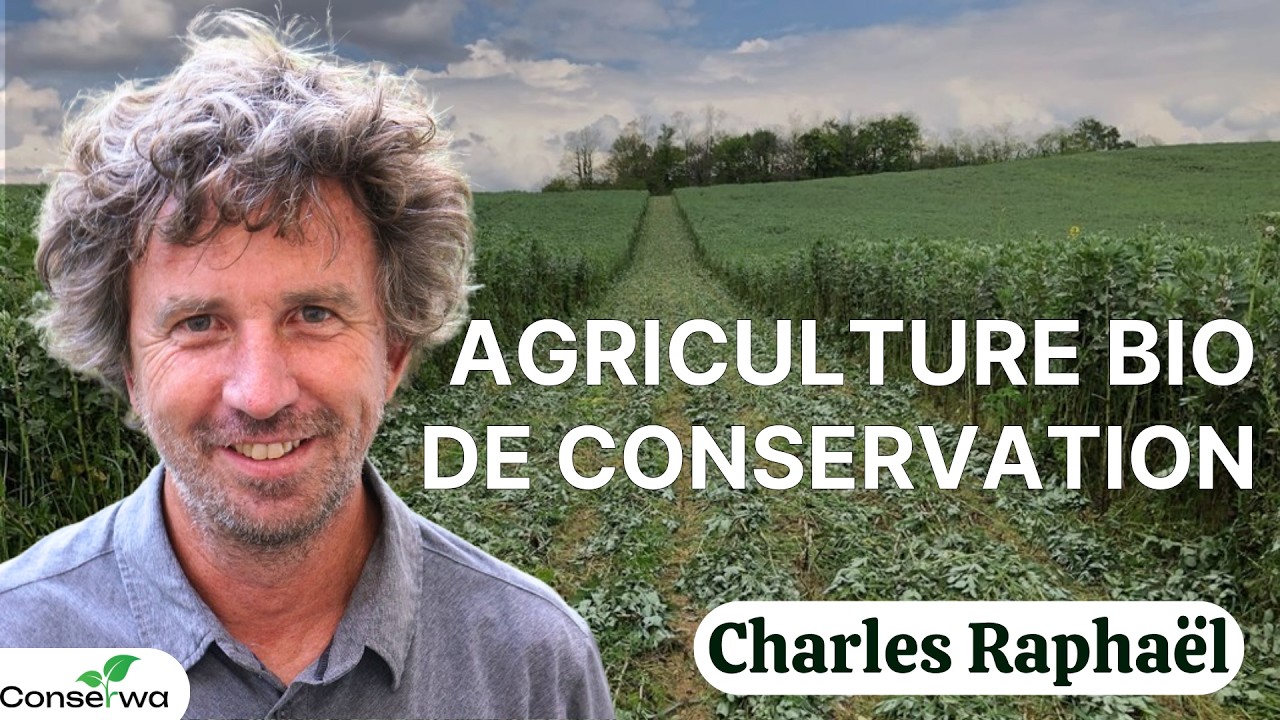
Agronomist and arable crops expert, Raphaël Charles heads the French-speaking Switzerland department of FiBL. He talks about his work on organic conservation agriculture.
Introduction
This webinar on the YouTube channel of the Centre National d'Agroécologie welcomes Raphael Charles, an agronomist at FiBL working on arable cropping systems. FiBL is presented as one of the world's leading research institutes on organic farming, present in particular in Germany, France, Austria, Hungary and Switzerland. Raphael Charles belongs to the French-speaking Swiss department.
In his introduction, he recalls his career: after working for about 20 years in conventional agriculture, in particular at Agroscope, he has headed the French-speaking Switzerland department of FiBL for 10 years. FiBL has about 350 staff in Switzerland, mainly in German-speaking Switzerland, with a smaller French-speaking department responsible in particular for links with French-speaking practice. This explains the many exchanges with France and with colleagues at FiBL France.
Raphael Charles specifies that he is speaking here as a researcher. Research aims to understand systems and does not always immediately provide directly applicable solutions. FiBL's goal is nevertheless to stay close to practice, in order to combine understanding of systems with the search for practical solutions.
The talk offers:
- a few reminders about the main levers of organic conservation agriculture;
- a quick overview of the situation;
- above all, a presentation of results from various projects carried out in recent years.
Threats to soil quality
Raphael Charles recalls that a research programme on soil as a resource highlighted four main threats to soil quality:
- compaction;
- loss of organic matter;
- erosion;
- loss of biodiversity.
These threats are influenced by:
- cropping techniques;
- production systems;
- agri-environmental contexts;
- economic pressure.
In this context, organic conservation agriculture, like conservation agriculture in general, is a way of addressing these threats, either to respond to degradation that is already visible, or to maintain soil quality.
Beyond labels
Raphael Charles emphasises the subtitle of his talk: "beyond labels". According to him, it is not just about one or two technical levers, but about a system. Labels such as "CA" or "organic CA" are useful for communicating and understanding each other, but they become limiting when they lock practices into oppositions or silos.
He points out that there is no settled definition of organic soil conservation agriculture. One can start from the FAO definition of conservation agriculture, to which the pillars of organic farming are added. Among the most important elements, the following always come up:
- tillage;
- soil cover;
- rotation diversity.
He also mentions other related concepts:
- regenerative agriculture;
- "living" agriculture;
- carbon farming;
- permaculture;
- agroforestry;
- syntropic agriculture.
In the Swiss context, organic farming is often considered quite close to regenerative agriculture, particularly when it adds:
- permanent rooting;
- permanent soil cover;
- strong attention to biodiversity, including soil biodiversity;
- integration of animals;
- minimal soil disturbance;
- site-adapted management.
His approach is therefore intended to be more unifying than dogmatic.
Raphael Charles recalls that work on these questions is not new. He cites several set-ups and projects that, for more than 20 years, have helped advance knowledge:
- the DOC trial in Switzerland, which has been comparing biodynamic, organic and conventional systems for more than 40 years;
- trials set up in the early 2000s on different tillage methods in organic farming, particularly on FiBL's main site;
- European projects such as TILMAN-ORG, which made it possible to link the different initiatives;
- various set-ups focused on soil quality, soil functioning and reduced tillage systems.
He stresses that organic CA is a long innovation process, fed by trials, field experience, successes but also failures.
Innovating from niches to the "mainstream"
Raphael Charles then presents a more conceptual reading of how these practices develop. He distinguishes:
- a dominant technical, socio-political and economic landscape, the "mainstream";
- innovation niches, where new practices that are still not well consolidated develop.
According to him, organic CA, like organic farming in general, is still largely in these niches. But the long-term goal is for these innovations to gradually enrich the dominant system. This also applies to conventional farming, which can learn from the innovations, risk-taking and experiments carried out by pioneering farmers and committed institutions.
He stresses the importance of treating these innovations as scientific challenges rather than as claims to be dismissed. He takes the example of compost teas: even if these practices sometimes arouse scepticism, they can also lead to deeper knowledge of soil life.
The technical pillars recalled
Reduced tillage
Raphael Charles recalls the basics of reduced tillage. He does not detail all the machines, but stresses that there is now a very wide range of implements, from alternatives to the plough to shallow seedbed preparation implements, as well as various implements for the intercrop period.
He insists on several points:
- the range of machines and innovations has progressed a great deal;
- these machines still need to be chosen and set up properly;
- tillage always meets several objectives:
- economic;
- plant nutrition;
- soil protection;
- water management;
- weed control.
He recalls that ploughing, historically, is not only a weeding tool: it also serves to trigger mineralisation and make nutrients available.
But today, the issues also include:
- protection against erosion, particularly in sloping regions such as some areas of Switzerland;
- water conservation in a context of climate change;
- limiting soil disturbance.
Weeds as a central difficulty
Weed management is still presented as one of the major challenges of organic farming, and therefore of organic CA. Raphael Charles distinguishes:
- annual weeds;
- perennials, in particular thistle and dock.
It is often these perennials that force farmers to return to more intensive tillage practices, even when they would like to reduce them. He nevertheless points out that there is progress:
- new knowledge on managing these weeds;
- new machines;
- finer technical strategies.
He raises an important question: is a good 20 cm ploughing better than many shallower but repeated passes? This is one of the central issues in designing systems.
Cover crops
Raphael Charles then addresses catch crops, green manures and cover crops. He stresses the diversity of possible solutions:
- cover crops before autumn crops;
- cover crops before spring crops;
- complex mixes;
- decision support tools for designing your own mixes.
The point he finds particularly interesting today is undersowing. It provides living soil cover from harvest onwards, which is particularly useful in hot, dry contexts where it is becoming difficult to establish a cover crop in July.
In these systems, the cover present in the cereal can:
- develop immediately after harvest;
- produce biomass during summer and autumn;
- better secure soil cover.
He draws attention, however, to legume fatigue, as legumes are frequently used in these systems. Their increased repetition can increase certain health risks, particularly those linked to soil fungi such as aphanomyces.
Rotation as a key element
Raphael Charles recalls that organic CA is too often confused with simply reduced tillage. Yet rotation is a fundamental lever, just as in conventional conservation agriculture people sometimes tend to talk only about direct seeding and forget the other pillars.
According to him, rotation is crucial, but it also depends heavily on the economic context:
- what can be produced?
- what can be sold?
- which crops have markets?
He particularly stresses the role of rotation in managing organic matter. Humus content can change significantly depending on:
- the species grown;
- the presence of grassland;
- organic amendments.
He describes the major role of temporary grassland in Switzerland, where the organic specifications require 20 % grassland in the rotation. This grassland makes it possible:
- to increase humus content for 2 or 3 years;
- then to feed the following crops through the decomposition of this organic matter;
- before starting a new cycle with new grassland a few years later.
This cyclical logic is important for soil fertility and for organising the rotation.
Intercropping
Intercropping is presented as an increasingly important lever in organic farming. Raphael Charles cites the example of European projects that have produced technical factsheets on these intercrops.
These intercrops have several advantages:
- they make it possible to play on complementarities between cereals and legumes;
- they reduce risks in more demanding systems;
- they can help stabilise yields.
He indicates that current work aims to preserve the food value of these intercrops, and not only their use as forage. He gives the example of:
- wheat + faba bean;
- with the aim of obtaining, on the one hand, bread-making wheat and, on the other, faba bean that can be used for human food.
The importance of knowing your soil
Raphael Charles insists that knowing your soil well is a prerequisite for embarking on organic CA. On this subject he mentions the work of Olivier de Serres, which he presents as an old but still relevant reminder of this need.
Before switching to organic CA, you need to know:
- what state the soil is in;
- whether it is ready to bear additional demands;
- or whether some points must first be improved.
He also recalls that research on soil quality has now produced a large number of indicators:
- physical;
- chemical;
- biological, with soil biology becoming increasingly important.
The organic matter / clay ratio
Among the indicators he finds particularly useful, Raphael Charles highlights the relationship between:
- soil organic matter;
- clay content.
As clayier soils can store more organic matter, the organic matter / clay ratio makes it possible to correct for this effect and better assess the soil's organic matter level.
This ratio is cross-checked with simple field tests, such as the spade test or VESS scores. He indicates that there is a relationship between a good ratio and good structural quality observed with the spade. This indicator is used with farmers as part of diagnoses.
A soil disturbance index
Another important piece of work presented by Raphael Charles concerns the development of a soil disturbance index, called STIR in English.
This index combines several dimensions:
- working speed;
- type of operation;
- working depth;
- area disturbed.
The aim is to give a score to each operation:
- a simple pass without modifying the soil corresponds to 0;
- ploughing corresponds to 100 points.
By adding up the operations on a crop, then on a rotation, an overall estimate of disturbance intensity is obtained.
Some orders of magnitude given:
- a ploughed potato crop can reach about 200 to 400 points depending on the operations;
- a cereal represents about 80 points;
- first-year grassland about 40 points;
- grassland not reworked in its second or third year: 0 points.
He gives an example: a potato crop at 300 points, followed by three years of grassland and a cereal, can bring the average annual intensity down to a level close to that of a simpler cereal rotation. This index therefore makes it possible to think about the system at rotation scale, rather than judging an isolated technique.
The "Hubs for soils" project: comparing cropping systems
Raphael Charles then presents a project called Hubs for soils, translated as innovation hubs for soil-improving cropping systems.
This project, carried out with several Swiss institutes including Agroscope, ETH Zurich and FiBL, compared three networks of farms over about ten years:
- conventional farms;
- direct seeding / conservation agriculture farms;
- organic farms.
The aim was to characterise practices and assess various soil quality indicators, particularly on wheat fields.
Characterising the three groups
The systems studied show consistent profiles:
- conventional farming is characterised by:
- high yields;
- high nitrogen fertilisation;
- many treatments, mainly fungicides;
- heavy traffic;
- direct seeding is characterised by:
- the use of cover crops;
- high rotation diversity;
- more herbicides;
- a strong presence of legumes, notably through cover crops;
- organic farming is characterised by:
- a higher presence of weeds;
- intensive mechanical weeding;
- more frequent organic amendments;
- relatively high tillage.
Soil carbon
The results first show classic trends for soil carbon:
- under direct seeding, carbon enrichment in the 0 to 5 cm layer;
- stronger surface protection;
- in conventional farming, lower surface cover and carbon.
But a result considered particularly interesting is observed in organic farming:
- the surface carbon stock is not so far from that of direct seeding;
- between 20 and 50 cm, some organic fields show a trend towards carbon enrichment.
The explanation considered most likely is the effect of the deep rooting of grassland, which injects carbon at depth through rhizodeposition.
Structural stability
For soil structural stability, measured notably by aggregate diameter, the results show something similar between:
- direct seeding;
- organic systems.
Raphael Charles stresses that this goes against a common fear that organic systems work their soil too much to maintain good structure. According to him, the presence of grassland and the more frequent use of organic amendments probably explain this closeness to CA systems.
Soil life
Analyses of soil life, in particular:
- mycorrhizae;
- microbial biomass;
- soil respiration;
show fairly similar levels between organic and CA. Organic farming nevertheless generally shows a slightly higher rate of mycorrhizal colonisation.
Raphael Charles insists that in organic farming, despite regular tillage, there is therefore no reason to systematically consider these systems unfavourable to soil microbial life.
Structure of fungal communities
More detailed analysis of the structure of rhizosphere fungal communities shows that:
- organic systems have greater diversity;
- connections between communities are more numerous there;
- direct seeding is closer to conventional than to organic on this point.
Among the explanations put forward, Raphael Charles mainly cites the role of mineral phosphorus, which reduces the need for mycorrhizal symbiosis in conventional systems. He also mentions a possible effect of higher bulk density under direct seeding.
Pesticides
The project also measured:
- the number of pesticides;
- their concentration.
Conventional and direct seeding systems show similar profiles in number of uses. In organic farming, residues are still found, described as "ghosts of the past", but at much lower concentrations.
These differences are reflected in some responses observed in microbial biomass and mycorrhizae. Raphael Charles thus stresses that pesticides do contribute to pressure on soil life.
Soil health and yield
By combining several indicators, the project produced an overall soil health index. This index is, on average, better in organic farming than in the other two systems, even though there is strong variation within each group.
When this index is linked to yields:
- in organic farming, soil quality does not directly explain yield;
- in conventional farming, the best yields are achieved where soil quality is high;
- in CA, the situation is intermediate.
Raphael Charles highlights an important point here: in organic farming, a very good soil does not automatically guarantee a high yield, because other factors are limiting, in particular:
- nitrogen nutrition;
- disease pressure;
- other agronomic constraints.
He therefore recalls that soil quality should not be assessed only in terms of yield, but also in terms of sustainability and environmental objectives.
A network of farms around soil quality
Another project involved following a group of farmers interested in soil quality, with tools comparable to those of the previous project.
The practices observed show a real desire to improve the humus balance:
- compost applications;
- cover crops;
- manure, sometimes bought in.
But the diagnoses reveal that, despite these efforts:
- many fields still lack organic matter;
- structural quality is often still poor.
Raphael Charles then distinguishes three main profiles:
- a group strongly oriented towards cover crops and legumes, but without livestock and with few organic amendments;
- an arable group returning straw, but without grassland or livestock;
- a mixed crop-livestock group, with more organic amendments and grassland in the rotation.
The indicators show that the best results in terms of organic matter / clay ratio and microbial activity are found in mixed crop-livestock systems.
He draws an important lesson from this: current practices also tell the past history of soils. The efforts made do not instantly produce visible effects. Often, the farmers most committed to soil protection are precisely those starting from the most degraded situations.
In other words, claiming to practise CA or organic CA is not enough for the soil to already be in good condition. It takes long-term work.
The Adventisol network in organic farming
Finally, Raphael Charles presents a network called Adventisol, focused on reconciling:
- weed management;
- soil quality.
This network follows nine organic farms in French-speaking Switzerland working on this issue.
Intensity of soil disturbance
The STIR index shows:
- large differences between farms;
- but overall, tillage that is still fairly intensive;
- with values often above 100.
Since 2018, there has been little change: practices remain intensive. The index mainly reflects the weight of demanding crops in the rotations.
Raphael Charles concludes that tillage intensity remains a major challenge.
Soil cover
Soil cover measurements also show large differences between farms. Cover depends first on the choice of crops in the rotation.
Over time, however, some farms have improved:
- residue management;
- keeping residues on the surface;
- the use of certain implements such as the rotary harrow (rotoétrille).
This reflects a real change in practices.
Carbon balance and nitrogen fertilisation
Monitoring of carbon inputs shows that, in these systems with little or no livestock:
- the crop itself remains the main source of carbon;
- some changes in practices, such as greater use of cover crops, are clearly visible in the indicators.
Nitrogen fertilisation, for its part, remains relatively stable over time, but the differences between farms are large. Very different strategies are observed:
- some farms stay at very low nitrogen input levels, in a very extensive approach;
- others, depending on the crops, rise to relatively high levels for organic farming, around 80 to 100 units of nitrogen as a median.
General lessons
In conclusion, Raphael Charles recalls several key points:
- Many levers can be used in organic CA.
- It is important not to stop at simplified principles such as "do not till the soil".
- One should remain relaxed about ploughing: well-managed ploughing, combined with other levers, can make it possible to maintain good soil quality.
- It is still difficult to provide simple, universal recipes.
- Cropping systems rather than isolated techniques should be supported, particularly in public policies.
- Quantitative indicators change slowly.
- On the other hand, the quality of operations is clearly improving:
- better cover crop management;
- better biomass production;
- semi-permanent soil cover;
- better residue management.
- Tillage nevertheless remains intensive, notably because of weed management.
- Nitrogen fertilisation depends on choices that shape the whole farm.
- Grassland plays a central role in Swiss systems, and reducing it often leads to dead ends:
- for organic matter;
- for weeds;
- for the overall balance of the system.
He insists that an annual cover crop does not replace grassland.
Discussion with the audience
On mechanical innovations and current needs
Asked about innovation needs, Raphael Charles replies that there is already a wide range of machines. According to him, what is mainly lacking is rather:
- expertise in fine-tuning them;
- control of working depth;
- correct use depending on the context.
He believes there is sometimes a form of over-mechanisation, particularly in the Swiss context, and that existing implements should first be put to better use.
He nevertheless notes major changes:
- in weeding implements;
- in the use of artificial intelligence;
- in the fine adjustment of machines that used to be more rudimentary.
He also gives the example of organic sugar beet, now sometimes transplanted rather than sown, to make weed control easier. Even if this may seem economically excessive, it shows how far some technical developments are going today.
On banning glyphosate for cover crop destruction
Regarding the possible ban on glyphosate in some schemes, particularly in Belgium, Raphael Charles recalls that glyphosate is a clear boundary between CA and organic CA.
He believes that its removal is a strong constraint, which profoundly changes the prospects of conventional conservation systems. He considers that this may seem unfair given CA's contribution to soil protection.
However, he also observes that the most advanced systems have often already greatly reduced their glyphosate use. He mentions several options:
- working with relay cover crops;
- preparing a living cover even before destroying the previous one;
- shredding the biomass before winter;
- then having rye or crimson clover already in place;
- then using shallow scalping or other surface destruction methods.
On this subject he cites work carried out with AgriGenève on these relay cover crops.
On the Swiss rule requiring 20 % grassland
Asked about how markets are organised, Raphael Charles explains that this rule is long-standing in the Swiss organic specifications and has long been integrated by the profession.
Solutions include:
- exchanges between farms;
- proximity to livestock areas;
- processing of some forages;
- the growing obligation to use Swiss basic forage for ruminants;
- uses on the farm itself, such as shredding and returning to the soil;
- in some market gardening systems, transferring biomass from grassland.
He stresses that this constraint has also encouraged farms, supply chains and territories to reconnect.
Conclusion
To conclude, Raphael Charles recalls that regional developments around organic farming, CA and organic CA are particularly stimulating when they are built collectively, by combining viewpoints, systems and experiences.
Finally, he mentions the 10th anniversary of FiBL's French-speaking Switzerland department, celebrated this year through several local events.
His talk ends with an invitation to keep observing, describing and understanding soils with farmers themselves, particularly through simple tools such as soil pits and field tests. According to him, this ability of farmers to describe their own soils is key to making progress.
