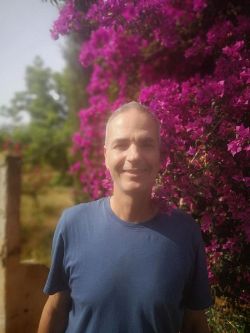
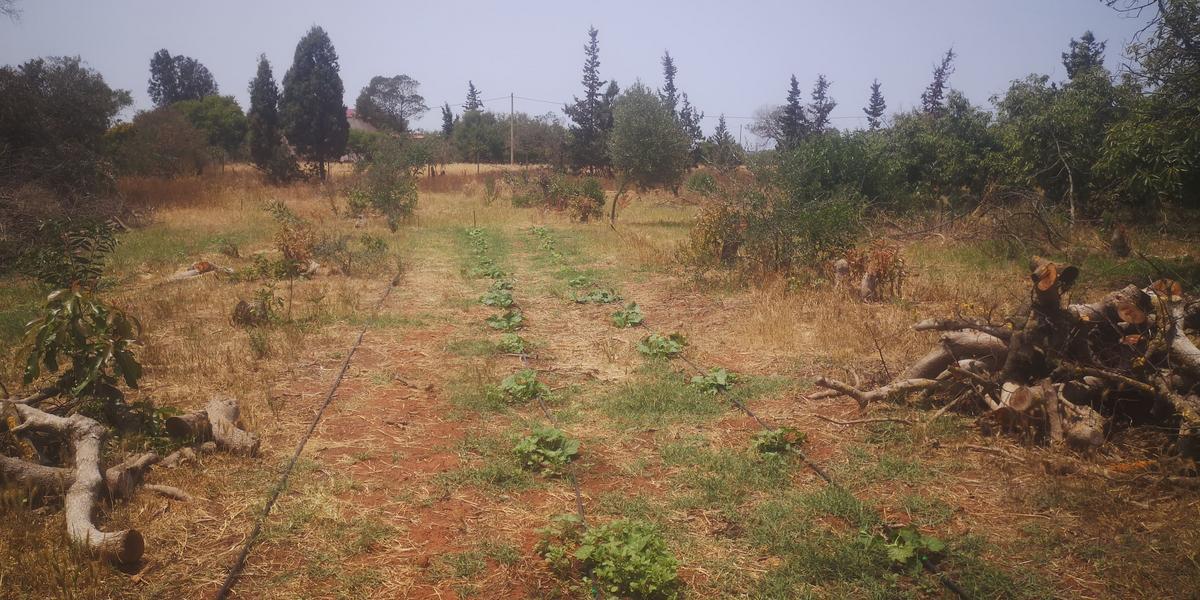
Karim Boutayeb, a farmer in Tamesna, Morocco, cultivates his land and raises his animals according to agroecology principles. Here is a portrait of his farm.
Climate: According to the Köppen-Geiger climate classification, Rabat has a Mediterranean climate with hot summers (Csa). Temperatures generally range between 13 °C and 24 °C throughout the year, with extremes rarely dropping to 5 °C or rising to 39 °C. Average annual rainfall is about 383 mm, spread over 52 rainy days per year.
Marketing
Karim is not yet in a seed marketing phase; he should go through a standardization system to be authorized to sell them. He mentions a potential contact with Carrefour for unprocessed products, but points out that large retailers take 60% of the margin on agricultural products and seeds.
Labor
1 full-time worker.
Karim would like to employ a second full-time worker, but for that, he would need to enter the marketing phase.
Agricultural production
Farm organization
Crop rotation of the farm (surface proportions are not respected)
Plant production
2 ha in Orchard including 0.6 ha in citrus production and more than 1 ha of old avocado plantation. He plans to eventually reduce the avocado crops because they are too water-demanding and not suitable for the climate according to him.
Row of healthy pomegranate trees, having resisted repeated episodes of hot winds and drought over the past six years.
A citrus orchard was planted by his sister seven years ago, at a time when citrus prices were still high. Since then, the price of lemon has dropped sharply (1 dirham/kg currently), to the point that it no longer covers irrigation costs. He therefore plans to reduce the number of lemon trees. He also grows other citrus (about seven varieties), including oranges and kumquats.
Walnut trees were allocated to him under an aid program, but they are not adapted to the local climate. However, pomegranate trees show good results.
He planted 200 avocado trees ten years ago, but most were uprooted after an episode of dry, hot wind that caused their drying out. The dry climate is not suitable for avocado trees, which are too water-demanding.
Animal production
He now only has 4 hens, whereas he had 30 before. He lost them gradually, mainly due to stray dogs. However, he plans to buy some again soon.
Education, training and life path
Karim Boutayeb started his path with studies in agronomy engineering, before switching to economics where he pursued a master's degree. However, at 39, he decided to leave the economic sector, no longer finding meaning in his work.
In 2003, he returned to agriculture, following training in biodynamics. He then worked in Ibiza, Spain, on a farm for four to five years, then engaged in managing a battery sales company with his wife.
Health problems forced him to stop in 2015. Exhausted by travel, he chose to return to Morocco to take over the family plot and devote himself to more meaningful work.
Motivation and objective
Karim resumed working the land thinking it would be beneficial for his health. Today, he notes that it has indeed had a positive impact: he feels much better. His production aims primarily at self-sufficiency, but eventually he hopes to market it. He is particularly attached to agroecological principles, notably no-till and the use of heirloom seeds.
Agronomic aspect
Agricultural practice
Karim does not use plastic on the farm.Spontaneous cover crop in the orchard
For mulching, he produces his own straw, because the price of bales has increased sharply: the cost is 50 MAD per bale, whereas before the drought episodes, bale sizes were larger and could be bought for 5 Dirhams.
Karim Boutayeb practices no-till in the orchard and vegetable garden parts; for the cereal part, the information was not provided. Orchard vegetable garden, carrot crops between rows of olive trees.
Some areas in the orchard have spontaneous cover crops.
He also broadcasts barley between the trees,associating it with green manure such as vetch. He also grows soft wheat on the orchard plot. Some local varieties come from ICARDA (The International Center for Agricultural Research in the Dry Areas), which has a large stock of heirloom seeds.
For cover crop management, he also does manual mowing which he returns to the soil to manage spontaneous covers in the orchards (chop and drop).
He has set up growing beds in orchard vegetable gardens. He moved from small beds of 5 to 10 m long to longer beds of 20-25 m by 1 m wide (visually estimated).
Water management and soil characteristics
He has three wells, but only one is used for irrigation. It goes down to 126 m deep and can provide water continuously for 24 hours. The other two wells (70 m) have autonomy of less than an hour. The storage basin is 40 m3. Irrigation is manual (with a hose), done by a worker.
Practices of interest
Innovations, seed selection and processing
Context
Karim practices varietal selection to adapt his plants to the local climate. He started producing his own seeds in 2023. He focuses on three tomato varieties well adapted to the climate: Black Crimea, Honey of Mexico and Orange Beefsteak.
Seed recovery and storage
Tomato crop with shade structure under construction.
Tomato cultivation
He grows tomatoes from seedlings started in February, with planting at the end of March and a first harvest in mid-April. He must harvest seeds before the high heat.
He observed that above 30 °C, tomatoes tend to hybridize more easily between varieties. Indeed, flowers develop a longer pistil which facilitates reception of external pollen, while the plant's own pollen becomes less functional.
Method to recover seeds
To produce seed from 30 kg of tomatoes, it takes about 5 to 6 hours of work.
He starts by harvesting the first tomatoes located at the bottom of the plants, as they generally give better quality seeds. For 30 kg of cherry tomatoes, it takes about 3 to 4 hours to select the good fruits. Selection is also based on plants showing good qualities, such as drought resistance or good vigor.
Once the tomatoes are harvested, he washes them in a large basin, which takes about 30 minutes for 30 kg. Then, he cuts the tomatoes in half. He recovers the seeds with a small spoon. For cherry tomatoes and Black Crimea, it takes about one minute per tomato. For beefsteak tomatoes, this step is longer, although he does not know the exact time.
He then puts the seeds and pulp in a large sieve. He crushes the pulp with a spatula to let the juice and seeds fall through, while the flesh remains in the sieve. Depending on the variety, he may add a little water in the sieve to help the seeds sink.
The seeds are then placed in a bowl of water. Those that float must be removed because they are sterile (no embryo). This step takes about 5 to 10 minutes.
He then leaves the bowl in a shaded and well-ventilated place, preferably somewhere he passes regularly to not forget. After two days, a white fungus forms on the surface. This is normal: the fungus develops on the seed's mucilage layer. It helps break it down, which facilitates germination. This is the fermentation of the mucilage. When the fungus is present, seeds can be removed for the next step.
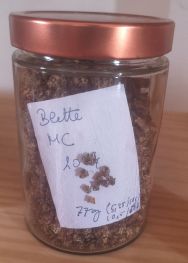
Jar of self-produced chard seed. On the label, Karim notes the seed quantity and sometimes the fruit condition when harvested. Seeds are then cleaned again in a sieve, which takes about ten minutes. They are then placed in a coffee filter, drained and hung in a well-ventilated place for a day to dry. When well dried, they can be stored in a jar or a bag with a label.
Then, seeds are placed in the freezer for one week to break dormancy. They must be completely dry, otherwise the embryo risks freezing and the seed will no longer be fertile.
Tomato seeds can be stored in jars for easily 4 years.
Note: He notes that some tomatoes, like beefsteak, produce few fruits (2 kg this year). Moreover, he also observed that in some fruits, not all seeds are necessarily mature.
Processing and valorization of tomato pulp
To valorize the pulp extracted during the seed filtering process.
For tomato sauce, 30 kg of fruit can produce about 40 half-liter jars (20 liters of sauce). The pulp is cooked with herbs, then put in sterilized jars.
Jars are filled using a funnel to avoid contamination on the edges.
Advice and improvement (seed collection and tomato pulp recovery):
Do not work alone in the process, as it can be long and tedious.
Be very careful that the seeds are well dried before putting them in the freezer, to avoid sterilizing them.
He currently stores his seeds in a metal cupboard, which is not ideal. Karim advises keeping them in a wooden cupboard, in the shade, cool, in a room where the temperature remains stable, to avoid large temperature fluctuations. He was also advised to use a refrigerator. There are possibilities to rent refrigerated storage space from companies specialized in seed conservation.
Seed recovery on other varieties
Karim also produces pepper seeds, notably the Sweet Dreamvariety, well adapted to the local climate. Extraction is simpler: open the fruit, rub the seeds to detach them, then sort them by flotation in a bowl similarly to tomatoes and dry them.