
Jardin de l'Espoir Farm
Market gardening farm with minimal soil tillage
Ousmane Sambu
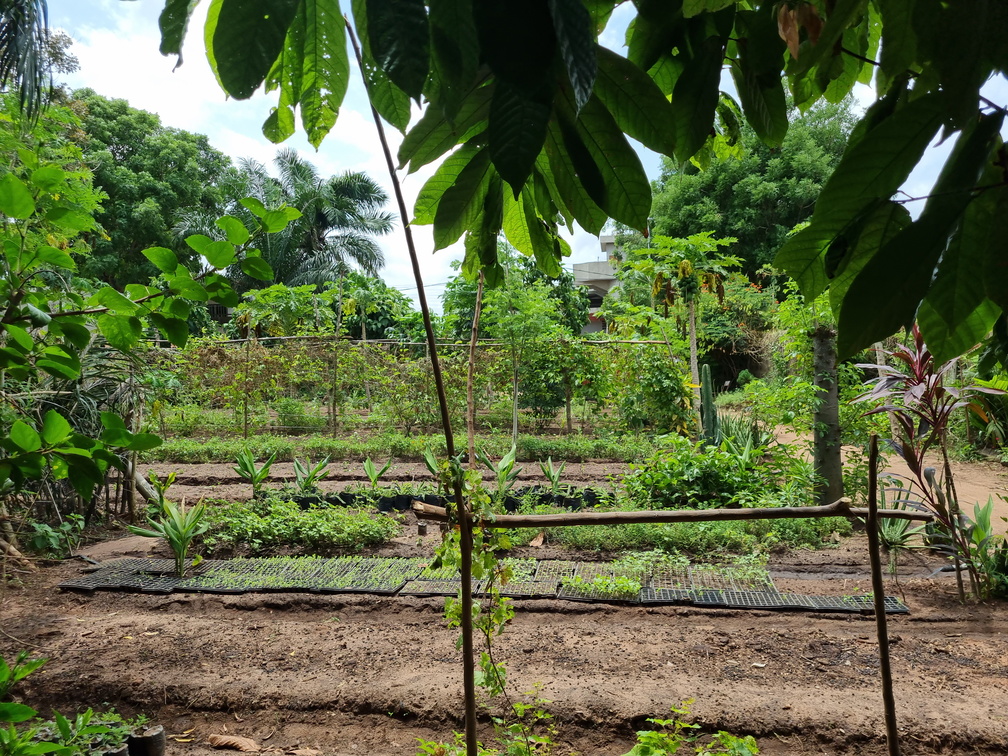
Ousmane Sambu, a farmer in Abomey-Calavi, Benin, cultivates his land and raises his animals according to agroecology principles. Here is a portrait of his farm.
Context
The farm
- Farmer's name : Ousmane Sambu
- Farm name : Garden of Hope
- Location : Abomey-Calavi, Benin
- Establishment date : 2014
- Cultivated area: 1.3 ha. The cultivated area is 3000 square meters. The newly acquired plot is one hectare.
- Soil texture : Sandy loam. Sandy-clay at depth.
- Number of people working on the farm (FTE) : 3: Ousmane and two of his Nigerien brothers. Beninese interns are also present and trained on site, some later settling on their own.
- Climate : Calavi has a humid equatorial climate, with alternating rainy and dry seasons. According to the Köppen classification, it is a tropical savanna climate (Aw), influenced by the monsoon. The average annual temperature is 26.5°C and average precipitation is 1342 mm.
- Studies/training/life path : Ousmane learned gardening in Benin with a Nigerien brother Suleymane, who returned from France. Suleymane trained him in agroecology, direct sales, and general farm management. Since Suleymane left, Ousmane continues to train himself by seeking information online, practicing, and visiting other places in Benin and West Africa to learn interesting techniques that he then adapts on his farm. He considers himself to have a "green thumb."
Motivations and objectives
- Interest in agroecology : Ousmane practices agroecology and believes it is easier and more profitable than conventional agriculture. He sees agroecology as a source of more stable income. He emphasizes patience, the "green thumb," and love of work as key elements for success in agroecology.
- Goal / future projects : Ousmane wants to increase his production. The current site being limited, he has acquired an additional one-hectare plot in town to increase production and supply baskets to more clients in Calavi and Cotonou.
Information about the farm:
Agronomic aspect
Plant productions:
- Market and food crops : Ousmane produces a wide variety of vegetables: leafy vegetables, fruit vegetables, and root vegetables. He notably cites local basil (chayot), venonia (Amavive), large morel (Goma), amaranth (fauteuil), lettuce, cabbage, beetroot, carrot, radish, vanilla, eggplant, okra, and green bean. He also grows aromatic plants (basil, thyme, rosemary, fennel, dill) and medicinal plants such as Artemisia (Artemisia annua and Artemisia afra). Corn is also mentioned among the crops.
- Fruit trees : The farm includes papayas, pomegranates, noni, and passion fruits. Moringa is also present and consumed.
Agricultural practices
Fertility management
Ousmane makes his own compost. He uses droppings, cow dung, wood ashes, dead leaves, and charcoal powder. The compost is left to decompose for three months and is turned after one and a half months to avoid heat that can kill earthworms and harm plants. The compost is very rich and allows successive harvests over several months, even more than a year, without constant new input. About 4 to 5 bags of compost are applied per 24-meter-long bed (or 1 bag per 4-5 meters) each year. Ousmane also sells part of his compost to neighbors or colleagues.
Pest management
- Main pests : Mites are a major problem for tomatoes and peppers, making them difficult to grow. Nematodes are present but Ousmane manages them with his techniques.
- Natural treatments : Ousmane uses treatments based on Neem oil, Neem leaves, and papaya leaves. He has also tried solutions based on chili and ashes. The concentration of these treatments is crucial, as too high a concentration can burn plants, and too low is ineffective.
- Preventive strategies : He practices crop association, planting aromatic herbs such as Artemisia, basil, onion, and leek with vegetables. The strong smell of these plants repels insects and allows to "dip" them.
- Losses : Tomatoes and peppers are the most difficult crops to manage, partly due to mites and potentially the irrigation system which makes them too wet.
Soil work
The work on the crop beds is done with a hoe mainly for weeding when planting. The beds are always covered and there are perennial crops, so work is minimal once crops are established and mainly consists of manual weeding.
Strategies to face constraints
To cope with high heat, palm branches are used as shade, especially for young plants in the nursery. For pests, he relies on natural treatments and crop association. For seeds, he participates in seed exchange fairs (e.g., in Senegal) and keeps his own good seeds, reducing dependence on purchases.
Water system
The farm uses an electric submersible pump. It is connected directly to the national grid with a card meter. The electricity cost for irrigation is about 20,000 CFA francs per month in the dry season and 10,000 CFA francs per month in the rainy season, about 100,000 CFA francs per year. The watering system uses perforated pipes or drip tapes that water by sprinkling, which can make some crops like tomatoes too wet. During the dry season, water needs are higher, increasing electricity costs.
Social aspect
Satisfactions/dissatisfactions
- Workload : Not specified, but managing three people and interns, as well as daily sales, suggests intense activity.
- Economic : Ousmane is satisfied with his income. He considers his agroecological model more stable and beneficial than conventional, despite annual fluctuations linked to production. He earns about 800,000 CFA francs per person per year
- Social : Ousmane works with his brothers and trains Beninese interns, helping them later settle on their own sites. He shares his knowledge and offers advice (local products, pest control with natural methods) to neighboring farmers for free.
Environment
The farm focuses on agroecology. It uses natural methods for soil fertility (compost) and pest management. Crop diversity is a key strategy. Ousmane recognizes climate change challenges, such as increased heat.
Technical support/Aids
Ousmane receives seed samples from organizations like Seeds Without Borders. He participates in seed exchange fairs with other countries. He has never resorted to bank loans or microfinance.
Cooperation with other farmers
He exchanges seeds at international fairs (e.g., in Senegal). He advises and helps neighboring farmers, especially for nurseries and natural treatments. He also offers paid training so interns take learning seriously.
Economic aspect
Land tenure
Ousmane rents the land. The rental cost is about 300,000 to 350,000 CFA francs per year.
Equipment
- Submersible pump: 85,000 CFA francs.
- Wood for stakes/trellising: about 90,000 CFA francs per year (3% of income).
- Ropes for climbing plants.
- Seedling trays (for nurseries): Sometimes bought in batches of 20 to 50. Price: 850 to 1500 CFA francs per tray.
- Donations, financial aid: No direct donations or financial aid mentioned, but seed exchanges with organizations and other farmers.
Expenses (estimated annual)
- Materials for compost (cow dung, droppings, wood ashes, charcoal powder): Included in overall "soil nourishment" expense.
- Electricity (mainly for irrigation): about 100,000 CFA francs.
- Wood and stakes : about 90,000 CFA francs.
- Ropes.
- Seedling trays : Variable costs, purchased occasionally (e.g., 30 trays at 1500 CFA francs = 45,000 CFA francs for a year if bought).
- Fuel for transport (motorbike deliveries): about 5 liters per week (variable, as deliveries are not daily).
- Delivery fees (when sending someone).
- Land rental : 300,000 - 350,000 CFA francs.
- Total estimated expenses around 600,000 CFA francs per year.
Income (Annual turnover):
The farm's total income is estimated between 3 and 4 million CFA francs per year.
- Artemisia (medicinal plants): 50% to 60% of income.
- Fruits (papaya, pomegranate, noni, passion fruit): about 15%.
- Leafy vegetables and root vegetables : about 35% (the rest).
Commercial strategy / Markets
Sales are mainly by order. Ousmane assembles varied baskets (containing vegetables, fruits, aromatic plants) depending on availability. He also sells directly to neighbors who come to the farm. Sales at a local market (Fidji Rossé) have been paused. He sells his products daily. Compost is also sold in 50 kg bags at 4000 CFA francs per bag. Passion fruit is sold by the kilo, its price having doubled from 2500 to 5000 CFA francs per kilo due to strong demand and low local production. He also produces passion fruit juice, estimating production at about 1000 bottles per year.
Farmer's advice
Ousmane's advice for those interested in agroecology is to remember three essential things: patience, the "green thumb" (things take when planted), and love for what you do. He insists that agroecology is not complicated if you have these qualities.
Photo gallery
Sources
Interview with Ousmane Sambu conducted in 2025.
