Introduction to Technical Routes in Market Gardening

Technical itineraries (ITK) are the recipe to follow describing all the steps for a successful crop. To simplify, there are 6 main types of technical itineraries :
- Small seeds
- Large seeds
- Bulbils
- Tubers
- Plants
- Leeks
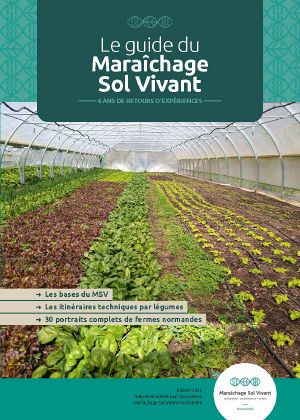
In the 2022 LSV Guide, several feedbacks from farms belonging to the network of the association MSV Normandie have been collected. This guide tries to give a synthetic vision of what is done in the field, but it should not be forgotten that variations are numerous! Trials must be conducted to find the technical itinerary that suits us best : testing different materials, different thicknesses,... These trials can take place on the same vegetable bed, leaving a few meters between the modalities. Playing with parameters allows knowing which ones really play a role in achieving objectives of weed reduction, irrigation, work... while increasing yields. In living soil, it is not uncommon for large-sized vegetables to grow on the beds. However, these are unsellable. To avoid this problem, one must bet on density which allows to regulate the size of the vegetables : a denser bed will not allow vegetables to grow to large proportions, and vice versa.
Design and cost of the technical itinerary
Identify limiting factors
To properly design an ITK, limiting factors must be identified : is it a lack of light, water or nutrients affecting the weak plant? What will the vegetable lack in the current configuration? In LSV, it is often observed that water can be lacking during the early stages of the crop or to activate mineralization.
Providing enough light, water and nutrients also means being careful to limit competition between weeds and vegetables since the latter are less powerful than weeds in seeking water and nutrients. Thus, a minimum of 6 weeks delay between the growth of the vegetable and that of potential weeds should be aimed for. Clearly, from the middle of the vegetable’s life, the plot can start to weed without damage to the crop. Before that, weeds greatly impact yield. An elegant way to counter this competition in case of weeding is to overfeed the bed to feed both the vegetable and the grass generating porosity and nutrients for the next vegetables. Buffer fertilizers, poultry manure will then be applied along with good monitoring of the plot’s humidity.
However, be careful to anticipate the destruction of spontaneous weeds for the next crop (mulching one month before planting then planting in the mulch, if perennials, or direct planting, if no perennials).
Warning
The technical itineraries described on this page very often use organic matter brought from outside. We
recommend these practices because they are the easiest to implement to start. However, it is clear that for soil life,
the ideal is to practice rotation on grassland (self-sufficient in organic matter) or systematic use of cover crops. Rotation on grassland can only be considered if one has access to double the cultivated vegetable area. On the other hand, cover crops require technical mastery for assured establishment and destruction.
Choice of crops
A good way to decide between two possible vegetable variants is to determine the production cost of these two itineraries. For this, a spreadsheet giving average costs for each vegetable is offered. You can download it here.
If the reference data do not suit, it is possible to modify them as desired in the orange cells. In the “itinerary comparison” worksheet, one can select a vegetable for which a comparison is desired between the previously modified itinerary and a variant.
Using this file, it may become obvious that operational costs are generally very low on small surfaces, per vegetable. The cost of organic matter inputs slightly modifies the profitability of ITKs. Likewise, working much more on one vegetable only slightly impacts profitability. However, working more on one vegetable adds time to an already generally overloaded week.
Below is an example of modeling comparing a squash planting itinerary on mulch with direct seeding. The modeling clearly highlights what constitutes the turnover of a market gardener. The various charts below allow visualizing the most profitable crops, the possible margins on each vegetable as well as the hourly income of a vegetable, that is, the gross margin made in 1 hour. Obviously, these are models that must be taken with all necessary precautions. It is very important in technical itineraries not to lose too many vegetables in the field, to succeed in selling all the production so that these data translate into real income.
Itinerary comparison by vegetable
| Vegetables | Squash | Alternative
itinerary |
|---|---|---|
| Technical itinerary
description |
LSV squash on
woven mulch |
Squash direct
seeding |
| Establishment | Woven mulch
1 plant/m² |
Direct seeding |
| Area (m²) | ||
| Indicative produced
quantity |
||
| Yield (kg or
units/m²) |
||
| Loss in field, storage and
sale |
40.00 % | 50.00 % |
| Indicative direct sale price
(€/kg incl. tax) |
2.5 | 2.5 |
| Total turnover excl. tax (€) | 3,412 | 2,844 |
| Turnover excl. tax (€/m²) | 4.3 | 3.6 |
| Soil work / mulching
occultation (h) |
||
| Preparation / mulching (h) | ||
| Establishment (h) | ||
| Monitoring / Irrigation (h) | ||
| Harvest (h) | ||
| Total working time (h) | ||
| Working time (h/m²) | 0.15 | 0.13 |
| Labor cost
(€/m²) |
2.90 € | 2.55 € |
| Labor cost (€) | 2,320 € | 2,040 € |
| Organic matter (€) | 80.00 € | |
| Seeds / plants (€) | 120.00 € | |
| Operational costs
(€) |
200 € | 160 € |
| Operational costs
(€/m²) |
0.25 € | 0.20 € |
| Turnover | 3,412 € | 2,844 € |
| Gross margin (€) | 3,212 € | 2,684 € |
| Gross margin (€/m²) | ||
| Total costs | 2,520 € | 2,200 € |
| Total margin including
labor cost (€) |
||
| Margin including labor
cost (€/m²) |
1.1 € | 0.8 € |
| Hourly income (without
marketing!) |
27.7 € | 26.3 € |


As part of the "GIEE 2024 - 2026 on modeling production costs of LSV technical itineraries" led by the MSV Normandie association, new versions of these tools are being improved, you can access them here.
Technical itineraries
- Démarrer en maraîchage sol vivant
- Le cycle de la fertilité des sols
- Les vers de terre dans l'écosystème sol
- Diagnostic de son sol
- Stratégie de gestion de la fertilité
- Réaliser son bilan humique
- Gérer l'enherbement en maraîchage sol vivant
- Gestion des maladies et des ravageurs en maraîchage
- Conditionnement et conservation des légumes
- Commercialisation et transformation en maraîchage
- Produire ses propres semences
- L’installation en MSV
- Conversion en MSV
- Jardin amateur
- Verger maraîcher
- Avoir un atelier poules pondeuses
- Introduction aux itinéraires techniques
- Conseils de maraîchers sol vivant