
Occultation

Occultation is a weed control method that consists of eliminating dormant seeds stored in the soil, and seedlings by heat and light deprivation. Weed seeds placed in moist conditions and under the influence of solar radiation (temperature increase) germinate then perish in the absence of light. It is performed before planting.
Although the use of plastic may not seem ecological, it is a temporary method that can help clean the soil of dormant seeds and then, after a few years, allow to do without it.
Prerequisites
- When: The effectiveness of occultation varies according to the seasons. It is maximal on plantings from April to August, more limited from January to March (choosing a thermal film is crucial in this period). The highest soil temperatures occur when days are long, temperatures are high, the sky is clear, and wind is low. The soil warming effect is not as strong on cloudy days. Wind disperses trapped heat and can detach or damage the sheets. Occultation is also possible in October to maintain the setup throughout winter. However, this configuration should be reserved for soils less prone to compaction. It may also favor voles.
- Advantages:
- Non-chemical
- After several years, if the weed seed bank in the soil is well reduced, it can be dispensed with.
- Disadvantages:
- Long method, minimum 4 weeks.
- Limited effectiveness on perennial plants: treatment periods must be extended.
Equipment: which plastic to use?
Several options are possible but factors to consider are opacity, permeability, and thermal effect.
Black polyethylene
Ease of installation:
- Easy mechanization (mulch layer unroller).
- Strong wind catch (during laying).
- Delicate removal (fragile).
Permeability:
- None, so little risk of surface drying.
- Keeps soil moist.
Effectiveness on weed growth:
- Good (if planting conditions are optimal).
- The thermal effect of polyethylene optimizes weed germination.
- No occultation of inter-bed paths in mechanical laying.
Lifespan:
- Difficult or impossible to reuse. It may tear when removed or be biodegradable, lasting 2 months in summer and 6 in winter, then can be buried and decomposed by microorganisms.
- Cost: 1 m on 1000 m for €180.

Woven fabric
Ease of installation:
- Light but prefer heavier ones (130 g/m²).
- Medium wind catch.
- Possible mechanization.
- Various widths available.
- Suitable for uneven soils (basins).
Permeability:
- Good to medium (varies with quality and age).
- Tends to dry the soil surface but re-wetting possible by irrigation and rain.
Effectiveness on weed growth:
- Good (if planting conditions are optimal and moisture is maintained in the top few cm of soil).
- Lower if thickness is low and/or fabric is old.
- Surface soil drying.
- Slightly thermal.
Lifespan:
- Reusable for 5 to 10 years (multiple uses per year possible). This fabric becomes less opaque to light due to solar radiation and weathering.
- Cost: 100 m roll by 1 m costs about €60.

Green or black silage tarp
Ease of installation:
- Good wind resistance.
- Custom cutting possible. Available in large widths.
- Heavy.
- Manual laying only. Manual laying and removal are more demanding as tarp size increases. Limit widths to 3 beds or 4 m max and handle with two people to optimize laying/removal time (wind catch, unrolling...).
- Ensure soil is very flat to avoid water pooling causing tarp tears during removal.
Permeability:
- None, little risk of re-wetting and surface drying.
- Keeps soil moist.
- Risk of compaction in heavy soil and after fine tillage.
Effectiveness on weed growth:
- Good (if planting conditions are optimal).
- The thermal effect of the tarp optimizes weed germination.
Lifespan:
- Cost: 6 m by 50 m about €150.
Process

- Soil preparation: soil preparation is equivalent to a false seedbed.
- Avoid deep loosening by plowing or rototilling, favor tools with tines (cultivator, ridge cultivator, actisol) that maintain seed positioning in the soil profile. The goal is to keep the maximum germinating seed on the surface.
- A very smooth soil (roll the soil), with few clods and litter on the surface, will allow the tarp to rest firmly on the soil, producing fewer air pockets, reducing tear risk from wind and heat dissipation. Do not prepare too finely when soil is clay or silt as it will compact. High moisture and long occultation duration worsen this.
- If the tarp is applied on a prepared seedbed, it allows later planting with minimal soil disturbance, minimizing chances of bringing buried weed seeds that survived treatment to the surface. Preparing a seedbed can also improve soil water retention.
- Moisten the soil to obtain better results. Irrigate so moisture under the tarp is sufficient and constant to allow weeds to germinate under optimal conditions. Moist seeds are more sensitive to thermal destruction than dry seeds, and moisture can stimulate germination. Water also increases conductance, allowing heat to be transported deeper in the soil profile to reach more deeply buried seeds. Raised bed or ridge preparation is generally preferred to promote drainage in case of excess water. Also consider that this configuration will be that of the following crop to minimize soil reworking between occultation and planting.
- Apply the plastic: the closer the plastic is to the soil surface, the better the heating. It must be well stretched and pressed to the soil (a short spray after laying improves adhesion). To prevent weed growth, avoid any air passage under the plastic or soil hollows. Laying can be done only on planting strips, but applying over the whole field can make the tarp even more effective by reducing heat loss at edges. This avoids leaving bare soil where weeds can survive.
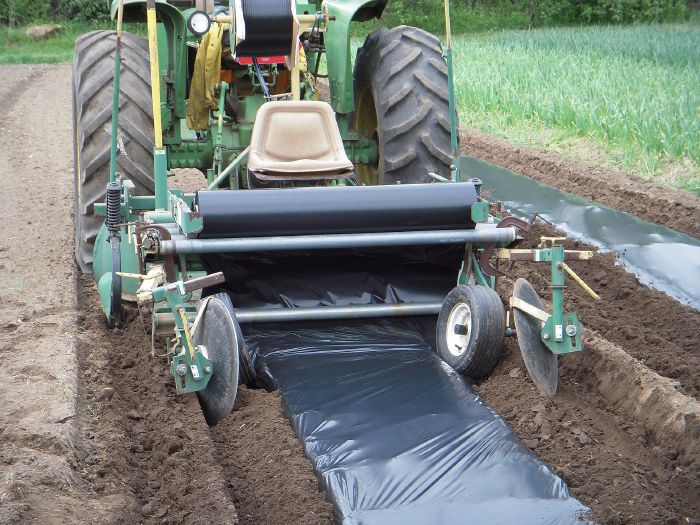
- Mechanical laying – Straw layerer, unroller:
- Fast
- Good wind resistance (buried in soil).
- Laying is delicate if film is fragile.
- Weighting with soil shovelfuls:
- No specific equipment but physically demanding.
- Medium wind resistance.
- Metal staples:
- Fast.
- Good wind resistance (1 staple every ~4 m).
- Difficult if soil is rocky.
- Removal sometimes difficult (rust).
- Pierces the film.
- Edging is still necessary if field is windy.
- Silo bags, tunnel bars:
- Good wind resistance (1 bag every 5/6 m approx.).
- Fast for re-laying.
- Heavy to handle (laying and removal).
- Cost.
- Mechanical laying – Straw layerer, unroller:
- Option: to treat small areas in cooler climates, it may be useful to use a double layer of plastic with an air gap created by objects such as plastic bottles or PVC pipes between layers. This method has been shown to increase soil temperature by 1 to 5°C more than temperatures obtained with a single layer of transparent plastic.
- Duration of cover application: varies according to installation date:
- January to March: 8 weeks (planting: early March to early May).
- April to mid-May: 6 then 5 weeks (planting: mid-May to mid-June).
- Mid-May to mid-September: 4 weeks (planting: mid-June to mid-October).
- September to year-end: long occultation aiming for early sowing (March-April next year), especially in soils difficult to work after winter.
- For early periods, this implies being able to work the soil and prepare a seedbed at late winter.
- Ensure to keep the top 10 cm of soil sufficiently moist, necessary for weed germination.
- Planting: Minimize soil disturbance after removing the plastic to avoid bringing new weed seeds to the surface. Planting can occur immediately after tarp removal or require drying time depending on context. Ideally, direct seeding or planting without soil reworking. If conditions are unfavorable, necessary soil work due to surface compaction must be very shallow (3 to 5 cm, never beyond 10 cm) to limit risk of bringing weed seeds up. This can be done with a crust breaker or a harrow for example.
- If the plastic is removed before planting, it can be reused. Otherwise, if left on soil, planting can be done by making holes in it. This prevents weed emergence.

Comparison with solarization
Solarization uses a transparent tarp, it is more effective in a hot and sunny climate, occultation uses a black tarp, it is more effective in regions colder or with more shade and wind.
- Temperature: higher with solarization. During solarization, light waves penetrate the transparent plastic and directly heat the soil beneath. Heat is then trapped under the plastic by a greenhouse effect. With a black tarp, solar energy is absorbed by the plastic, part of the heat is transferred to the soil and part lost to surrounding air. Applying a double layer of transparent plastic, or transparent over black, can further increase temperatures and effectiveness.
- Light-dependent germination: the black tarp could block germination of some seeds. Light is an important signal for germination of many species, and for photosynthesis of plants.
Possible combinations
Occultation can be combined with solarization in conditions requiring optimization of the weed control technical itinerary. This may be the case in preparation for an early sowing of carrot or for establishing a leek nursery. Then a summer solarization (early August – late September) followed by occultation to keep the plot clean until planting after winter. If the plot is available the summer before occultation, it may be interesting to plant a frost-sensitive summer cover crop, such as buckwheat (Fagopyrum esculentum), which can develop quickly and secrete, through its roots, toxins limiting weed development. However, care must be taken that this cover crop does not go to seed, generating new weed flora the following year.
Effectiveness and impact
Effectiveness against weeds
- Occultation weed control is effective against most annual weeds, reducing their seed banks. The practice induces weed seed germination and seedling destruction by absence of light. Experiments have shown a clear effect on weed growth for several months after occultation.
- It is less effective against perennials which can survive and regrow once the tarp is removed. Generally, the longer the occultation duration, the more effective it is on perennials.
Impact on fauna
Certain fungi species may be favored by the microclimate created by the plastic film (e.g. Rhizoctonia). Plastic films can form a shelter favoring rodents such as voles.
Economic impact
- There is a labor saving (weed pulling), treatment or mechanization cost (mechanical weed control) reduction.
- Initial investment ranges from €0.08 to €1.10/m² [1] depending on thickness and plastic type used. This investment can be amortized over several years if plastic is reusable.
- Support for the recycling sector set up by Adivalor is also important. It is financed by two means (source CPA): an eco-contribution at source of €240/t new plastic (2020) for mulch films, and collection fees of €145/t used agricultural film (UAF) for mulches when contamination rate exceeds 50% (2020). A bonus is also possible and returned for UAF with contamination below this rate: €95/t for clear plastics, €50/t for colored plastics (2020).
Sources
- Alternative weed control in market gardening, Chamber of Agriculture of Ain, 2016.
- Weed management by occultation in vegetable production, GIS PICLég, 2021.
- Solarization and Tarping for Weed Management on Organic Vegetable Farms in the Northeast USA, National Organic Program, 2018.
