Hamid Majjaoui Farm
Farm with market garden orchard and cereal in CA
Hamid Majjaoui
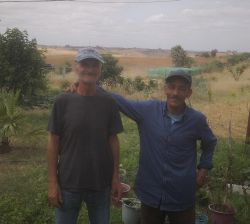
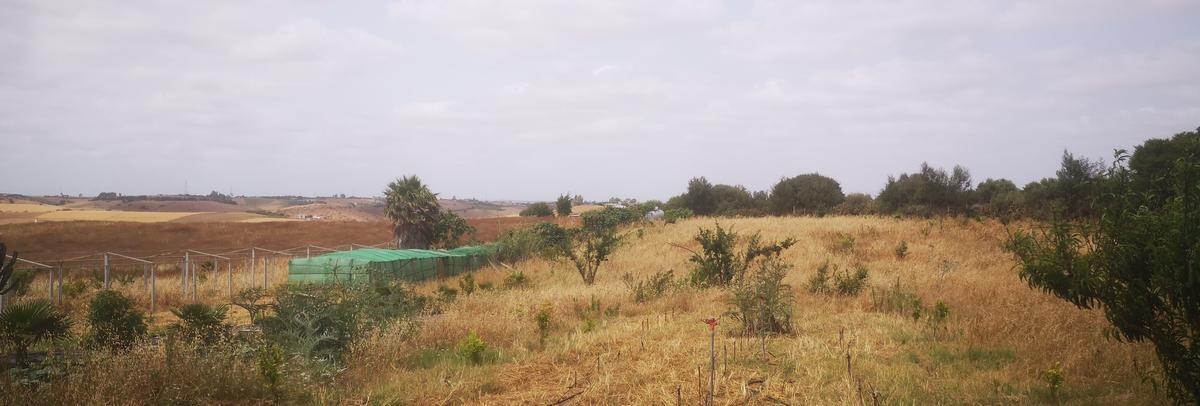
Hamid Majjaoui, a farmer in Shoule, Morocco, cultivates his land according to agroecology principles. Here is the portrait of his farm.
Context
The farm:
- Farmer's name: Hamid Majjaoui
- Farm name: Maamoura Farm
- Location: Salé, Shoule, Morocco
- Date of installation: 2014
- Cultivated area: 6.25 ha.
- Soil texture: Clay-Limestone
- Number of people working on the farm (FTE): 2.
- Climate: According to the Köppen-Geiger climate classification, Rabat has a Mediterranean climate with hot summers (Csa). Temperatures generally range between 13 °C and 24 °C throughout the year, with extremes rarely dropping to 5 °C or rising to 39 °C. Average annual precipitation is about 383 mm, spread over 52 rainy days per year.
Workforce
- He works with:
- 1 permanent worker. About this worker: “I am happy to have staff I trained; now it is much easier for field actions and the instructions I give him.”
- Up to 6 daily laborers during peak production.
- A student who helps him on Sundays and during holidays.
Marketing
- He practices direct selling with a stand in Casablanca run by his wife and basket sales. On average 12 baskets/week.
Crop production
The crop rotation is:
- 1.25 hectares of olive trees.
- 1 hectare of market garden orchard, notably with nectarine and peach trees. In market gardening, the main crops are potato, tomato, lettuce, cabbage, pepper, beetroot, as well as bean intercropped with maize.
- 4 hectares of barley, with an indicative yield of 70 quintals per hectare, compared to 15 quintals per hectare on average in the region.
Animal production
Currently, he has only one ewe, having stopped cow milk production as it was not profitable. He is currently considering resuming livestock to be self-sufficient in manure.
Education, training and life path
Hamid Majjaoui followed training in permaculture and no-till farming. In 2002, he acquired a 6.25-hectare plot left fallow. It was only in 2014, after returning to Morocco, that he began to cultivate it with no-till seeding. His goal: to verify for himself if it was really possible to cultivate without tilling the soil as he had seen in YouTube videos.
Motivation and objective
- For him, this project of working with living soil was a challenge, but now, it is time to think about passing it on. He plans to return to Canada for health reasons. He is therefore preparing an educational video on the technique of sunken culture beds so that these experiences are not lost.
- He would like to form a working group with a student to monitor, reference practices, and do calculations he no longer has time to do himself. He says: “When you start selling, you no longer have time for these things.”
- He emphasizes the importance of soil cover: “The soil must always be covered.”
Agronomic aspect
Agricultural practice
- No-till seeding for cereals, no plowing.
- Crop association, maize bean.
- Optimization of irrigation in the market garden orchard thanks to localized irrigation on vegetable beds, which also benefits the root system of fruit trees planted on the edges.
- Valorization of pruning waste for composting and mulching. Self-production of ramial chipped wood (RCW) for mulching.
Weed management
- Hamid Majjaoui uses plastic sheets left for several months to reduce weeds in market gardening.
- His shrub areas are maintained by chop and drop, mowing grasses returned to the soil.
- Weeding is manual, without chemicals.
- He developed a specific technique for cover management for maize and bean seeding.
- Finally, for grasslands with brambles and woody plants, he designed a homemade brush-cutter-mower, used occasionally (detailed in section 4 of the agronomic aspect at the end of the article).
Practices of interest
1. Establishment of a crop association in a weed cover
Objective of the practice
Hamid was looking for a method to regulate weed pressure while maintaining a vegetation cover on the soil. His goal was to establish crops directly in this cover, without resorting to mechanized soil work or manual weeding.
Implementation

Hamid Majjaoui uses a sickle held blade towards the ground, which he pulls towards himself while stepping backward to align the herbaceous stems of the weed cover. The grasses caught on the blade are then collected at the end of the bed and spread on the soil as mulch.
Next, he uses a board with a rope to press the grass to the ground. He steps on it to compress the vegetation, then lifts the board with the rope to advance.
- Estimated time: 1 day for a 30 × 8 m bed → 50% of the time to align fibers, → 50% to press the straw.
Monitoring and establishment of the maize + bean crop association in the cover
- Seeding takes 10 minutes on a 30 × 8 m bed.
- Seed: 2 kg maize, 1 kg bean (local varieties).

Irrigation
- He uses sprinklers to irrigate his crops on beds.
- He added sprinklers with a 1 m rod to exceed the vegetation cover at early growth (notably cereals and maize).
- On the 30 m long × 8 m wide system: he starts with 3 steps, places a sprinkler with a radius of , then 7 steps, and so on until 4 sprinklers per bed.
Equipment cost
- Large model sprinkler, including metal rod: 75 dirhams.
- Hose: 1.2 dirhams/meter.
Result and observation
- Maize height: up to 3 m, with three roots visible on the stem = indicator of good rooting. The ears produce grains sometimes as large as fava beans. Beans also develop and use maize stalks to climb.
- He notes that this method is very physical, especially when pressing the grass with the board.
- Remark: a trial with a water-filled barrel to flatten the straw proved impractical due to the slope of the plot (pulling the barrel uphill was very hard).
2. System of fertilizing culture beds with organic matter input in pits
Objective
He was looking for a new way to prepare easy-to-cultivate beds in market gardening because he faced a strong presence of unwanted weeds (weed seed bank). His goal was to design beds capable of storing water well while reducing weed pressure. To do this, Hamid thought of digging pits into which he would add compost and green waste.

Steps to implement the pit system
He digs 40 pits for deep fertilization:
- Dimensions per pit: 10 m² (10 meters long × 1 meter wide)
- Depth: 60 cm
Composition of each pit (from deepest to most superficial layer):
- 40 cm of dry trunks
- Dry chipped wood to fill gaps
- 20 cm of freshly cut green wood
- Another layer of chipped green waste (to fill gaps)
- 10 cm of garden soil
- 4 cm of compost
- Soil watered and compacted at each layer.
By layers (cost and labor time):
- Tree trunks: Wood cut on the farm → minimum 1 day of work → 4 m3 of cut trunks.
- Dry chipped wood: (produced on the farm) Spreading → 30 minutes → 2 wheelbarrows of dry chipped wood per bed. Must be walked on to compact well → 10 minutes if done properly.
- Green wood: (produced on the farm) 1 wheelbarrow of green chipped wood needed per bed → 30 minutes.
- Green chipped wood: (produced on the farm) Must be walked on to compact well, can take 10 minutes if done properly.
- Cinder blocks: → Positioning the blocks takes on average half a day of work. → Cost: Beds are surrounded by cinder blocks costing 3 dirhams each; here there are 56 blocks, so 56 × 3 dirhams = 168 dirhams per bed (price valid 2 years ago).
- Forest soil: The soil used in the beds is forest soil bought at 90 dirhams per truckload. → It takes half a day for a worker to put it in a bin.
- Compost: (produced on the farm) To put the compost on top, 4 cm above the soil → 30 minutes → about 2 full wheelbarrows.

Total estimated time: One pit per day with four people, including manual digging and adding the different materials into the pit. This time does not include upstream preparation work needed to have materials ready: green and dry chipped wood, cut tree trunks, etc.
Irrigation management in market garden pits
- Watering frequency (especially for beetroot):
- From germination: daily (from day 4).
- Then: twice a week → once a week at maturity.
- Watering sessions last 10 minutes.
- Irrigation in orchards starts once a week, and he also uses compost in irrigation.
- The positioned sprinklers are micro sprinklers, costing on average 1 dirham including the metal rod with the sprinkler; for irrigation hose it is 1.2 dirhams per meter.
Result
Better crop performance on these beds:
- Beetroots: 64 plants/m² (vs 15/m² in conventional).
- Well-formed bulbs, healthy foliage.
- Harvest grouped (vs staggered harvest in conventional systems).
Observation & comment
- To show porosity Hamid inserts a 50 to 60 cm metal rod into the soil and it goes in easily.
- Labor difficulties: During pit installation, most staff were untrained; Hamid had to supervise to ensure work was done properly according to living soil rules.
- Advice if done again: Hamid estimates losing about 25% of time due to poor site organization at the start. For him, it is essential to have all materials ready before laborers arrive, to give clear instructions and avoid time loss.
3. Production of chipped wood for compost or mulching
Objective
- Reduce dependence on straw and external inputs by developing autonomy in organic matter directly on the farm.
- This approach aims to limit costs, especially in a drought context where straw becomes rare and expensive.
Pruning management before chipping
- He uses all plant prunings to make compost or mulch. He prunes twice a year (estimated about 30 m3 per pruning).
- In case of urgent need (e.g. after weeding), he can chip directly to obtain mulch. Otherwise, the delay between storage and chipping generally does not exceed 3 to 4 months.

Self-built chipper
- He does not have a professional chipper: he built one himself with a welder's help:
- Manufacturing cost: 6,500 dirhams including 1,000 dirhams for welder labor including screws, bolts, etc. He provided the metal to the welder.
- 220 volts motor, plugged into mains.
- Took 4 to 5 days of work with the welder, especially to calibrate the chipper blades.
Remark:
- He uses fresh chips on areas without planned seeding or with non-sensitive plants (e.g. trees, resistant plants), but not for market garden crops like zucchinis.
- The welder later sold 10 units with the same plans, indicating the mechanism met a need for several farmers in the area.
Several composting methods
In all methods, compost watering rhythm is based on a simple observation: just look 20 cm deep into the compost.
- If it is still warm, decomposition is active → no need to water.
- If cold, water to restart decomposition.
Watering lasts about 10 minutes.
Remark: Generally, this means watering once a week, but frequency may vary with season (outside temperature and air humidity have significant influence).
Classic method
- Compost is turned 3 to 4 times over 9 months. It is composed of green waste, rotten vegetables and weeds from the farm.
- After 9 months, compost is ready to use. However, if too rich, it can cause root burns. In this case, he dilutes it with soil from his land, for example for repotting.
- If he can leave it decomposed longer, he does. He notes that the older the compost, the better it is.

Bin organization
- 6 compost bins, each 1 m³.
- Each bin can be turned with a fork in about 1 hour.
- Compost is also used directly in the field, on all crops.
- He stores crop waste, seed-bearing weeds, etc.
Method with chipped wood
- He chips wood as previously described; chips can be from reeds, Acacia mollissima (soft tree rich in tannins), mulberry, bamboo. Wood is more stable, producing compost usable as substrate or organic amendment to improve structure.
- He composts chips in piles, not bins. He can compost chips alone or mixed with soil (half soil / half chipped wood). This takes about 9 months.
- To help decompose chip piles, he adds water and some vegetable waste to accelerate decomposition.
Berkeley method
- Berkeley method tested: 20 days compost instead of 9 months, provided the pile is turned every two days; it is fast but requires close monitoring. To do this, he piles compost and covers it with a plastic sheet to limit evaporation.
Compost production method for seedling substrate
- Compost containing straw can be used, up to half the mix. After 6 months, if straw was incorporated, the pile contains fewer fine particles, less suitable for seedling substrate. → For the pile shown in the photo, about one 45 L bucket of sieved compost is obtained (estimated volume 0.6 m³).

Pile of chipped wood in composting phase. - To obtain larger quantities of seedling substrate, it is better to use a pile composed only of composted chipped wood.

Sieving can be done in two ways: with a small manual sieve (about 10 dirhams) → sieving time: 30 minutes. With a large mesh sieve, more expensive but more efficient → sieving time: 10 minutes. Compost is shoveled onto the mesh surface. Fine particles fall through, residue is collected behind the grid.
Remark:
- For seedling substrate, a fine mesh sieve must be used to obtain a homogeneous substrate.
- Priority is given to sieving compost from chipped wood, as it provides fine material well suited for seeding.
- To date, the ideal formula has not yet been found according to Hamid.

4. Homemade brush-cutter
- Works like a mower, integrates hammers like in a mower for straw.
- Effective in grasslands with some woody material (bramble, small wood, small palm).
- Manufacturing time with a welder: 1 week.
- Runs on gasoline, but he uses it little since he adopted the cover management technique with sickle and board.
- Does not work well on rocky terrain.
- Price = 40,000 dirhams because prototype and motor had to be purchased.
Remark: He stresses: be careful with safety (risk of projection in front of the mower).
Farm photo gallery
Sources
Interview of Hamid Majjaoui conducted in 2025.

Cette page a été rédigée dans le cadre du projet Urbane avec le soutien financier de l'Union Européenne, avec la participation du Centre National d'Agroécologie et de Ver de Terre Production