
Fighting resistant weeds with Benjamin Perriot from Arvalis
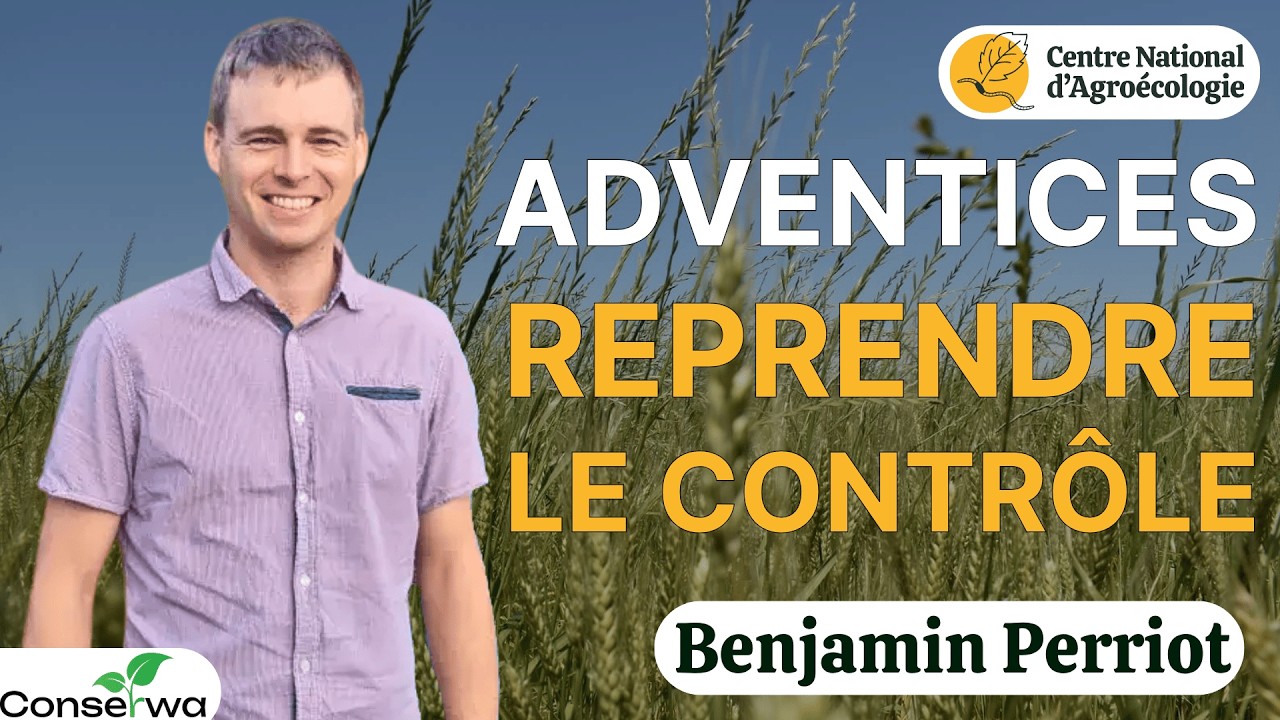
Benjamin Perriot is a specialist in spraying techniques and head of the Weed Flora unit at Arvalis.
He leads the research topic and the team in a context of changing practices within the technical institute.
Introduction
In this video, Jasmin, from the agronomy team of the CNA, visits Benjamin Perriot of Arvalis, a specialist in weed flora management. The discussion focuses on alternative and partial methods of weed management, in particular problematic grass weeds such as ryegrass and black-grass, in a context of increasing resistance to herbicides.
Several levers are discussed: crop canopy architecture, sowing date, seeding rate, tillage, spring crops, mechanical weeding, but also the future of active substances and the limits of simplistic explanations about fertilisation or mineral deficiencies.
Canopy architecture as an agronomic lever
Benjamin Perriot explains that this subject is already being studied at Arvalis. The idea is to assess whether crop architecture, for example a spreading or an upright habit in wheat, can have an effect on weed infestation in the field.
According to him, the effect exists, but it remains limited: we are talking about a few percent of efficacy. So it is not a lever to bet everything on. It must be used in combination with other levers, because relying on it alone would be dangerous.
On maize, the work is only just beginning. Some seed companies have recently started developing varieties with a slightly more spreading habit. Arvalis therefore has few references so far, with only a few years of hindsight.
On small-grain cereals, there is more history, particularly in organic farming. In that context, organic varieties with a very spreading habit have shown an ability to limit weed development. However, the effect varies depending on the weed species concerned.
In conventional farming, with the varieties traditionally used, the results are harder to demonstrate. That is why Arvalis is working on this subject again by including a new lever: hybrid varieties. Some have a more spreading habit than conventional varieties, which could be of interest for managing grass weeds.
Hybrids: leads on barley, wheat and maize
The discussion returns to hybrids, particularly after observations considered interesting on hybrid barley, where the effect of the more covering habit seems to work quite well.
Jasmin asks whether a similar effect can be expected in other species, such as hybrid wheats or some hybrid maize. Benjamin Perriot replies that this is precisely what is being studied in current projects, with work mainly under way on wheat and maize.
He stresses, however, that this research is only in its early stages, with few results available so far.
Seeding rate: a false good lever for managing weeds
The subject of seeding rate is then discussed. The question is whether it is a real lever, for example by greatly increasing the wheat seeding rate to compete better with weeds, or simply an illusion.
Benjamin Perriot is quite clear: the seeding rate is not a priority lever for managing weed flora. It is mainly linked to row spacing and to the search for an optimal plant population for production. Whenever row spacing is changed, the seeding rate is often adjusted too, but not with the main aim of managing weeds.
According to him, not much can be expected from this lever on its own. Greatly increasing seeding rates, for example sowing wheat at 600 seeds/m² to manage ryegrass, appears more risky than effective. It can lead to other problems, such as increased risks of disease, lodging or excessive use of mineral resources.
He points out that seeding rate tables were built on agronomic criteria and soil and climate contexts. Before departing significantly from them, it is better to favour other levers considered much more effective.
Sowing date: a strong lever
Among the agronomic levers available, Benjamin Perriot highlights delaying the sowing date. Reasonably delaying wheat sowing, for example by one to two weeks compared with the usual date, can greatly limit grass weed infestations.
This lever is one of the so-called prophylactic approaches. It is particularly interesting when combined with other adjustments, for example in row spacing, the variety chosen or tillage.
The general idea defended in the interview is that one should not look for a miracle lever, but think in terms of integrated management.
Tillage and occasional ploughing
Tillage is presented as an interesting lever. Benjamin Perriot specifies that even occasional ploughing can sometimes allow fairly drastic management of the weed flora.
Here again, it is not a universal tool, but a lever to be used depending on the context. Some farmers may prefer to occasionally reintroduce tillage if, for example, spring crops are not possible in their soil and climate context.
An integrated, combinatorial management approach
One of the central messages of the interview is that current weed management relies on a combination of levers. Benjamin Perriot insists that people often tend to want to identify a "super effective" lever, whereas in reality it is above all combinations that produce the best results.
This is the logic behind the projects mentioned in the discussion, in particular Gramip, Gramixible and the Parsada work as described in the discussion. The aim is to work on both prophylactic and combinatorial aspects.
This integrated management also includes chemical solutions. Benjamin Perriot specifies that Arvalis does not work with the aim of eliminating chemistry entirely, but with the aim of using all means of control.
Emergence dynamics of ryegrass and black-grass
The interview then turns to a concern from the field: the feeling that grass weeds such as ryegrass or black-grass are emerging later and later, or even almost all year round.
Benjamin Perriot indicates that Arvalis has been reworking the emergence dynamics of these species for two years. Although the work is not completely finished, the first findings show that most emergence still takes place in autumn.
He acknowledges that ryegrass also emerges in spring, sometimes spread over part of the spring, but this does not call into question the value of spring crops as a lever.
Spring crops remain relevant
In rotations dominated by winter crops, introducing a spring crop remains, according to Benjamin Perriot, a lever that is still worthwhile today to "break" the rotation.
Even though grass weeds can also emerge in spring, the fact that most emergence remains autumnal still gives these crops agronomic value. It is, however, a compromise: some farmers will accept an economic risk to improve weed management, while others will favour other levers more compatible with their context.
Benjamin Perriot points out that the right choices depend largely on the soil and climate context and on how the farm is organised. There is therefore no universal recipe.
Crop sequence: a question still poorly documented
Jasmin then raises a more specific question: if one maize crop already reduces part of the weed infestation, what happens with two or three successive maize crops? Can a cumulative cleaning effect on potential emergence be expected?
Benjamin Perriot acknowledges that, from an agronomic point of view, many people think about this idea, but it has not really been verified in the field. This subject relates to the influence of the crop sequence within a rotation.
He explains that people often think "rotation" in the broad sense, without always taking into account the precise order of crops. Yet this sequence could be very important. It is a field of work that is starting to be looked at, but for which there are not yet enough references to take a firm position.
Mechanical weeding in maize: useful, but weather-dependent
The case of maize is also discussed from the angle of mechanical weeding. With the loss of some active substances such as S-metolachlor, pre-emergence programmes are sometimes less effective than before, leaving more grass weeds to manage.
In this context, hoeing appears to be an interesting lever. But Jasmin asks whether this mechanical pass might also trigger new emergence.
Benjamin Perriot replies that this is a real question, and even a general question for mechanical weeding. Unlike a chemical application, which acts instantly, a mechanical pass can be beneficial or harmful depending on the weather conditions that follow.
He gives the example of cereals in autumn: in some cases, mechanical weeding is very helpful; in others, it can on the contrary multiply grass weed emergence. The same problem is found in maize.
The key point is drying out after the operation. If conditions are wet after the pass, it can sometimes do more harm than good. Benjamin Perriot hopes that current work on "available days" for intervention will provide better answers to these questions.
The future of active substances
The interview then turns to the future of active substances. In the field, many people wonder when new products will arrive and whether new chemical solutions can still be expected.
Benjamin Perriot first replies that Arvalis works on all types of farming and all means of control. The aim is not to switch to a "100 % alternative to chemistry" approach. Chemistry is still part of the toolbox.
But he also notes that chemical solutions are becoming scarcer. In this context, it is essential to develop reliable alternatives if we want to keep producing tomorrow.
On the arrival of new molecules, he is cautious. He nevertheless mentions the potential arrival of two new molecules in small-grain cereals, as autumn root-acting products. But he immediately stresses the risk: if these molecules are used massively and too quickly, they can very soon be compromised by resistance.
That is why they too will have to be integrated into an overall approach, with other agronomic and prophylactic levers.
Nitrogen and weeds: beware of simplistic explanations
The discussion then addresses the idea that ryegrass and black-grass are nitrophilous plants, and therefore that nitrogen management could influence their presence.
Benjamin Perriot acknowledges that these species can be described as nitrophilous, but believes it would be simplistic to explain their development mainly by nitrogen. According to him, they have above all been favoured by a succession of practices and by the appearance of resistance.
He also points out that in conventional farming, nitrogen inputs are already regulated and aim at a certain level of production. Adjusting nitrogen even further with the specific aim of managing weeds does not seem to him to be a credible option.
He takes the example of organic farming, where less ryegrass is often observed. But this cannot be attributed only to the fact that there is less nitrogen: rotations, disease pressure and the whole system also change.
For him, the weed infestation of a field reflects first and foremost the cropping system in place, much more than the nitrogen rate applied.
Weed infestation reflects the history of the field
Benjamin Perriot strongly insists on this point: weed infestation is first linked to the history of the field. A field has a seed bank that has built up over time. This bank grows with each successive poor weed management.
There can also be new introductions, particularly via harvests and machinery. That is why current projects attach importance to cleaning implements and combine harvesters, identified as major vectors of dispersal.
But despite these introductions, the main factor remains the history of the field. Successive cropping practices can then favour some species more than others.
Annual decline rates of seeds in the soil
Jasmin also asks Benjamin Perriot about the charts of the annual decline rate (TAD) of weed seeds in the soil. Are these data reliable, outdated, or regularly updated?
Benjamin Perriot replies that these figures are broadly known, but that what matters most for weed management is not so much the exact percentage as the ranking of species. What counts is knowing which species decline quickly in the soil and which are able to remain there for several years.
The precise values can naturally vary depending on soil and climate contexts. He specifies that the decline rates are not really "updated" as such, but that current projects aim to improve knowledge of germination and emergence dynamics, particularly for ryegrass and black-grass.
The Parade project is cited as also due to contribute, through specific trials and controlled conditions, to improving knowledge of emergence dynamics and of species phenotypes depending on soil and climate contexts.
Weeds as bioindicators: an idea of limited use today
Another subject discussed: the "rumours in the countryside" that the presence of black-grass or ryegrass indicates a deficiency in calcium, magnesium or potash.
Benjamin Perriot remains very cautious about this idea. He points out that people sometimes talk about bioindicator plants and that, historically, some species have indeed been associated with certain soil states or certain chemical conditions.
But according to him, in arable farming today, the presence of a particular weed can no longer really be used to diagnose the state of the soil. Farming practices have blurred these historical links.
He cites the example of black-grass, long associated with very waterlogged soils. This observation is sometimes still true, but the species is now also found on soils that are not waterlogged. The same goes for ryegrass. The presence of these weeds today therefore reflects much more the history of practices than the intrinsic characteristics of the soil.
Glyphosate: efficacy, water hardness and adjuvants
At the end of the discussion, the conversation turns to glyphosate, with reports from the field of loss of efficacy, sometimes compensated by dose increases up to very high levels.
Benjamin Perriot indicates that current projects, in particular the AZAP project with various partners including Inrae, aim to update knowledge on the presence of resistant plants according to modes of action, including glyphosate.
He specifies that when resistance is becoming established in the field, there is generally not much more to be done. But he also points out that glyphosate is a molecule that must be properly optimised, and which has probably been taken too much for granted.
Water hardness
The first major point is sensitivity to water hardness, that is, to the presence of calcium and magnesium. If the water is hard or calcareous, it must be treated, in practice with adjuvants based on ammonium sulphate.
The sulphate traps calcium and magnesium ions and prevents them from binding with glyphosate.
Water volume
Second point: the water volume must be limited. Arvalis recommends a maximum of 100 L/ha for a glyphosate application. The more the water volume increases, the more calcium and magnesium are added, and the stronger the hardness effect on the molecule.
Benjamin Perriot also points out that glyphosate responds to a concentration effect: the more concentrated it is in the spray mix, and therefore the lower the water volume, the faster and the more it penetrates the plant.
Adjuvants
On adjuvants, he indicates that oils do not improve glyphosate efficacy. On the other hand, some wetting agents can improve efficacy on weeds or plants that are difficult to destroy.
Water pH: a lever not recommended
Finally, the question of the pH of the spray mix is raised. Should the water be acidified to improve efficacy?
Benjamin Perriot's answer is clear: no. Arvalis absolutely does not advise changing the pH of the water.
On the one hand, with glyphosate, no worthwhile improvement has been observed through acidification or alkalinisation. On the other hand, handling large quantities of acids can be dangerous for the operator, especially at the scale of a sprayer tank of several thousand litres.
Finally, some molecules can be sensitive to a drop in pH and degrade very quickly in water. Benjamin Perriot points out that when a molecule is sensitive to a certain pH, manufacturers already add co-formulants to the can to buffer the spray mix.
For all these reasons, Arvalis recommends not changing the pH of the water, but only working on hardness, and only in the case of glyphosate, which is particularly sensitive to the presence of calcium and magnesium.
Key points
The interview with Benjamin Perriot highlights several strong ideas:
- there is no single miracle lever against resistant weeds;
- the most promising levers lie in combination: sowing date, canopy architecture, tillage, spring crops, mechanical weeding, management of the rotation and crop sequence;
- chemistry remains a tool, but active substances are becoming scarcer, which requires strengthening agronomic approaches;
- the weed infestation of a field reflects first and foremost its history and the cropping system;
- many simplistic explanations, whether about nitrogen, mineral deficiencies or certain "bioindicator" readings, cannot on their own explain the infestations observed;
- even for molecules still in use such as glyphosate, optimising application conditions remains essential.
The whole discussion is therefore part of a vision of integrated weed management, where the challenge is no longer to look for a single solution, but to build robust strategies adapted to each context.
