
Fascine

A fascine is a constructed device, composed of bundles of branches held between two rows of stakes. It is a linear soft hydraulic structure placed perpendicular to the slope and allowing to reduce erosion of soils.[1]
Fascines constitute a permeable obstacle that slows water and retains soil. Their role is to reduce the solid load of runoff in erosive environments by trapping suspended materials (sand, silt, etc.). They also contribute to the slowing down of runoff at the scale of the plot or a small watershed over several tens of meters downstream by decreasing the water velocity.
They can be easily installed and have many advantages.
Different types of fascines

Fascines are mainly composed of bundles of wood (and in rare cases, straw) and can be of 2 types :
- Living : Built with living branches capable of rooting which “transform” over time into a hedge that strengthens and perpetuates the action of the structure. At installation, it is the branches that are effective in slowing runoff. Then the branches age and lose their effectiveness. The trees, which have then sufficiently developed, take over regarding runoff. They also promote water infiltration.
- Dead : Built with dead wood, their lifespan depends on the rate of wood degradation and will be on the order of a few years (about 4 years).
Building a fascine
It is advisable to contact a chamber of agriculture or a watershed association before starting the construction of a fascine. Indeed, the size, number, and positioning of fascines will depend on the intensity of erosion and will be decided case by case depending on the farms.

Where to place a fascine?
Fascines should be positioned on the path of concentrated flows, at the head of the watershed or downstream of erodible plots. To slow flows at the heads of watersheds, fascines must be perpendicular to the slope and thus to the axis of the gullies :
- On boundaries or between plots.
- Within a single plot.
- At the foot of slopes with gentler gradients (2 to 5%) but affected by issues of intense rain on bare soil (e.g., sowing of corn or beets) or with a very runoff-prone land use type (e.g., potatoes), and especially if the plots are cultivated along the slope.
- In a plot corner to retain soil and slow water (axes of concentrated flows)[2].
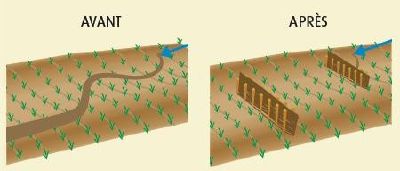
Before and after the installation of a fascine

Beware of planting distances. As a reminder, the civil code imposes minimum planting distances for trees from property boundaries. The minimum distance is thus 50 cm if the tree is less than 2 m tall, or 2 m if the tree is taller than 2 m. These distances also apply to living fascines which are assimilated to hedges.
Required resources
- Willow stakes 10 to 15 cm in diameter, 1.5 m high and anchored 50 cm deep.
- Bundles of branches (willow, beech, hazel) with a maximum diameter of 3 cm and 2 to 3 m long, about 25-30 cm in diameter for the bundles, tightly packed to allow them to stop very fine particles.
- For a living fascine, fine willow rods, a species that roots well[3].
Construction
- Dig a trench about 30 cm deep and 30 to 50 cm wide.
- Install two rows of stakes on either side of the trench (staggered or opposite).
- Make two bundles of wood branches with a diameter of 3 to 4 cm and a maximum length of 3 m. The bundles must be as dense as possible and held together with biodegradable twine.
- Place the first bundle in the trench and the second on top of the first. The total height of the two bundles should reach about 60 cm.
- For a living fascine, stick the fine willow rods every 15 cm approximately between the stakes. To ensure their rooting, they must be driven about 50 cm deep.
- Firmly pack all the bundles and install battens or iron wires attached to the stakes on top to hold everything together.
- Make a soil joint at the base of the fascine to ensure good contact and good sealing.
For a living fascine, stakes must be chosen from a species capable of rooting (willow, hazel, elder…). Caution in vineyards for willow and hazel species : risk of flavescence dorée under study. Bundles can be made from the same species or with a different, non-rooting species, or with a mixture of several species. Prefer the use of locally available species.[4]
Follow the same advice for creating a dead fascine, but use non-rooting dead wood instead.
Success of fascine installation
Key factors
The key factors for the effectiveness of fascines are :
- The density of the bundle to create a flow barrier. The stem density must be greater than 40% and preferably more than 50%.
- The length of the fascine to prevent runoff bypass.
- A minimum width of 30 cm is however necessary to ensure proper action.
Evaluation of fascine effectiveness
- Fascines create an immediate operational barrier effective in reducing flow velocities.
- The solid load reduction rate can reach up to 99% for aggregates and coarse particles.
- The infiltration capacities of fascines are around 170 mm/h but remain very variable. For recent fascines, average infiltration at their base is very low, and biological activity remains limited in depth. The benefit of combinations such as hedge + fascine, or hedge + fascine + grass strip is demonstrated to ensure durability of action, and to combine positive effects on infiltration and sedimentation of different particle sizes. The effectiveness of fascines is also very low or even null on clay particles.
- In erosive regions, the concept "a hedge doubled by a fascine on the water path " is recommended.
- A regular maintenance is also essential to preserve this filtering role of the fascine in the long term.
Maintaining a fascine
- Prune the branches from cuttings every year.
- Reuse the pruning wood to replenish the fascine bundles. If the pruning yield is insufficient, external wood supplies can be considered.
- Replant some pruned branches, to densify the network of cuttings. If some stakes have not taken or are dead, replace them in the same way.
- If necessary, spread the accumulation of soil that will gradually occur upstream of the fascine within the plot. However, if the soil accumulation becomes too large and reaches the height of the fascine, the arrangement should be reconsidered and possibly supplemented with other erosion-limiting measures (keyline design, swales, hedges, etc.).
A dead fascine must also be regularly replenished with bundles of dead wood, as soon as its height begins to decrease significantly. Likewise, stakes must be replaced when they are too degraded.
Cost and interest
Cost
The installation cost is generally estimated at less than €100 including tax per linear meter for labor, materials, and equipment (in 2022). This cost can be even lower in the case of self-construction or use of materials harvested at home or in nature.
Fascines are not recognized as Ecological Focus Areas (EFA) under the Common Agricultural Policy (CAP). Their creation can however be supported like other Agro-Ecological Infrastructures (AEI) within the framework of Territorial Contracts (CT) Water. Contact the organization managing the CT Water in your area.
Advantages and disadvantages
| Advantages | Disadvantages |
|---|---|
| Soil protection - limits erosion and slows runoff | Regular maintenance (sediment removal) |
| Biodiversity if coupled with a hedge - habitat for shelter, feeding, and reproduction | May cause obstruction during agricultural machinery passage |
| Often located on plot edges | On a large watershed, partial solution but insufficient |
| Ease of assembly and low cost |
Sources
- ↑ Olivier Ancelin, 2012 : La fascine : quelques règles d’implantation pour garantir son efficacité https://www.action-agricole-picarde.com/la-fascine-quelques-regles-dimplantation-pour-garantir-son-efficacite
- ↑ CA Hauts de France, 2013 : Guide against erosion https://hautsdefrance.chambres-agriculture.fr/fileadmin/user_upload/National/FAL_commun/publications/Hauts-de-France/guide_erosion_2013_02.pdf
- ↑ CA Pays de la Loire, 2021 : La fascine https://pays-de-la-loire.chambres-agriculture.fr/fileadmin/user_upload/Pays_de_la_Loire/022_Inst-Pays-de-la-loire/RUBR-Agro-ecologie/IAE_BAO_La_fascine.pdf
- ↑ CA Marne, 2018 : Les fascines https://marne.chambre-agriculture.fr/fileadmin/user_upload/National/FAL_commun/publications/Grand-Est/51-Fiche-hydraulique-douce-fascine.pdf
