Conversion to MSV

Redesigning one's market gardening system is a bigger challenge than starting directly with MSV at installation because it requires deconstructing part of what was previously done to switch to new practices.
For an established market gardener
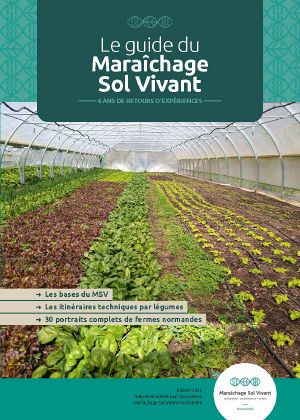
The first areas easily convertible to living soil are greenhouses. Indeed, wanting to manage weed cover and create porosity in dead soil can justify soil tillage in open field. But in tunnels, weed management is facilitated by drip irrigation which limits the growth of weeds. Likewise, porosity is not degraded by the water shocks caused by the outside weather. It is precisely these water shocks that compact the soil “naturally” first.
A smoothed rainfall thus results in limited weed cover and preserves the porosity of the soils.
Starting under greenhouse in MSV therefore consists of stopping or limiting soil tillage operations. A massive input or a gentle revival should be considered to properly feed the soil and thus feed the plants. In case of weed cover, priority will be given to implementing cultivation on plastic mulch.
Outside, it is recommended to transition by starting with small areas. Start with what is simple : crops on grassland or on grass-covered soil with the addition of organic matter (OM). It is possible to plan the transition and massive OM inputs (if necessary) by dividing the land into distinct zones.
For vegetable growers
Vegetable growers by definition cultivate several hectares of a few vegetables (which distinguishes them from market gardeners who have a range including notably early vegetables).
Some vegetables are easier to grow than others on a large scale without soil tillage. Starting with onions, squashes, cabbages, lettuces or melon is easier than carrot or leek. A vegetable grower will benefit from lengthening their rotations with some vegetables within a cereal rotation. A rotation based on cereals and oilseeds conducted in conservation agriculture (thus including many cover crop intercrops) can accommodate one or more market gardening crops.
Vegetables requiring soil tillage can even be considered (every 3 to 7 years) where the loss of biological activity and organic matter is compensated by the good practices of the rest of the rotation.
It is important to reason with the humus balance while taking care to exit the very degraded soil zone. At the start, one can begin with strongly positive humus balances and then, perhaps, reach a regime with balanced balances. The cover crops that are very successful and possibly inputs of wood/chips/green waste are the keys to starting these systems.
An experimental culture must imperatively be set up by vegetable growers who want to be pioneers in deploying these new practices. The action-research methodology for No-till under Cover Crops (NTCC) systems defined by Lucien Séguy and published by Olivier Husson et al. can be a serious basis to start : Co-designing innovative cropping systems that match biophysical and socio-economic diversity: The DATE approach to Conservation Agriculture in Madagascar, Lao PDR and Cambodia, O. Husson et al., Cambridge University Press, 2015.
For greenhouse growers
Greenhouse growers who are often equipped with soilless production systems can consider cultivating their production in culture trays where the inert substrate is replaced by a mixture of compost / shredded green waste / nitrogenous materials which will provide a large part of the nutrition for vegetable plants. A multiplication of epigeic worms (Eisenia fetida) should be considered to accelerate good biological activity in the culture trays.
Deployments over several hectares of high-tech tomato greenhouses are underway at various production sites in France. These practices will bring major changes for the long supply chains of vegetables grown under greenhouses. Detailed studies are to be expected to document the technical, economic, environmental, and nutritional results of these new production systems.
To watch on Youtube
- Potatoes and permanent covers - Nicolas Hallegouet
- Adaptation of ribouleau NG+3 seeder to No-till - Jacky Berland
- 600 tons of tomatoes per hectare in living soil - François Mulet
- Démarrer en maraîchage sol vivant
- Le cycle de la fertilité des sols
- Les vers de terre dans l'écosystème sol
- Diagnostic de son sol
- Stratégie de gestion de la fertilité
- Réaliser son bilan humique
- Gérer l'enherbement en maraîchage sol vivant
- Gestion des maladies et des ravageurs en maraîchage
- Conditionnement et conservation des légumes
- Commercialisation et transformation en maraîchage
- Produire ses propres semences
- L’installation en MSV
- Conversion en MSV
- Jardin amateur
- Verger maraîcher
- Avoir un atelier poules pondeuses
- Introduction aux itinéraires techniques
- Conseils de maraîchers sol vivant