Choosing Your No-Till Seeder with Tines or Discs

In no-till farming, the choice of seeder is crucial as it is part of the cropping system. It depends on the soil type, crop rotation, sowing dates, type of crops… In no-till, two options are available: tines or discs.
Description
No-till farming is more demanding on equipment because it is used on a surface without soil tillage before sowing. The seeder has three main components:
- Opening element: This is an optional element but ensures the opening of the furrow. However, it can cause some constraints: soil disturbance, weed emergence, and poor management of cover crops or surface residues.
- Seeding element: It ensures the placement of the seed according to several factors: depth, row spacing, distribution along the row, and whether or not inputs are added.
- Closing element: It ensures the soil/seed contact and closes the furrow.
Opening element
The furrow preparation can be done by a disc or a tine.
Discs
The opening disc, more common even on a tine seeder, promotes the creation of fine soil which facilitates seed emergence and allows a good contact with the soil. For better efficiency (penetration, working with residues), the opening disc can have a slight angle. There are several types of opening discs (different shapes):
- Smooth discs: Linear cutting effect, ideal for sowing under cover crops.
- Notched discs: They improve the adhesion of the disc and thus its rolling capacity. They are suitable for sowing on straw (which comes out better from the furrow), on dry residues, and on stony soils.
- Wavy, corrugated discs: They enter the soil vertically and exit horizontally. This produces fine soil that is deposited on the sowing line. However, under wet conditions, they cause more damage than a normal disc (increased smoothing).
-
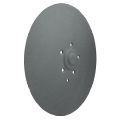 Smooth disc (Source: Agripartner)
 -
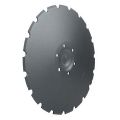 Notched opening disc (Source: Agripartner)
 -
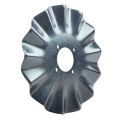 Wavy, corrugated disc (Source: Agripartner)


Tines
Tines allow to create the furrow and close it:
- Pointed tines: Pointed tines use a single point to open furrows in the soil. They are generally used in light to medium soils and offer easy penetration and good control of sowing depth.
- Winged tines: Called inverted T tines, these tines have wings or blade-shaped extensions that open and close the furrows in the shape of an inverted T. Winged tines provide good furrow closure and are suitable for light and medium soils. Compared to a simple fine vertical point, the wings of the T tine create a less constricted furrow, allowing better water and air circulation, with a firm base favorable to capillary rise which corresponds precisely to the seed placement zone.
-
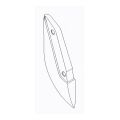 Pointed tine
 -
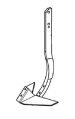 Winged tine


The material of the tine determines its durability and wear resistance. Forged boron steel is known for its abrasion resistance and longevity. Carbide-tipped tines are even more wear resistant.
Seeding elements
Discs
Discs have the advantage of adapting to different cropping techniques, from plowing to no-till, being able to work on significant vegetative covers (not flattened) and to perform quality sowing on uneven seedbeds. There are 4 options for disc seeders:
- Single disc: It consists of a disc to open the furrow and a coulter (point or small blade), positioned on the side of the disc, to guide the seed to the bottom of the furrow. It is often accompanied by a press wheel at the front and a closing wheel at the rear.
- Double discs: The second disc is smaller in diameter or offset, which widens the furrow to allow seed passage. It requires reducing speed and demands less power. In this system, the two important elements are the disc diameter and the opening angle between the two discs. The diameter influences the rolling capacity (increased with larger discs) and the soil projection (reduced with increasing diameter). The opening angle creates a worked zone (fine soil) wide enough (30 to 60 mm) on the sowing line. The larger the opening angle, the greater the pressing effort required and the harder it is to maintain in the soil (the soil penetration surface is larger).
- Triple discs: A first disc, often corrugated, opens the soil, creating fine soil on the sowing line, a pair of discs places the seed in the furrow, and a press wheel controls sowing depth and firms the soil around the seed.
- Inclined discs: Distinguished by their ability to penetrate the soil (the angle causes a beveled cut of the soil, so the furrow closes naturally by gravity, without excessive force), they can adapt to different soil conditions (even clayey soil), ensure good sowing depth, no rebound effect, more ease in developed covers (helps avoid clogging). However, the inclination can cause faster wear, uneven seed placement, smoothing under certain weather conditions.
Advantages
- Can operate in stony terrain (they push stones down).
- Ease in developed covers (no clogging).
- Little soil mixing (causes less weed emergence, less drying out).
- Consistent work (allows better emergence).
Disadvantages
- Higher purchase price (more complex elements: bearings, pressing system, bushings, discs...) and require more maintenance.
- Row sowing: Concentration on the row thus competition in the inter-row.
- Residues: Risk of incorporating residues at the bottom of the furrow (straw), causing poor germination. Inclined discs are a good alternative to counter this problem.
- Soil conditions: More demanding, in high moisture risk of smoothing and in dry soil, risk of rebound (prefer inclined discs).
- Lower mineralization (less air injection into the soil).
- Speed: The faster you want to work with discs, the greater the pressing forces required and the heavier the machine must be.
- Can cause compaction along the sowing line.
- Difficulty closing the furrow.
- Weeds: When the disc passes, soil is thrown out on each side. This is fine soil rich in organic matter which, placed on the inter-row, benefits weeds rather than the crop, hence the addition of closing elements.
Tines
Cheaper, less complex, and lighter. Tines are suitable for well-leveled soils and straw residues. They have good capacity to push aside obstacles (suitable for stony soils or soils with residues, straw, ideal after harvest), preferred for their pedoclimatic versatility but their depth control lacks regularity.
The tine can be combined with other tools for more precision:
- Vibrating tines: Seeder tines mounted on springs or “pig tails” create a vibrating effect, which reduces smoothing, fractures the soil and allows the formation of a seedbed. However, they do not guarantee regular sowing depth, so they should be avoided for small seed sowing and can cause more mixing.
- Independent coulters allow different depths for seeds and fertilizer.
- To limit depth: Two cage wheels per tine or a small wheel.
- A coulter: It promotes good soil tracking and regular sowing depth because it moves little soil and has very low draft.
Tine thickness: The thinner the tine, the less specific it is to a soil type, and the less traction power is needed (because the soil is less disturbed).
Advantages
- Versatility regarding pedoclimatic conditions.
- More suitable for chopped residues, as they incorporate less straw into the furrow and increase mineralization by soil mixing.
- Inter-row width more easily adjustable.
- Better soil/seed contact (good vigor after winter), but rolling is sometimes necessary.
- Simplicity: self-construction is possible.
- Lower price than discs.
Disadvantages
- Under cover crops: Risk of raking and clogging of cover crops (especially with woody, climbing species), if residues are too abundant or if the inter-row is too narrow.
- Weeds: Soil disturbance by tearing which can cause higher weed emergence.
- Higher power required in dry conditions (depends on tine shape, not weight).
- Effect on soil: Drying + stones rising to surface.
- Depth: Variable if soil is not uniform.
Combination of discs and tines
The main advantage is that this method provides greater sowing precision. However, the required traction is higher because resistance occurs when residues get between the discs and the tine.
Closing elements
The need to close the furrow is correlated with sowing speed. The higher the speed, the more soil is ejected and the less soil is available to close the furrow. Usually, these are wheels. The wheel ensures the pressing (filling) and anti-rebound function. It can be single or double, smooth, notched, beveled, made of steel or rubber. The soil pressure promotes soil/seed contact and capillary rise. In clay soils, a smooth wheel is avoided as it tends to form a crust that cracks quickly in dry weather (reopening the furrow). Notched or toothed wheels produce fine soil and close the furrow more easily.
- Straight cast iron wheel: Rolls on the sowing line to close the furrow.
- Beveled cast iron wheel: Rolls on the sowing line. It is disadvantageous on poorly drained soils as it can create depressions under the furrow where water accumulates.
- Finger wheel: Penetrates the sides of the furrow which breaks the furrow wall and produces fine soil. However, it does not press the seed and may tend to fluff soil out of the furrow.
- Rubber press wheels: Firm the soil.
- Wide wheel with a notched disc: Its width allows good pressing of the seed and breaking the furrow walls. The notched disc loosens fine soil on the furrow. With some moisture, the wheel can stick to the seed and pull it out of the furrow.
- Pneumatic roller: To compact and promote capillary rise.
- Horizontal finger rollers: They close the furrow by pressure (break the wall) and shearing (produce fine soil). They press the seed well and work in wet conditions but can jam in presence of stones. Straight finger wheels do not have this seed pressing ability and tend to push soil out of the furrow.
- Low-angle disc (9° instead of 13° for most): For sandy soils, no seed pressing in the furrow.
- Star or straight notched discs: They work the furrow, penetrate well into the soil and generate fine soil. However, the disc does not bring soil back onto the furrow, not suitable for wet conditions (can clog with soil in clay soils) and does not press the seed in the furrow.
- Concave discs coupled with press wheels: Work each side of the furrow, bring fine soil onto the furrow and fragment the furrow wall.
- Blade: “The gardener’s finger” (for example made of Teflon) to promote soil/seed contact.
-
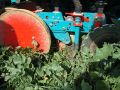 Press wheel (source: Supagro)
 -
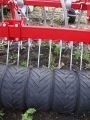 Pneumatic roller (source: Supagro)
 -
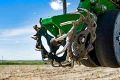 Horizontal finger rollers (source: APAD)
 -
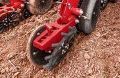 Straight finger wheel (source: APAD)
 -
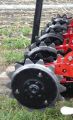 Star discs (source: Supagro)
 -
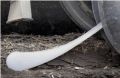 Blade (source: FDCUMA du Tarn)


Behind the discs or the wheel, if the soil is not sufficiently closed:
- A chain or harrows to bring fine soil back onto the sown row and ensure good closure. More used on bare soil, with more soil to cover the furrow.
- A harrow (puts straw back on the surface) which will finish leveling the soil. It can also be placed in front of the roller. More used on bare soil, with more soil to cover the furrow.
-
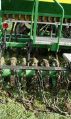 Chain on seeder (source: Supagro)
 -
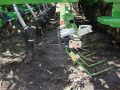


Properly adjusting the closing system
- Closing wheel inclination: Changing the closing wheel's angle modifies its impact on the soil, the amount of soil it loosens and the compaction it generates.
- Pressure: Too high pressure can cause smoothing or compaction of the sowing line.
- Two wheels: Combining two wheels can improve furrow closure and better bring soil onto the sowing line but beware of clogging risks. They can be mounted in parallel or offset. Slightly offsetting the axis of the first wheel relative to the second can reduce clogging risk and improve self-cleaning of the wheels.
- Alignment: If there is a single wheel, its advance can be aligned with the seeder or at a slight angle to move sideways ("crab walk"). This generally improves the folding of fine soil onto the furrow.
Regulating pressure and depth
Disc seeders have a higher capacity to avoid obstacles, consequently, they need more pressure to maintain depth.
- The press wheel or gauge wheel is a tool mounted on seeders, cultivators, and stubble cultivators, which regulates working depth, ensures stability, distributes pressure on the soil, and reduces traction effort needed. They can be made of iron or rubber (not suitable for wet bare soil as rubber sticks to soil). Also on disc seeders, they can equip tine seeders. Pressure ensures good seeder penetration but can cause smoothing effects (in winter pressure should be lower, lifted gauge wheels reduce pressure). The press wheel can be beside the disc (acts on depth) or behind the disc (acts on depth and pressure); the closer it is to the disc, the more precise the depth control. Pressing should increase with seeder speed. For large size machines like seeders, it is recommended to use dual wheels for better stability and pressure distribution.
- Single wheels: Consist of a single tire or tread and are generally used for small to medium-sized soil-working tools. Good compromise between stability and adaptability to terrain variations.
- Dual wheels: Consist of two tires or treads mounted side by side. Suitable for large soil-working tools or machines requiring greater stability and better pressure distribution on the soil (seeder).
- Suspension wheels: Have a shock absorption system, usually springs or elastic elements, which absorb shocks and vibrations when passing over uneven terrain. They offer better working comfort and reduce equipment wear. Preferred for uneven terrain.
- Hydraulically adjustable wheels: Allow quick and precise adjustment of working depth from the tractor cab, thanks to an integrated hydraulic system. Particularly useful for operations requiring frequent depth adjustments and for soils with significant texture or moisture variations.
- Depth stop on the disc: You must change the stop to change depth. It is precise because it is at the seed release point.
- Closing wheel: It can also control depth, but it is less precise because the wheel is farther from the seeding element.
- One wheel in front and two behind closing the furrow: By an average between front and rear.
Advice
The criteria for choosing the seeder are numerous and specific to the cropping system, here are some tips:
- To be informed and guided in the choice, there are several options: Gather information from experiences of other farmers, conduct trials (some manufacturers or associations offer free trials), rent (Agriaffaire, VotreMachine ...), contact a CUMA to get information on comparisons and tool trials (with for example the media Entraid’) or webinars (Design your direct seeding tooth seeder system).
- Number of hoppers: Prefer a hopper with multiple compartments, which allows sowing a cover crop with several species, applying a fertilizer at the same time as sowing.
- Machine width: Take into account the tractor power and the speed which is lower in direct seeding (4 to 8 km/h). Driving at 10 km/h instead of 4 km/h causes 30% more wear (discs, bushings, bearings, ...).
Comparison

According to the soil cultural state
On bare soil
- Tooth seeder: The tooth creates fine soil and facilitates seed implantation. Suitable for all conditions, dry or wet. Requires more power than disc seeders. Ideal tool for beginners.
- Shoe + disc seeder: Promotes the creation of fine soil. Good sowing quality. Poor disc penetration capacity on dry soil and smoothing of the furrow on wet soil. Seeder suitable for drying soils.
- Inclined disc seeder: Good versatility and good sowing quality. Beware on wet soil the disc creates smoothing of the furrow. Seeder suitable for drying soils.
- Double disc seeder: Beware on compacted soil with low porosity: Poor penetration capacity, no fine soil and poor furrow closing (furrow edges compacted because the furrow is opened by compression). Moisture conditions are needed. In this configuration, superficial soil work must be done before using the seeder.
- Triple disc seeder: Good capacity to create fine soil. On bare and cloddy soil, speed must be increased beyond 10 km/h to create fine soil, in this situation power demand may be high. However, the triple disc concept works well on a single-seed seeder.
In stubble
- Tooth seeder: The tooth creates fine soil and facilitates seed implantation. Low harvest residues do not hinder the passage of the tooth. The seeder works well on both dry and wet ground. The tooth seeder develops better working capacity than the disc seeder on short stubble.
- Disc seeder: Beware on dry soil, poor disc penetration capacity, on wet soil smoothing of the furrow. Risk of pinching and high risk of straw incorporation into the furrow. To limit these effects: sow diagonally relative to stubble lines and cut high at harvest (20 cm of stubble). If straw is chopped, sow immediately after harvest. Discs have better efficiency in tall stubble than in short.
- Inclined disc seeder: Good penetration capacity thanks to the inclined disc on dry soil. Little smoothing effect on wet soil. The inclination avoids the risk of straw pinching.
In abundant residues
These are the most difficult conditions for a direct seeding seeder. To limit losses at emergence, favor seeds less sensitive to poor coverage and with good germination vigor (wheat is the most suitable), increase seeding density by at least 10%, and perform a rolling pass to promote seed-soil contact.
- Tooth seeder: High risk of clogging. If there is no choice, better to have a seeder with a large passage between teeth (teeth distributed over at least 4, even 5 beams). Do not hesitate to chop to have fine residues.
- Disc seeder (single, double, triple): Significant residue pinching. Do not hesitate to roll the sowing if conditions allow. For maize, do not chop the stalks.
- Inclined disc seeder: The working capacity of this seeder is better than the shoe + disc seeder (furrow opening by tearing). Do not hesitate to roll the sowing if conditions allow. For maize, do not chop the stalks.
In cover crops
- Tooth seeder: Risk of clogging in branched cover crops (radish, crucifers, buckwheat) and with high biomass. Possible in erect cover crops (sorghum, sunflower, flax, oat) and with low biomass.
- Disc seeder: Good penetration capacity thanks to soil moisture, regulated by the cover crop. The cover creates optimal sowing conditions, the root hairs create fine soil, seeds are in emergence conditions and furrow closing is good. Only condition, do not roll too fast.
According to seed type
The type of seeder impacts the furrow shape and thus the seed burial.
- Disc seeder: Furrow in V shape, the risk for large seeds is that they cannot reach the bottom of the furrow and thus do not benefit from good seed-soil contact.
- Tooth seeder: Furrow in U shape or other depending on the shoe. Seed coverage is more optimal due to the furrow shape and seed coverage by fine soil (created by the seeder).
According to soil type and conditions
| Seeder
with discs. |
Seeder
with teeth. | ||
|---|---|---|---|
| Working
conditions. |
High
moisture. |
Risk of
smoothing. |
Advantaged. |
| Dry soil. | Seed may
remain on surface (or prefer the inclined single-disc). |
Advantaged. | |
| Soil
type. |
Rocky. | They push them down. | They bring them up. |
| Soils where rock
outcrops frequently. |
Advantaged (more
fluid and less mechanical risk). |
More impact.
More soil disturbance. | |
| Sandy. | Advantaged. | In loamy and sandy soil,
do not over-fine to avoid crusting (can block germination). | |
| Clayey. | Advantaged if soil
is dry. |
Advantaged if soil is wet. | |
| Structure
defect. |
Needs prior
soil work. |
Advantaged. | |
On the consequences and repercussions of the tool
- The disc seeder will have less impact than the tooth seeder on soil disturbance, its drying and the emergence of weeds. But it is heavier.
- The tooth seeder represents a simpler investment: Self-construction is possible, equipment cost and required power are lower, adjustments are simpler.
Cost
Generally, the direct tooth seeder costs 20% less than a disc seeder. But it all depends on options and characteristics.
- A mounted tool will be cheaper than a trailed tool but can be used with less powerful tractors.
- Tooth seeders:
- In self-construction: The average cost is less than €5,000/m. The width easily dilutes the cost per linear meter and allows an interesting work rate with low power (100 HP for 6 m).
- New: For a 6 m mounted seeder without hopper, €25,000 (3m) to €40,000 (6m). And trailed, from €38,000 (3m) to €78,000 (6m).
- Operating cost (fixed charges and repairs): €18/ha on average.
- Disc seeders:
- New: From €35,000 (3m) to €100,000 (6m).
- Operating cost (fixed charges and repairs): €24/ha on average.
Future?
Experiments are underway on a monoseed seeder without shoes, discs, or gauge wheels capable of working in high moisture conditions and with less power. It thus reduces compaction effects and widens the spring working windows.
Sources
- Article, AgroLeague, Economic data on disc seeders.
- Article, Le Paysan Tarnais, 2016, Soil work: advice for choosing your direct seeding equipment.
- Article, Le Sillon Belge, 2021, The keys to success in direct seeding: beyond the choice of seeder, agronomic practices must also be adapted.
- Document, FDCUMA du Tarn, 2018, The technical guide to choosing your tool well.
- Dossier, Chambers of Agriculture, The 2022 costs of agricultural equipment.
- Web page, work program, Supagro, Seeder for direct seeding.
- Web page, APAD, Closing element.
- Web page, ACS, Which direct seeders for which needs?
- Web page, L’agriculteur, What is a gauge wheel?
- Web page, Entraid’, Arvalis advice for choosing the seeder.
- Web page, Techmagri, Presentation of a tooth seeder, The opening discs.