
Biodynamics, a Promising Path Towards Tomorrow's Sustainable Agriculture

"No activity, not even medicine, is as important for human health as agriculture," Pierre Delbet (1861-1957), Member of the Academy of Medicine.
This vision has accompanied biodynamics since its early beginnings and is beginning to make its way into scientific circles. More and more researchers are interested in the parallels and relationships between the microbiomes of soil, plants, agricultural products, food, and the digestive tract, this marvel of nature that connects us to the nurturing earth.[1]
Healthy soils for a healthy life

By choosing the slogan "healthy soils for a healthy life" for its 2015 campaign, declared by the United Nations as the "International Year of Soils," the FAO aims to raise global awareness about this fundamental relationship and the fact that soils, humanity's most precious asset, are at the crossroads of the major challenges of our time, including food security as well as the quality of food, water, air, environment, and climate.
Regarding food, whose quality is closely linked to soil health, it is far from being only a matter of proteins, carbohydrates, lipids, and calories. Besides being crucial for physical health, it is equally important for mental and psychological health, and through this, it influences thinking, emotions, choices and priorities, behavior, and the way of cultivating the land, raising animals, and organizing life.
Feeding the plant through the soil
Feeding the plant through the soil as well as the disruption of plants and underground life by chemical fertilizers were central themes of Rudolf Steiner's Farmers' Course, initially titled "Fertilization biologique". Already in 1924, this was one of the main causes behind the decline in the quality of food, fodder, and seeds, the weakening of cultivated plants, and signs of degeneration in livestock herds.
Steiner notably drew attention to the harmful effects of water-soluble fertilizers on the life and organizing forces of the soil, and consequently on the plants, animals, and humans who depend on it for their food. By substituting processes of enormous complexity as well as the function of many microorganisms of the "soil food web" (soil food web), they sow disorder in this masterpiece of nature, of which even today our knowledge remains very fragmentary.

However, it is only recently that scientific information and publications have begun to circulate showing the downside of chemical fertilizers. These studies explain in particular how these products destroy or disable certain microorganisms and short-circuit many processes that ensure the assimilation of nitrogen from the air, the plant's supply of nutrients and water, proper recycling of plant waste, water and nutrient storage, disease and pest control, detoxification processes (mycotoxins, pesticide residues, etc.), and soil structural stability. We are beginning to realize that the path to truly sustainable agriculture starts primarily with the soil and its mineral and biological reserves.
An unparalleled means to restore life and fertility to the soil
"The history of every nation is ultimately written by how it cares for its soils," Franklin D. Roosevelt, American President (1933-1945).
Embracing a holistic vision, biodynamic agriculture seeks to promote good balance and health at all levels of the biological pyramid. Considering that soils, the pedestal of life on Earth, are so degraded that they can no longer regenerate themselves or produce quality food, it proposes innovative means to remedy this degradation. To survive and thrive, humanity must acquire a new and profound understanding of the laws of life. Only through such deepening and a broader vision of nature can we restore the earth's health and fertile vitality, two properties closely linked to the health of plants and animals, these two pillars of the physical and psychological balance of humans, ... and of any flourishing society and civilization. The importance of a regenerated and living soil is an open secret well known by all agronomists and farmers who have already planted a crop after a meadow, that is, in a rested and regenerated soil that has not been disturbed by tools for some time: a revitalized soil has better organization, is easier to work, has a significant self-fertility buffer, retains water better, produces better yields, and is accompanied by low pressure from weeds, diseases, and pests! However, since meadows and perennial crops such as alfalfa are difficult to manage and economically valorize without herbivores, integrating livestock with cereal and vegetable crops seems essential to develop truly sustainable agriculture.

The agricultural domain: a living, diversified, and autonomous organism
A fundamental concept of biodynamic agriculture is that of a diversified, individualized, and as autonomous as possible agricultural organism. This vision, sacrificed on the altar of productivism, is not new and today regains its nobility with agroecology and various organic farming currents. Starting from the principle that, like an individual, each farm has its specific character, special attention is paid both to seeking symbioses between soil, plants, animals, and humans and to social perspectives and the integration of the farm into the ecological, economic, and cultural fabric of its region.
Ideally, external inputs are limited to a strict minimum by the presence of a diversified livestock, methods and crop rotations favorable to soil life, good fertilization management, waste recycling, the use of biodynamic preparations, as well as management and feeding adapted to the physical and physiological needs of the animals. These practices, and notably the association of crops and livestock, allow for greater balance and autonomy of the farm which, at the same time, is better protected against all kinds of contamination and hazards from outside: cadmium imported via phosphate fertilizers, mad cow disease (BSE), foot-and-mouth disease, swine fever, avian flu, and a whole range of bacterial, viral infections or genetic problems. Thanks to the low volume of external inputs and the remunerative and stable prices of products sold in short supply chains, the biodynamic farm benefits from more independence and freedom of action. It also protects itself against the mercantile hurricanes to which productivist and highly specialized agriculture is increasingly exposed.
In the search for autonomy and balance, market gardening and processing often play an important role. Much more productive, potentially less resource-demanding, and with a smaller environmental footprint than open-field agriculture, market gardening has many assets that put it at the forefront for feeding the planet. Moreover, with a proximity orientation where quality is an essential factor, it is a preferred means to build links with consumers and the farm's socio-economic environment. Engaged on this path, many biodynamic farms are linked to AMAPs (Associations for the Maintenance of Peasant Agriculture), a movement inspired by the American CSA model, which in 1986 was initiated by two European biodynamic practitioners.
Biodynamic agriculture also seeks to broaden the socio-economic and cultural foundations of agriculture. This new vision of the farm as a living organism and basic unit of the agricultural and social landscape necessarily leads to a new appreciation of production means, the farm's setting, and the role of the farmer. Forests and wetlands, hedgerows and groves, wild flora and fauna, social organization and cultural aspects, all considered integral parts of the agricultural organism, receive as much attention as meadows and fields, livestock and crops, orchards and apiaries, equipment and economic reality. The farmer is then seen not only as a technician but also as a keen observer and "conductor" seeking to harmonize this whole and gradually infuse it with their individuality.
Agricultural practices that respect the soil, animals, and the environment
"The greatness of a nation can be judged by the way its animals are treated." Gandhi
A broad vision of nature and agriculture revives in humans a new sensitivity and greater respect for the living world and the links that unite it to the soil, landscapes, plants, and animals, whether wild or domestic.
The domestic animal, faithful companion and servant of man since time immemorial, is at the center of the biodynamic practitioner's concerns. They consider it their most basic duty to cherish, protect, raise, ennoble, and ensure living conditions that reflect gratitude and respect, including respect for physical integrity: cattle with horns, pigs and sheep with their tails, or poultry with their beaks. The horns of cattle, for example, are considered organs fully participating in the physiology of this ruminant and seem to have particular importance in digestion-related processes and thereby in the intrinsic quality of products such as milk, cheese, and meat.
As for production, it is limited to a yield that is in harmony with the animal's capacities. For most dairy cattle breeds, for example, 4000 to 5000 liters per year seems a reasonable amount that allows feeding them with coarse fodder, maintaining correct physiological conditions and a normal lifespan, while providing milk whose quality can be recognized by its organoleptic properties and ease of processing.
The cornerstone of biodynamics: informing substances of a new conception
By acquiring a profound and dynamic understanding of life, Biodynamics has developed a series of informing substances, also called biodynamic preparations. These allow to improve fertilization quality and act on various metabolic processes in nature, notably those related to key elements for agriculture such as silica, calcium, potash, phosphorus, sodium, nitrogen, hydrogen, oxygen, carbon, and sulfur. These preparations are dynamized and sprayed on the soil and crops, or also used in the preparation of various composts and the refinement of slurry. Derived from quartz, cow manure, and various plants, they stimulate the organizing forces and vital energy of the soil and plants.
Furthermore, promoting balance between cosmic and terrestrial influences such as, for example, climatic shocks, or even a lack or excess of water or sun, they also support strong and harmonious root and plant development, increase organic matter content, good soil structure and stability, a more diverse and abundant soil fauna and flora. Thanks to a better-developed rhizosphere and plant-soil exchanges, these factors contribute not only to a high level of soil self-fertility and good plant health balance but also to better nutritional and gustatory quality of products.
Biodynamics has also developed a series of new-conception practices and remedies aimed at regulating the proliferation of weeds and pests. Supported by the effect of preparations and the organization of certain tasks according to solar, lunar, and planetary influences, these can be a valuable aid against diseases and weeds difficult to manage with usual methods.
Biodynamic preparations and their manufacturing processes are in the public domain and are neither handicapped by commercial secrecy nor exorbitant cost. They can be bought, made oneself, or made collectively within a group. To be fully effective, they must be carefully prepared and associated with good agricultural practices:
- minimize soil work and compaction by heavy machinery
- diversified rotations including intercropping,
- undersowing and multi-species cover crops,
- no-till,
- fertilization with green manures and compost
- foliar fertilization
- perennial crops such as alfalfa, long-lasting multi-species pastures, hedgerows and groves, even agroforestry.
Moreover, the presence of animals, notably a cattle herd, is a tremendous asset for achieving good agronomic and economic balance on the farm.
The 6 preparations intended for composts
Cosmic influences
"What animates life is a small electric current, produced by the sun." Albert Szent-Györgyi, Nobel Prize in Medicine.
Without making it a dogma and insofar as their consideration is compatible with time, work organization and respect for good agricultural practices, biodynamics seeks to take advantage of certain cosmic influences.

The importance of the sun for agriculture and life in general is obvious to everyone. However, on closer inspection, it appears that living beings also react to much subtler influences related to the moon, planets, and star constellations. Although secondary and much more nuanced than solar forces, it is nevertheless possible to demonstrate their impact on water, seeds, plants, animals, and even humans using classical analytical tools possibly complemented by methods such as morpho-chromatography or bioelectronics (simultaneous measurements of pH variations, redox potential, and electrical resistivity of an aqueous medium). It is notably the effects of certain phases and positions of the moon and planets (nodes, perigee, apogee, eclipses) and their passages in front of zodiac constellations that can be evidenced by these methods.
Like the sun, this star located 149 million km from Earth is the dominant factor; its circadian and seasonal rhythms are important elements in organizing agricultural work:
- those intended for the aerial parts of plants, for example, are done if possible in the morning when the sap rises (earth's exhale phase), so horn silica (501), which targets foliage, is sprayed early in the morning. Grass for hay is preferably mown in the morning after spraying a (501) and a few hours of sun to increase sugar content in the sap. The same applies to most vegetables and medicinal plants whose aerial parts are consumed.
- those directed towards the soil and root development are done rather after 3 p.m. solar time and in the evening. Horn manure (500 and 500P) is applied in the evening (inhale phase). The ideal time to harvest carrots and other root vegetables is around evening during the descending sap.
Preferences are the same for soil work, planting, and sowing, where afternoon and evening are also favored.
As for lunar and planetary influences, the best studied and most followed by biodynamic practitioners are those related to sowing, fermentations, and product preservation.
The Interest of Biodynamics Confirmed by Numerous Studies
"No one can deny the reality of a fact."
Biodynamics, over the past 90 years, has largely demonstrated its effectiveness as well as the undeniable reality of cosmic influences and the often spectacular effects of minute doses of its preparations, both on soil life and fertility and on the development and health of plants. Beyond the evidence gathered in the field or provided by researchers who have contributed to the development of this form of agriculture and gardening, the great value of the biodynamic approach is confirmed through numerous studies conducted by private and governmental organizations in several European and American countries. Notably, soil transformations obtained with the use of the horn manure preparation (500P) are often rapid, spectacular, easy to see, and also easy to measure with simple analytical methods.
Both two studies by the Ministry of Agriculture of Baden-Württemberg in Germany and another in the Netherlands conducted by the consulting firm Berenschot at the request of Triodos Bank conclude that biodynamic agriculture would be a major asset for the country's economy, job creation, and obviously for the environment and product quality.
In 1978, the Research Institute of organic agriculture in Frick, Switzerland (FIBL/ IRAB) began a long-term comparison on a 4 ha field divided into 96 plots. Continued today in partnership with the Federal Institute of Agroecology, this comparative trial shows significant differences between conventional, organic, and biodynamic agriculture. Despite classical cultivation techniques and the pruning tiny size of the plots, Biodynamics has notably distinguished itself at the soil level by:
- lower acidity (higher pH),
- higher organic matter content,
- better structure and stability (less tendency to Erosion, compaction, and crusting),
- stronger microbial and enzymatic activity,
- a better-developed rhizosphere,
- greater richness and diversity of soil fauna.
Of all the trial modalities, biodynamic agriculture has the highest microbial biomass rate and the best energy balance. Moreover, biodynamic plots that have received only biodynamic preparations without any measurable fertilization for over 20 years challenge experts and seem to contradict classical agronomic theories based on import-export reasoning. Analytical methods such as sensitive crystallization and Ehrenfried Pfeiffer's morphochromatography, as well as Popp's biophotonics, which seek to highlight the living forces and constitutional harmony of a soil, plant, or food, have allowed, in most cases, a clear and reproducible distinction of biodynamic products.
Other studies show the positive effects of biodynamic preparations on the germination rate of wheat[2], root development of the dwarf bean[3], carbon dioxide absorption by leaves[4], vegetable preservation[5], food quality of products[3], soil structure and life[6]. A recent study on the consumption of foods from biodynamic agriculture (Demeter brand) in a German monastery highlighted an improvement in both physical and mental health and well-being of participants[7].
The Effects of Biodynamic Preparations
Numerous experiments have been conducted to demonstrate the effectiveness of biodynamic preparations. Find some of the results in these documents:
-
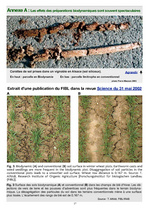 The effects of biodynamic preparations
 -
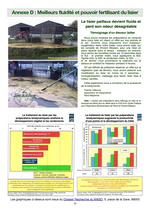 The effects of biodynamic preparations on slurry
 -
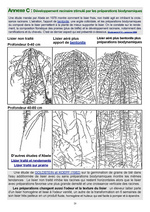 Root development under the effect of biodynamics
 -
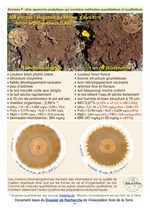 Comparative analysis between organic agriculture and biodynamics
 -
 Comparison of microbial networks according to the type of agriculture
 -
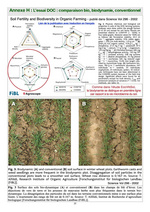 Comparison of types of agriculture
 -
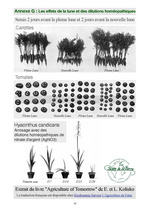 The effects of the moon and biodynamic preparations
Annexes
Sources
- ↑ Ulrich Schreier, 2021, Biodynamics: a promising path towards tomorrow’s sustainable agriculture
- ↑ Hagel 1988 http://www.vernoux.org/EffetGermination502-506-Hagel1988.pdf
- ↑ 3.0 3.1 Abele 1978 http://www.vernoux.org/QualiteMatiereGrasse-Abele1978.pdf
- ↑ Effect on photosynthesis – König 1988 http://www.vernoux.org/AbsorptionCO2-Koenig1988.pdf
- ↑ Elsaidi 1982 http://www.vernoux.org/QualiteEpinards-Elsaidi1982.pdf
- ↑ Care of the Earth and Biodynamics Services 2002-2016 http://www.soin-de-la-terre.org/wp-content/uploads/compressed-9c0aa73e96e68fe7c876eb96cc0d6c6b.pdf
- ↑ Monastery study K.Huber et al. 2005 http://www.demeter.ch/en/pdf/ernaehrungsstudie.pdf
