
Ard Al Khayrat Farm
Mixed farming and livestock farm
Anouar Khales Slaoui
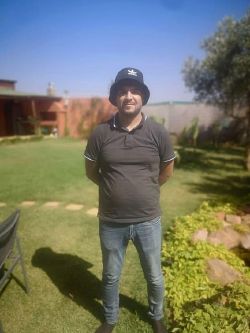

Anouar Khales Slaoui, a farmer in M’qam Tolba, Morocco, cultivates his land and raises his animals according to agroecology principles. Here is a portrait of his farm.
Context
The farm
- Farmer's name: Anouar Khales Slaoui
- Farm name: Ferme Ard Al Khayrat (“The land of blessings” in Darija)
- Location: M’qam Tolba, Rabat region (33.89595, -6.32074)
- Establishment date: 2021
- Cultivated area: 2.6 ha (≈ 1.3 ha market gardening + 1.3 ha orchards)
- Soil texture: Not specified (but suitable for market gardening, olive trees, citrus, vine)
- Number of people working on the farm (FTE) : 1 permanent + 3 occasional seasonal workers + involvement of the project leader
- Altitude: Not specified
- Climate: According to the Köppen-Geiger climate classification, Rabat has a Mediterranean climate with hot summers (Csa). Temperatures generally range between 13 °C and 24 °C throughout the year, with extremes rarely dropping to 5 °C or rising to 39 °C. Average annual rainfall reaches about 383 mm, spread over 52 rainy days per year.
Labor
- 1 full-time permanent worker
- 3 occasional seasonal workers, mainly mobilized during planting (market gardening, fruit trees, edible forest).
- Anouar Khales Slaoui himself is involved on weekends and holidays, alongside his main profession as an engineer.

Plant productions
- Market gardening: The market gardening area covers about 1 ha, organized into 80 beds of 20 m² each (20 m long × 1 m wide). The beds are grouped into blocks of 8.5 m × 20 m (170 m²). Each block is bordered by two rows of fruit trees and support trees, integrating market gardening into an agroforestry logic by promoting biodiversity, wind protection, and biomass production useful for mulching.
- Olive trees: 80–90 trees on ~795 m² (spacing ~9 m²/tree).
- Citrus trees: 80 trees on ~1,000 m²
- Vine : 300 vines, 5 varieties, on ~1,800 m² (6 m²/vine).

Crop associations: pepper–corn (staggered sowing, corn providing shade to peppers → reducing evapotranspiration and producing more resilient foliage).
Animal productions
- Chicken coop: ~2,500 m².
- Stock: 67 hens and 13 turkeys.
- Livestock started with 7–8 hens, gradually expanded.
Motivation and objective
- Family self-consumption: produce organic fruits and vegetables to feed his family.
- Progressive structuring: transform a secondary plot into a productive agroecological farm.
- Experimentation: test innovative practices such as the filtering pond and vermicomposting.
- Knowledge sharing and cooperation: exchange with other farmers (via WhatsApp, local network) and consider creating a cooperative to pool sales and equipment.
- Diversification: develop market gardening, arboriculture, livestock, and ecological infrastructures.
Agronomic aspect
Market gardening, arboriculture and crop associations
- The market gardening gradually occupies nearly one hectare, organized into 80 beds of 20 m² each. Soil work is done with a broadfork and weeding is manual, complemented by cutting weeds used as mulch to protect the crops.
- Arboriculture is diversified: about 80–90 olive trees (795 m²), 80 citrus trees (1,000 m²), and 300 vines of five varieties (1,800 m²). These plantations, aged 8 to 9 years, were already present when the land was acquired.
- Anouar also experiments with crop associations, notably pepper–corn: peppers are transplanted between the 5th and 8th week after sowing, then shaded by corn sown two weeks later. This system improves pepper resistance, promotes denser foliage, and reduces evapotranspiration, thus contributing to better water management.
Water management
The farm is fully equipped with drip irrigation, financed by Anouar without external aid. Water comes from a traditional well deepened to 32 m, ensuring sufficient volume for all crops.
- Hedges: self-regulating drippers spaced 40 cm apart, flow rate 8 L/h.
- Olive trees: pipes with drippers manually inserted according to tree spacing.
- Market gardening: drippers at 10 cm, flow rate from 0.55 L/h (0.8 bar) up to 1.2 L/h (2 bars).
The PVC pipes are buried 20 cm deep to protect the network, and the whole system is controlled by an electronic console (3,500 MAD).
Practices of interest
Vermicomposting
Objectives

Vermicomposting was implemented with the aim of fertility autonomy and valorization of organic waste. Inspired by videos on the Internet, Anouar wanted to test a practice still rare in the Moroccan context, to produce a rich compost, improve soil fertility, and benefit from vermicompost tea (worm tea), used as a foliar fertilizer with rapid effect.
Implementation
- Setup: 2 bathtubs elevated on metal frames (1.5 m × 2 m), perforated and equipped with filters (1 mm mesh)
- Introduction of worms: 4,000 Eisenia fetida + 4,000 Red Wigglers for a total cost of 4,000 MAD
- Management:
- addition of fresh manure, organic waste (banana, eggshells, foliage) on one side only → worm migration
- weekly watering
- addition of ice blocks in summer to limit mortality
- Expected production :
- compost: ~0.5 m³ every 3 months
- worm tea: ~5 L/week in summer
Results
Every three months, Anouar harvests about 0.5 m³ of compost. The system also produces about 5 liters of worm tea per week in summer, used diluted at 10% in foliar spraying (16 L backpack sprayer, cost 300–350 MAD). Results are quickly visible: on mint, for example, foliage becomes greener and more vigorous within 3–4 days after application.
Vermicomposting thus allows the farm to improve its fertility autonomously and experiment with an innovative practice still marginal in the region. Limitations lie in the sensitivity of the system to heat and the need for careful monitoring to maintain production.
Filtering pond
Objectives

The filtering pond was conceived by Anouar as a response to two major challenges: the scarcity of fresh water in his region and the need to strengthen functional biodiversity on his farm. It was intended to serve as a water point for birds, dragonflies, and beneficial insects, while helping regulate mosquito populations. The goal was both ecological (create a humid micro-ecosystem) and practical (reduce mosquito nuisance).
Explanation
General functioning
The pond consists of two parts at different levels: a higher zone and a lower zone. Water circulates continuously between these two compartments thanks to a pump.
The bottom is covered with a watertight geomembrane, preventing water loss. Gravel pits installed in the upper part act as natural filters. This cycle maintains clear, well-oxygenated water while creating a favorable ecosystem for aquatic plants, fish, and beneficial organisms.

Water cycle in the filtering pond
1. Infiltration into the gravel Water from the pond enters a pit filled with gravel. The gravel acts as a natural filter by retaining solid particles and hosting useful microorganisms.
2. Suction through the PVC pipe A perforated pipe placed in the pit allows filtered water to enter while preventing gravel from entering the system.
3. Water pumping The pump draws this clear water from the PVC pipe. It then directs it to an external pipe allowing it to rise.
4. Return to the pond The pumped water is re-injected into the basin. This movement prevents stagnation, improves oxygenation, and promotes aquatic life.
5. Continuous filtration The cycle repeats continuously: water circulates, clarifies through the gravel, then returns to the pond.
The system thus combines mechanical filtration (gravel) and biological filtration (bacteria and microfauna).
Implementation
- Installation date: September 2023
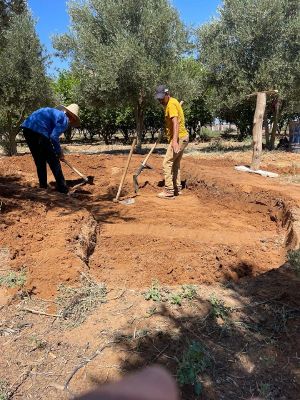
The pond is dug using shovel and hoe. - Work: Manual excavation by 3 workers in 2 days (≈ 4 m × 2 m, depth 80 cm, capacity ~4 m³)
- Sealing: geomembrane (38 MAD/m²)
- Equipment:
- Aquaflor pump (22,000 L/h, 3,500 MAD)
- natural filtration system (gravel)
- a monitoring unit was installed, connected to an air pump (aerator) purchased for 100 to 150 dirhams.
- Biological arrangements:
- lotus planting (100 MAD/plant)
- introduction of koi carp (30–50 MAD each)
- peripheral ornamental vegetation
- The stones used for the pond edges come half from the farm (including 25% donated by a neighboring farm) and half from a purchase made in Tifelt.
- The total cost of these stones is about 1300 dirhams, including transport.

Results
In one year, Anouar observes a marked increase in biodiversity: birds, dragonflies, bees, and various insects come to drink there. The most visible effect has been an 80% reduction in mosquitoes, an unexpected but much appreciated benefit. The pond is thus a successful local innovation, although its effect on crop pests (such as olive tree pests) remains limited. It mainly serves as a biodiversity reservoir and a regulatory space in the farm ecosystem.
Photo gallery of Mama Ghaïa farm
Sources
Interview with Anouar Khales Slaoui conducted in 2025.

Cette page a été rédigée dans le cadre du projet Urbane avec le soutien financier de l'Union Européenne, avec la participation du Centre National d'Agroécologie et de Ver de Terre Production