
Animal traction

The use of animal traction in agriculture has been experiencing a revival for about ten years. Initiated by environmentally conscious users, agricultural animal traction is often associated with alternative production methods to intensive farming.
In agriculture, the use of equines proves particularly well suited to market gardening or viticulture[1].
Description
Over the centuries, animal traction has proven to be a driving force of agricultural progress by enabling improvements in:
- the efficiency of soil work,
- the speed of interventions (sowing, transport),
- the productivity of human labor.
It has contributed to a better integration of agriculture and breeding thanks to the maintenance of soil fertility through animal manure and feeding animals from the crops system. Historically, animal traction has indeed allowed for improving agricultural productivity. Moreover, this form of energy, when well used, is more respectful of fragile environments than motorization[2].
Given the limited pulling power of draft animals, it is mainly in the maintenance work of vegetable crops, hoed crops and vines that animal traction is making a comeback[3].
Animal traction in market gardening
The tractor occupies little space in market gardening structures, especially on small areas. In such structures, the horse allows passage between crop rows, and thanks to adapted tools can completely replace the use of the tractor.[4]
Animal traction can be used for various tasks, ranging from mechanical weeding of crops to harvesting.
In market gardening, the advantages of animal traction are mainly agronomic and economic[4]:
- Precision of work
- Soil respect
- Yield increase thanks to a reduction of soil compaction
- Production of manure constituting a valuable fertilizer
Animal traction in viticulture
The horse is a valuable asset for vines because it easily passes between rows and can perform many tasks such as[4]:
- Plowing
- Spreading manure
- Hoeing or weeding (weeding under the vines)
- Hoeing
- Earthing up and earthing down
- Hilling
- Transporting grape clusters from the plot to the cellar during harvest
The advantages of using the horse in vineyards are numerous but the main one is agronomic:
- Reduction of soil compaction between vine rows and limitation of damage to the vines, allowing to extend the lifespan of the vines. The best wines are made from the oldest vines.
- Very high precision of work.
Choice of the animal
The criteria for choosing the draft animal depend on the required efforts, which themselves depend on:
- The area to be worked
- Soil texture (clay soils, heavy soils require powerful animals)
- The grass area to feed the working animals all year round.
As a general rule, the amount of food to be provided to an equine is proportional to its weight and the difficulty of the work required.
It is essential to remember that the choice of an animal also depends on intrinsic reasons for each person such as sensitivity, commitment, and affinity with the animal.
Choosing an animal for animal traction is a long-term commitment during which one must show patience, perseverance, and humility to achieve the expected results of this mode of management in market gardening or viticulture. Also, remember that service providers exist for producers who cannot commit sufficiently to start animal traction themselves. This solution should not be overlooked and will, on the contrary, allow benefiting from the advantages of animal traction while limiting the workload and animal care.
Live weight of the animal
Besides its usefulness for assessing dietary needs, live weight gives an indication of the pulling power of an animal, thus the instant power available to the farmer. Power (P) is the product of force (F) by the animal's speed (v), which is fairly constant for a given species: P = F x v.
The pulling force is proportional to live weight. Thus, approximately, a first classification relating animal weight and areas to be worked can be made as follows[2]:
- If harnessing a single animal:
| Area to be worked | Animal weight | Types of animals |
|---|---|---|
| Less than 2 hectares of crops | 150 to 350 kg | mostly donkey breeds, double ponies or small horses, mules and hinnies from small mares |
| Between 2 and 5 hectares of crops | 350 to 600 kg | draft horses of carriage type, small cob, draft-type double pony, mule and hinny from heavy mares |
| More than 5 ha and for open field crops | over 600 kg | heavy draft breeds, some Poitou mules |
- If harnessing in pairs: That is two animals working side by side, or sometimes one behind the other (in tandem), then the working force is greater and it is possible to increase the worked areas or use tools with a wider working width.
Choice of species
| Species | Strengths | Weaknesses |
|---|---|---|
| Donkeys |
|
|
| Cattle |
|
|
| Horses |
|
|
| Hybrids |
|
|
Age of the individual
If an animal can start working from 2.5 to 3 years old, it must be done very gradually and moderately, adapting the effort (frequency, duration, intensity) to its age. Ideally, it is recommended to wait until the animal is 4 years old, that is the end of its growth, before starting field work.
For age, the main choice criterion is related to experience in handling animals. When starting with animal traction, it is reasonable to choose an animal that has already worked under good hands, thus over three years old. It is accepted that the most stable animals are gelded males and females.
Morphological traits
The ideal model of draft horse and donkey is often a matter for breed specialists who define a standard. However, it is important that certain points of their morphology show no major defects.
In draft animals, the following are sought:
- Correct leg alignment
- A fairly short, tight back
- A powerful, short, well-attached loin
- Large, broad, dry hocks
- Well-proportioned, healthy feet with solid horn
- A broad chest
- A straight shoulder
Buying a draft animal
Ideally, buy a draft animal from market gardeners or farmers renewing their animals, but this supply is limited. There are professionals specialized in animals trained for market gardening or vineyard. Reliable animals with experience in horse-drawn carriage traction in town and countryside can be found from professionals or private leisure harnessing specialists, which will need to be adapted to soil work.
Once the type of animal is decided, consult the association of breeders of the concerned breed, and among the list, identify those who still harness or work with their broodmares and offspring.
If these leads are not fruitful, there remain three possibilities:
- Horse dealers
- Fairs
- Internet ads
Moreover, there is a certificate of aptitude (notably the "Equid Market Gardener" certificate) attesting to the animals' skills, which also helps ensure the choice of animal when purchasing.
Driving techniques
From the first contact, a relationship with the animal must be established.
- One method, among many, consists of bringing the haltered animal into a longeing circle (18 to 20 m diameter), to work freely, moving it forward at a walk, gradually integrating voice commands. These exercises are done on foot.
- Ideally, after a few longeing sessions, the animal responds to commands and listens freely.
- Once this step is confirmed, it is possible to harness the animal and check the adjustments. Then, start work in an enclosed area, like a small fenced meadow. The reins must establish a perfect straight line between the bit and the handler's hand on foot. It is possible to reproduce, with the reins, the same exercises as with the animal at liberty (in the longeing circle described above), prioritizing voice commands for direction.
- After this step, it is necessary to repeat the same exercises on outdoor outings with long reins and full harness. Time must be taken to confirm voice work. Outings also allow the animal to discover the different places where it will later work.
- Once this step is confirmed, it is possible to harness the animal to a dragged tool (type harrow, cultivator...) in an enclosed space. To accustom the animal to using its strength (especially without demanding too much at first), short sessions (half to one hour initially) should be done to develop the animal's working capacity (muscle and breath).
- Once this step is confirmed, if the animal must work with shafts and rolling equipment, several sessions of movement are necessary for it to get used to the equipment (noises, stopping or backing up) before real work.
In all situations, one or more training courses to initiate, learn, train, and improve are necessary. Because animal traction is complex and requires a set of knowledge to work under good conditions.
When driving techniques are learned and a trust relationship is established with the animal, work can begin, observing certain recommendations:
- Before each outing, feed and hydrate the animal at least one hour before so it has all the resources needed for the work.
- Since the horse remains an instinctive animal, safety and care rules must be respected.
- A slow pace is desirable for precise work.
Harnessing the animal
A draft animal for work needs a harness adjusted and set up to allow it, by pushing its mass, to push on a collar or a breastplate and to steer the equipment installed behind it. Depending on the device to be pulled and the chosen activity, the harness must meet certain requirements:
- To move a load, a tool or a vehicle, the animal needs a collar or a breastplate.
- Generally, a collar is used for soil work, moving heavy loads (wood...), treatment equipment, haymaking equipment with wheel drive, for significant transport of people, equipment, and goods. The collar best distributes the effort on the animal's shoulder.
- Generally, a breastplate is used for light soil work (maintenance of crops under greenhouse), light transport of people, equipment or goods.
Choice criteria
- An animal with 2-wheel rolling equipment: A collar or breastplate with traces, a saddle equipped with a mobile backband with shaft bracelets, a draft set, a bridle or headstall and simple reins.
- An animal with 4-wheel rolling equipment: A collar or breastplate with traces, a saddle equipped with a backband with shaft holders, a draft set, a bridle or headstall and simple reins.
- An animal with dragged equipment: A collar or breastplate with traces, a crupper and trace holders, a breeching, a bridle or headstall and simple reins.
- Two animals harnessed to rolling equipment with 2 or 4-wheel pole: Each animal is equipped with a collar or breastplate with traces and a false martingale, a saddle blanket, a backband with trace holders, a breeching, possibly a draft set, a bridle or headstall, and paired reins.
- Two animals harnessed to rolling equipment with offset shafts: One animal equipped with a collar or breastplate with traces, a saddle equipped with a mobile backband with shaft bracelets, a crupper, a draft set, a bridle or headstall and paired reins. One animal equipped with a collar or breastplate with traces, a saddle blanket and a crupper equipped with trace holders, a bridle or headstall and paired reins.
- Two animals harnessed to dragged equipment: Each animal is equipped with a collar or breastplate with traces, a saddle blanket and a crupper with trace holders, a breeching, a bridle or headstall, and reins.
To choose the appropriate equipment for your use, do not hesitate to contact various distributors: Tracthorse, Bernard Michon Hippomobile, Jourdant, ...
Agricultural equipment
Market gardening
The Kassine
A versatile tool carrier developed by the PROMMATA association, the Kassine is used for various tasks since many tools can be used by simply attaching a hook pin on the tool to fix it to the Kassine.

Here are the most commonly used tools[2]:
- Vibrocultivator: for breaking up plowing. Its teeth are narrow and flexible, for shallow hoeing. Different widths of vibrocultivators exist, allowing adaptation to the animals' strength.
- Multicultivator: for deep hoeing (Canadian function). It is a multifunctional tool on which various accessories can be adapted such as a ridger share, maize hoes... It is adjustable to 3 or 5 teeth, and different widths, depending on the animals' strength.
- Disc ridger: to form and reshape planting ridges. It is adjustable from 40 to 90 cm wide, depending on the desired ridge width.
- Subsoiler: to break plow pans, drain, and promote rainwater infiltration.
- Trisoc: to weed and loosen soil between ridges. It is adjustable in spacing, depending on ridge width.
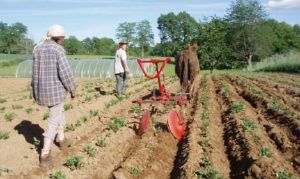
Potato ridging with the Kassine

- Ridging furrower: depending on whether one wants a furrowing or ridging function, the wings are adjustable.
- Spring-tooth harrow: to destroy emerging weeds, on the standing crop, or to break soil crust at potato emergence. There are four possible settings, two for soil work and two for crop maintenance.
- Potato harvester: potatoes are dug up and deposited on the sides, without any damage to the tubers if the machine is well adjusted.
Find here the assembly and maintenance manual of the Kassine and its tools.
One of the strengths of this tool carrier is the precision of adjustments which allows it to be used with a donkey, a horse, or an ox with the same ease and adaptability.

The Polynol
The Polynol is both a tool carrier and a front axle. It is used with two draft horses, its design also allowing it to be hitched to a single horse for certain light soil or transport tasks. It is mainly used in open-field cultivation, for soil preparation and crop maintenance[2].
The Polynol is a chassis mounted on two wheels composed of several elements[2]:
- Limonière : this system is advantageous because it is easier to stabilize a two-wheeled tool carrier with a limonière than with a drawbar. With offset shafts, the variations of the tool carrier are channeled like a two-wheeled vehicle hitched to two horses.
- Attachment system : a low bar system mounted on a pivoting axis allows for a perfect straight line from the harness hook on the collar to the height of the wheel axle, regardless of the height of the harness attachment. The tool carrier is therefore always pulled at a perfect angle.
- Lifting system : thanks to the wheels and the lifting system, tools can be easily moved to the plots being worked on without needing to use a trailer. The lifting system is manual. It has been designed to have sufficient leverage to lift the frame with the tools without effort. There is a dual control allowing the frame and the tools fixed on it to be lifted either from behind, from the tool carrier itself, or from the side.
The Polynol, still under development, will have a range of tools allowing for market gardening in open fields and the cultivation of cereals: harrow, rotary cultivator, spring-tooth harrow, frame allowing the use of several types of tines (tines for stubble cultivation, actinol tines are under study). It also allows, thanks to the tool bar and connectors, to mount Kassine-type tools.
The Néobucher
A market gardening tool carrier that can be self-built, it allows the use of a wide range of adaptable and adjustable tools. This tool features a combined self-steering system allowing easy and quick correction of any deviation of the horse or better following a planting line that is not completely straight. This tool can be made thanks to the trainings provided by Hippotèse and l'Atelier Paysan.
Find the construction plans for this tool here.
Viticulture

The Percheron
A versatile tool carrier for vineyards with a width from 1.40 m to 2.00 m, it is equipped with 4 steering wheels, controlled at the front by the shafts and at the rear by the driver. The Percheron allows the use of subsoilers, cultivator claws, ridging discs, plows or even seeders.
Self-construction
It is also possible to build various machines yourself such as this viticultural straddle carrier, this viticultural plow and this subsoiling plow, designed by a member of the Hippotese association:
- Panorama of self-built tools
-
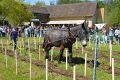 Viticultural plow
 -
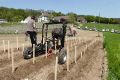 Viticultural straddle carrier
 -
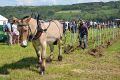 Subsoiling plow


Cost
The PROMMATA association has evaluated the investment and maintenance cost of a draft animal:
- Purchase of a trained horse: between €3,000 and €6,000
- Cost of equipment:
- Harness + collar: between €800 and €1,500
- Small stable equipment: €500
- Agricultural equipment: between €3,800 and €6,000
- Annual maintenance:
- €1,500 fed on hay in paddock
- €900 on pasture supplemented with hay
- To achieve self-sufficiency in pasture, fodder straw and cereals, about 1.5 ha per horse is needed, to be adapted according to the region and the animal.
For more details on the investments to consider, consult this document.
Training and support
It is important to train in animal traction and to be supported in setting up this project. Two leading associations offer training in animal handling and self-construction of animal traction equipment:
- The French Association Hippotese : Created in 1986, its objective is to promote the development of modern animal traction by encouraging its use wherever it has a technical and economic justification. In collaboration with l'Atelier Paysan, it developed a modernized replica of the Bucher market gardening tool carrier, famous in the 1960s. The goal is for users of the "Néo-Bucher", wherever they are, to be able to build it themselves thanks to royalty-free plans and relatively simple construction. The prototype is currently still being tested in practice.
- The PROMMATA Association : This association, based in Ariège, has developed a number of tools for its tool carrier working in arable farming and market gardening.
- FESTA Training at the National School of the Winegrower Horse and the National School of Market Gardening Donkeys.
Summary
Advantages
- Respect for the environment.
- Respect for the soil.
- Carbon savings up to 90%[5].
- More profitable on small and medium surfaces: it is more interesting to invest in the horse because its feed can be provided by the production on site and its investment cost remains lower than that of a tractor.
- Horse efficiency higher than tractor (20% versus 6% for the tractor): this gap is even more pronounced by the fact that the horse can work on almost all soils and in all weather conditions whereas the tractor is limited due to its weight and the strong soil compaction it causes.
- Precision work.
- Little compaction and no worsening of destructured soils.
Disadvantages
- Working with the horse is longer than with a tractor and entails expenses related to horse care.
- Daily management of the horse.
- Allow 2 years for perfect adaptation to the implemented cropping techniques.
- Training in animal traction is necessary.
- ↑ Faire à cheval, online, ANIMAL TRACTION IN AGRICULTURAL USES
- ↑ 2.0 2.1 2.2 2.3 2.4 Keller et al., MODERN ANIMAL TRACTION MANUAL, Biotacc Project.
- ↑ Bioactualites, online,Revival of animal traction
- ↑ 4.0 4.1 4.2 Equi-resources, 2014, Animal traction in agricultural and forestry environments
- ↑ See results of a study conducted by ADEME in the Appendices.
Further reading: Trait Vienne
- Horse energy compared to thermal and electrical energies
-
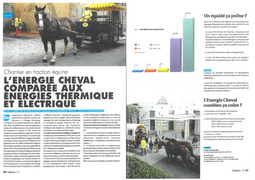 Horse energy compared to thermal and electrical energies: the case of beaches.
 -
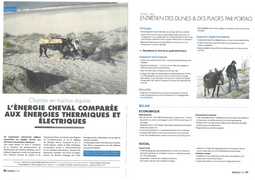 The case of carrying
 -
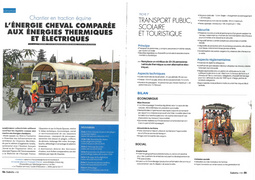 The case of transport
 -
 The case of invasive plant uprooting



