
Using Biostimulants

Biostimulants provide solutions within the framework of sustainable agriculture challenges. Complementing fertilizers and soil amendments, they bring innovation to agro-ecological systems that aim to:
- Improve soil fertility,
- Reduce the environmental impacts of fertilization,
- Promote quality food.
Description
Biostimulants are "fertilizers that stimulate the plant nutrition process independently of the nutrients they contain, solely to improve one or more of the following characteristics of plants or their rhizosphere:
- the efficiency of nutrient use,
- abiotic stress tolerance,
- quality characteristics,
- and the availability of nutrients confined in the soil and rhizosphere”[1]
The term biostimulants appeared in the early 1990s, encompassing a variety of terminology to designate these products: biofertilizer, resistance inducer, natural defense stimulator, growth stimulator, soil activator, ...

Properties of biostimulants
Many properties are recognized for biostimulants. Here is a non-exhaustive list[1]:
- Improvement of the plant’s absorption of nutrients present in the environment or supplied by fertilizers,
- Improvement of the bioavailability of soil nutrient compounds allowing better absorption and use within the plant,
- Increase in tolerance and resilience of plants to abiotic stresses (drought, excess water, frosts, salinity, etc.),
- Improvement of the quality criteria of harvested products (for example: sugar content, lipids, color, preservation, etc.),
- Improvement of microbial activity or physico-chemical properties of soils allowing better degradability of organic compounds,
- Economic gain through yield increase,
- Environmental gain by reducing the use of fertilizers from non-renewable sources.
On fruits
After application of biostimulants on fruits, one can observe[2]:
- Better fruiting
- Increase in size and weight
- Improved taste quality
On plant parts
After application of biostimulants on plant parts, one can observe[2]:
- Greater growth
- Higher yield
- Better assimilation of water and nutrients
- An adapted stress response
On flowers
After application of biostimulants on flowers, one can observe[2]:
- Faster triggering of budding and flowering
On seeds
After application of biostimulants on seeds, one can observe[2]:
- Better germination
- "Starter" effect
- Resistance to water stress due to grafting
On roots
After application of biostimulants on roots, one can observe[2]:
- Better root development
- Improvement of taste quality
- Faster rooting of cuttings
On soil
After application of biostimulants on soil, one can observe[2]:
- Improvement of physico-chemical properties
- Development of beneficial microorganisms
- Better retention of water and nutrients
- Resistance to stress caused by salinity
Product categories
The following three categories can be used to classify biostimulants according to their origins:
- Microbial biostimulants: the best known are bacteria nodulating for nitrogen fixation and fungi mycorrhizal. Other microbial biostimulants, bacteria (such as bacillus) or fungi (mycorrhizae and trichoderma) are currently marketed in France. These products promote the availability of mineral elements in the soil (especially phosphorus), stimulate root growth or the plant’s absorption capacity.
- Organic biostimulants: extracts of algae, humic and fulvic substances, plant extracts, yeasts, amino acids...
- Inorganic biostimulants: silicon chemical element present in the soil, trace elements...
Within the framework of the Agroecological project for France and the Ecophyto program, biostimulants have been classified as follows[3]:
| Origin | Biostimulation products |
|---|---|
| Living substance | Bacteria |
| Fungi | |
| Yeasts | |
| Plant extracts | |
| Algae extracts | |
| Non-xenobiotic synthetic substance | Phytohormones |
| Vitamins | |
| Antioxidants | |
| Xenobiotic synthetic substance | Functional analogues of acid salicylic, others... |
| Mineral-extracted substance | Humic substances |
| Rock powder |
Instructions for use
Biostimulants can be used alone, applied to the soil or growing medium, sprayed on plants or used as seed coatings. Due to the often small quantities required, the use of biostimulants is frequently combined with the application of other fertilizers.
Effectiveness of biostimulants
Factors influencing effectiveness
- Type of crop and varieties
- Environmental conditions
- Plant development stage: effect on product penetration and absorption and on the ability to respond to stimulation
- Product application methods: adherence to doses, timing, application over the entire leaf surface
- Duration of action: commercial formulation of microorganisms, expiration date, storage conditions [4]
Controversies on effectiveness
Controversies about the effectiveness of biostimulants mainly arise from the fact[4]:
- That some marketed products have variable effectiveness due to the strong influence of factors (environmental, physiological, etc.) that are poorly studied or poorly considered during application
- There is a gap between distributors’ claims, users’ expectations, and the effects actually observed. This gap may be related to poor regulatory positioning of the product and poor communication.
Cost
Regarding usage cost, the price of biostimulants remains quite high and is therefore mostly used in high value-added production. According to Arvalis, on wheat, a biostimulant can be profitable (depending on the wheat price) if:
- For a yield gain of 1 q/ha the additional mechanization and product purchase cost does not exceed €20/ha
- For a yield gain of 2 q/ha, the additional mechanization and product purchase cost does not exceed €30-40/ha
Regulation
Biostimulants fall under the regulatory framework of fertilizing materials. Unlike other EU countries that have opted for a registration system based on a declaration, France has chosen to individually evaluate each biostimulant before authorizing its marketing on the territory.
ANSES, the French Agency for Food, Environmental and Occupational Health & Safety, is responsible for evaluating the dossier of each biostimulant considering safety for humans and the environment, agronomic effectiveness, and product composition consistency. Test results, both in laboratory under controlled conditions and in the field, are submitted. ANSES issues a marketing authorization (MA) valid for ten years, indicated on the product by an MA number. The mode of use specified in the MA is indicated on the label with the dosage, application stage, and application methods for full user information.
Three cases arise:
- An MA obtained based on a complete dossier submitted to ANSES covering safety and agronomic effectiveness (for first marketing).
- An MA obtained by mutual recognition granted by ANSES, the product already authorized in another EU member state.
- The NF U 44-204 standard used when a biostimulant is associated with a fertilizer or amendment. In this case, the biostimulant is considered an agronomic additive. It must have obtained an MA for its use in mixture with the fertilizer or amendment. The MA number must appear on the label.
La technique est complémentaire des techniques suivantes
- Treating vines with plant extracts
- Protecting vegetable crops with plant extracts
- Practicing biocontrol
- Using algae extracts as biostimulants
- Using protein hydrolysates as biostimulants
- Using humic acid-based biostimulants
- Using silicon as a biostimulant
- Using bacterial biostimulants
- ↑ 1.0 1.1 Definition by the European Commission (from European Regulation 2019/1009 published in the Official Journal in June 2019 and applicable from July 2022), http://www.biostimulants.fr/produits-utilisation/definition/une-definition/
- ↑ 2.0 2.1 2.2 2.3 2.4 2.5
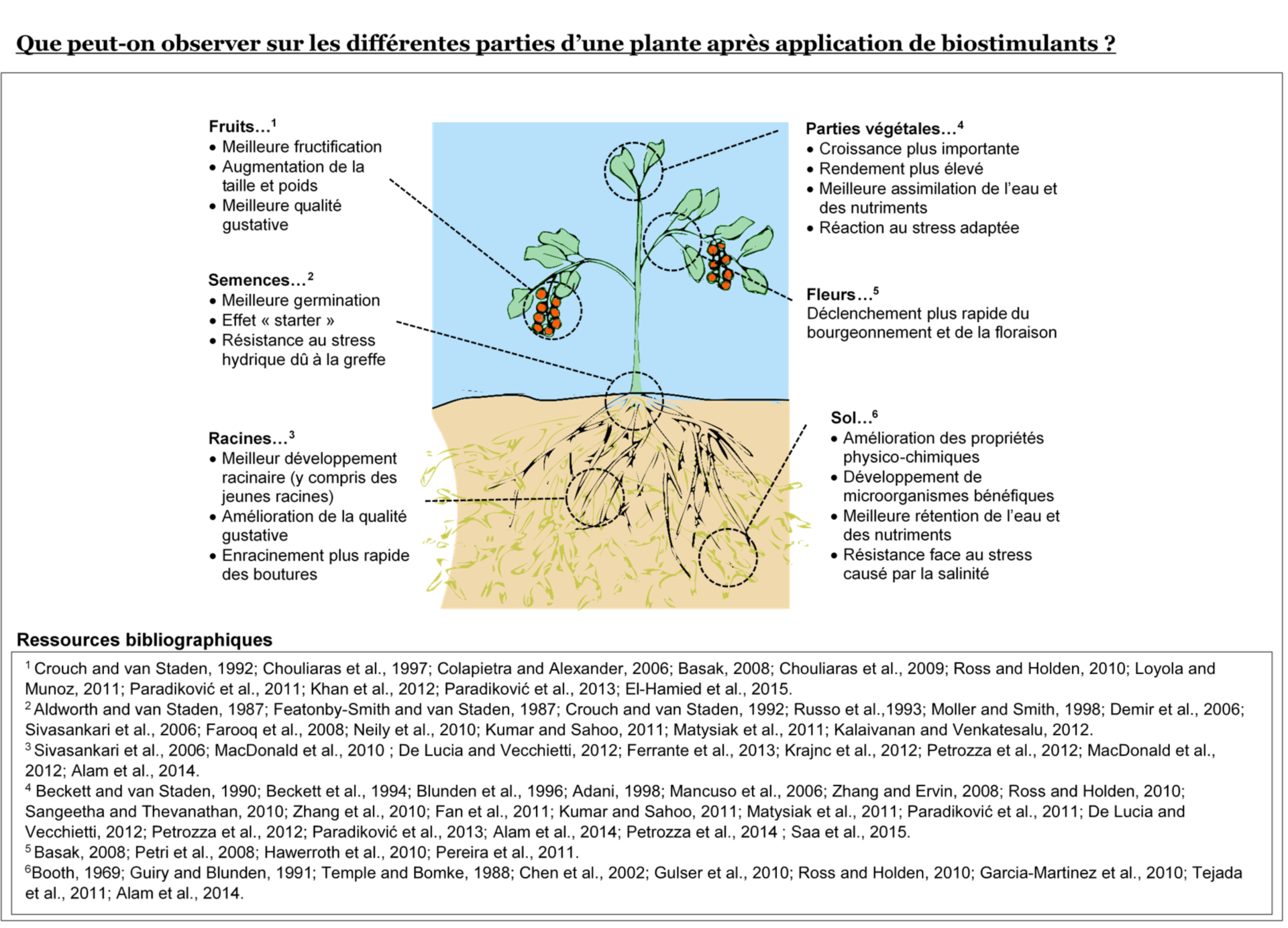 according to Povero et al., 2016, A Systematic Approach to Discover and Characterize Natural Plant Biostimulants
- ↑ Académie des Biostimulants, online, Composition & Categories/
- ↑ 4.0 4.1 ITAB, 2016, Biostimulants in agriculture Status and Regulation
