

Tree Size and Maintenance in Agroforestry

Tree management is a key point in the implementation of agroforestry arrangements. The final profitability of agroforestry plots mainly comes from wood production. The value of this wood being directly proportional to the quality of the monitoring implemented since planting, it is necessary to carefully manage all stages of tree establishment on agricultural plots.
This monitoring work begins as early as the preparation of the planting site, the installation of seedlings and mulching, up to taille operations (for the formation of the tree axis) and pruning over the years[1].
Principle, forms and uses
The tree is capable of regeneration, it can come back to life several times from its base. For deciduous trees mainly, the base of any cut produces branching on the branches and the cut trunks (reiterations). If it is damaged, diseased, or declining, it is possible to intervene gradually by removing the defective or dead parts: branches that are too long, diseased or exhausted.
Varying in size, species, shape... Trees have a multitude of different forms and possible uses. They can be pruned for fruit production. Formed as pollard for biomass, animal feed, litter production... and as low coppice to associate more easily with certain agricultural productions. Finally, it can also be used for timber production. In this case, it will be pruned to develop in height, with a straight trunk and without traces of maintenance passages.
Various strata
-
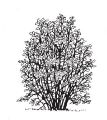 Shrub
Shrub -
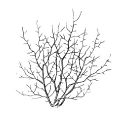 Bush
Bush -
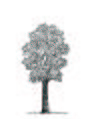 Medium tree
 -
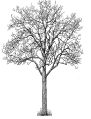 Tall tree
 -
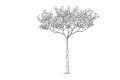 Medium fruit tree type


Various forms
- Coppice (coppicing): Coppice is not a type of woody plant but refers to the form of a woody plant carried by several trunks, by cutting or naturally, whether tree or shrub.
- Pollard: Like coppice, pollard does not designate a type of woody plant but a type of management. Pollarding consists of regular pruning of young shoots. Pollards belong to the large family of pollards.
-
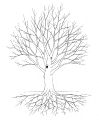 Free form
 -
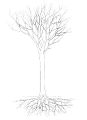 Forest type
 -
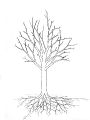 Countryside type
 -
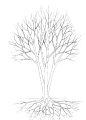 Coppice
 -
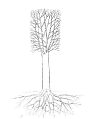 Urban civilized
 -
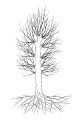 Pollard


.jpg)


Pruned or cultivated trees: pollards, pruned, coppices or... pollards
Different types of pruning
Formative pruning

For tall trees
Formative pruning of a tall tree promotes vertical and rapid growth, and corrects certain conformation defects that will give a better market value to the “butt log”:
- Pruning on the lower third of the tree height.
- Possible fork removal of the crown, to select a dominant vertical shoot or “apex”.
- Formative pruning to maintain the tree's balance and avoid competition between branches. If it is damaged, diseased, or declining, it is possible to intervene gradually by removing defective or dead parts: branches that are too long, diseased or exhausted.

For shrubs and bushy plants
A good lateral and thickness growth is sought to promote their role as “filler”:
- Coppicing at planting or during the first years is almost always necessary. This operation consists of removing all the above-ground parts as close as possible to ground level to encourage regrowth and give more vigor and volume to the plant. A severely damaged tall tree can be “recovered” in the same way, by coppicing.
- A formative pruning aimed at balancing the shrub may be necessary. The removal of overly dominant branches is particularly recommended.
Maintenance and pruning
_et_chicot_(droite).jpg)
Equipment
- Large loppers or hand saw.
- Chainsaw.
- Cherry picker for precision interventions (use governed by labor code 47-1592-65-48).
- Pole pruner.

Pruning
It consists of raising the trunk for technical reasons by removing obstructive lateral branches. This has the effect of “lifting” the crown. From a regulatory point of view, along roadsides, trees must be cleared to a height of 4.5 meters. This clearance can also be sought along the edge of cultivated plots.
Principle
To permanently remove a branch, a clean and sharp cut must be made against the swelling that connects it to its support: the trunk or a main branch.
This swelling or “insertion collar” will naturally close, covering the cut wound with bark. No sprouting should normally occur. To avoid tearing of tissues, the branch can be cut at a distance from the trunk to relieve the weight, then a clean cut made against the insertion collar. Before a mechanical intervention on linear features, an individual pruning of trees allows opening the worksite and simplifies lateral treatment of hedges, edges and riparian forests.

Lightening or balancing pruning
It is sometimes necessary to help the tree regain mechanical balance (leaning or asymmetrical subjects) to strengthen their stability and anticipate possible gravitational phenomena: falls, detachment, tearing, which can be accentuated by climatic events (wind, snow, frost, etc.). The pruning consists of selecting and pruning overhanging or horizontal branches to restore the tree's verticality.
Sanitary pruning
- Remove diseased or damaged parts by cutting well below the part to be removed.
- Remove stubs or spurs by a clean cut against the insertion collar.
Thinning pruning
Although rarely necessary, it consists of removing branches when the crown is very crowded with interwoven and competing branches that damage each other by rubbing. This pruning preserves the fundamental structure of the tree: it does not alter its natural form, the silhouette that is characteristic of the species. The entire branching system functions as a network, coordinated by the “assembly of buds”. Therefore, all cuts must be made preserving a natural extension or a sap sucker in good working order.

Restructuring and regeneration pruning
Faced with a poorly shaped, weak, unbalanced, or overgrown tree, it is possible to intervene to promote new growth, from branches, trunk or stump. This avoids condemning the tree.
Equipment
- Large loppers or hand saw.
- Chainsaw.
- Cherry picker for precision interventions (use governed by labor code 47-1592-65-48).
- Pole pruner.
Rejuvenation pruning or crown reduction
This involves treating the crown on its periphery while maintaining an equitable distribution of branches and the shape chosen by the tree, if possible. Useful to limit excessive shade or contain the tree's volume.
Branch removal or main branch treatment
Secondary branches are removed when they hinder or unbalance the tree.
Topping, removal of main branches or pollarding
A “pollard”, or “pollarded tree”, is a tree whose trunk or main branches have been cut at a more or less high level to induce the development of shoots that are periodically harvested. The pollarded tree is stockier, less vulnerable to strong winds and certain pests. It requires less water and mineral salts. Pollard pruning allows to “contain” the tree. The regularity of pruning cycles and the height of the main trunk(s) are decided according to environmental constraints. The volume of the aerial part of a tree being proportional to the volume of its underground part, by reducing the crown, the root system is also reduced, which can be interesting, especially in urban or cultivated areas.
Coppicing, a second youth

Coppicing consists of removing the above-ground part of the tree, above the collar. If it is healthy, it will sprout from the stump, i.e., it will emit new vigorous shoots giving a new generation of wood on several trunks: coppice or “stool”. From these shoots, it is possible to select a single stem (singling) to form a new trunk.
Not all species sprout from the stump: this is the case for a large majority of conifers.
Felling
When it is desired to completely remove a declining, dangerous or unwanted tree, the stump must be destroyed. To avoid costly and soil-destabilizing stump removal, grinding or chemical stump treatment is preferred.
Tree maintenance and management
Management of tree lines
It is possible to establish a grass strip along the tree line. To do this, it is preferable to respect some principles[1]:
- Favor sowing appropriate herbaceous plants: at minimum, it would be good to use a mixture of grasses and legumes adapted to the plot context.
- Sow densely enough and at an appropriate time to prevent problematic weeds from establishing (wild oat, thistle...).
- Maintain this strip, especially before the seed set of problematic weeds, while respecting the biological cycle of fauna that can find food and habitat in this vegetation at a given time.
Replacing missing trees
When planting steps are properly carried out, mortality rates of young plants are generally low. However, if this occurs, it is important to ensure replacement of dead trees during the first 3 years.
Training trees
Tree training is an important step in plantation management as it ensures the plantation's purpose (timber production, fruit production, energy wood production, protection...).
Whether for hedges or isolated trees, it is essential to train trees during the first 5-8 years.
Isolated trees
For isolated trees, it is about training the trunk and clearing it of branches up to at least 2 meters high, ideally 5 or 6 meters, especially to produce timber.
In the case of timber production, pruning aims to promote vertical growth and form a straight trunk with an elongated stem. To achieve this goal, it is necessary to:
- Prune the lower third of the tree height.
- Possibly fork the crown, to select a dominant shoot.
- Prune to maintain tree balance and avoid competition between branches.
Isolated trees can also produce energy wood. In this case, the pruning described above is done up to 3 to 4m, then a pollard pruning is implemented by topping above. The tree will thus be regularly topped (every 7 years for example) to valorize branches as energy wood. This pruning also limits tree shading. It clears the crown and, over the years, these successive prunings contribute to the formation of cavities in the trunk, thus providing new refuges for wildlife.
Hedges
For hedges, it is about ensuring horizontal containment to prevent its development into the inter-row of crops. Depending on the tree species chosen, the shade cast will be more or less strong.
Different uses and tree forms are therefore possible in agroforestry:

Some points of caution
It is necessary to anticipate certain problems related to tree planting and limit workloads by implementing appropriate equipment and techniques:
- Prepare the ground and plant trees at the right time, according to the rules presented in this article to maximize the chances of young plant establishment and good rooting and start.
- Choose tree species adapted to the pedoclimatic conditions of the farm.
- Use high-quality plant material (traced origin, sanitary quality, good shape, age).
- Anticipate cultural techniques and associated tools when choosing planting distance.
- Systematically protect tree trunks, adapting the type of protection to animal pressure (large game, cattle, sheep, goats, equines, poultry (notably guinea fowl)).
- Implement biodegradable mulching to avoid competition with existing herbaceous plants and prevent young trees from being penalized at the start.
- Anticipate problems of perching by raptors which may break tree tops by integrating some perches in the plot.
- Anticipate large game attacks, by planting or allowing to grow in the agroforestry line, trees called “martyrs” that will attract the animals' attention.
- Take charge of formative pruning of young trees from the first years.
Appendices and links
Est complémentaire des leviers
- Practicing agroforestry
- Practicing vitiforestry
- Implementing agroforestry arrangements
- Pollard
- Planting hedges
Sources
Le vademecum, 2022, Arbre et paysage 32
Viticulture and agroforestry, 2020, Arbre et paysage 32
Setting up an agroforestry project, LEADER, [1]
- ↑ 1.0 1.1 Transgal, Projet Agroforesterie, Sheet 11: Setting up an agroforestry project.



