
Protecting Vineyards from Frost

Frost sometimes causes significant damage in vineyards, compromising the harvest. This type of hazard will likely become more frequent in the coming years due to climate change. This climate shift also affects the vine's cycle. The dates of various phenological stages are increasingly earlier. Thus, the mid-budburst stage has advanced by more than 7 days in 30 years[1] (April 12 on average), which leads to much greater damage in the event of a spring frost, as buds have emerged and are therefore vulnerable.
The combination of an increased risk of spring frost and the advancement of phenological stages leads professionals to seek methods to combat the effects of frost on their vineyards to limit damage to the plant and protect the future harvest.
What type of frost?
There are 2 types of frost : radiative and advective. They can sometimes occur simultaneously, although one is usually predominant. In this case, it is called radiative or advective dominant.
Radiative frost
This is the most common type of frost. During the night, the sun's rays stop warming the soil. The soil then loses heat by emitting thermal radiation.

- If the sky is cloudy, part of the radiation is captured and returns to the ground.
- If the sky is clear, interception of radiation by clouds is impossible and heat loss is greater.
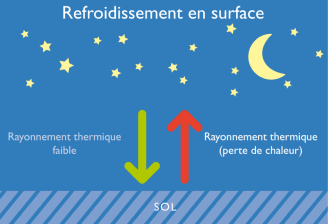

It is characterized by :
- clear sky during the night
- absence of wind
- temperature inversion at altitude
The humidity percentage in the air will determine the type of frost :
- high rate : white frost
- low rate : black frost
Advective frost
It is rare. It is characterized by the arrival of a large mass of cold air accompanied by wind over a region. It is caused by the passage of cold fronts or polar invasion. There is no temperature inversion at altitude due to the wind mixing air layers. This advective cooling is the main mechanism of frosts in winter, but it can occur in spring. It is characterized by :
- clear and open sky
- strong wind
- no temperature inversion This type of frost is extremely difficult to combat and there are few effective control methods.
What protection methods?
Depending on the type of frost, existing control methods vary in effectiveness. It is therefore relevant to determine the type of frost before implementing a control strategy to avoid unnecessary expenditure of energy, resources, and money. A diagnostic key has been developed to aid decision-making.

The severity of damage also depends on the phenological stage at which frost occurs. The more developed the organs, the more sensitive they are to frost.
- From the bud scale burst to cotton bud stage : vines can withstand up to -8 °C.
- At the green tip stage : first damage appears from -2 °C.
- Young green shoots begin to be affected by cold at -0.6 °C for 30 minutes exposure (temperature measured a little over one meter from the ground).
- Swollen buds, young leaves, and young shoots die at temperatures between 0 and -0.5 °C.
Passive control
So-called passive control methods allow prevention of spring frost damage. They rely on considering frost risk from planting and on prophylaxis.[1]
Key points of passive control are :
- Site selection when establishing new plots : avoid planting vines in frost-prone areas, especially avoiding terrain depressions or valley bottoms where cold air accumulates and stagnates. The presence of compact hedges of trees or wooded strips, by opposing cold air flow, can increase frost risk. Choose a well-drained plot or carry out drainage works.[2]
- Choice of plant material according to the site : on plots at risk of autumn or winter frost, favor varieties with early lignification and ensure effective phytosanitary protection of foliage, ensuring good reserve accumulation. For spring frosts, plant varieties with late budburst and raise the height of the stocks. Late pruning and tying of the vine after the frost risk period are sometimes also used by winemakers to reduce risk.[2]
- Soil management and possible cover crop : mowing before budburst on grassed plots can limit frost impact. Note that a sparse grass cover behaves almost like bare soil and it is important to mow or shred the cover several days before a frost episode, allowing it to disappear and no longer produce insulating mulch.[3]
- Subscription to a crop insurance, including frost and hail. However, the high cost of premiums is a significant barrier to the development of this type of insurance.[2]
Other levers of action are available on the page Combination of alternative levers in vineyard frost protection.
Active control
Summary of frost control methods

Selection criteria
The choice of a frost control system depends on multiple factors :
- frequency and intensity of frosts
- type of frost (radiative or advective)
- area to protect
- site topography
- availability of resources (water, fuel, electricity...)
- labor requirements
- proximity to dwellings
- cost (purchase, operation, labor...)
Conclusion
Frost control methods exist and are already used in France and abroad, notably in vineyards at risk of spring frosts.
However, most active control techniques represent a financial investment and high labor demand, sometimes with significant operating costs, for results that are not always optimal and can vary greatly depending on frost type and temperatures reached. Each technique has implementation and usage limits and does not guarantee 100% protection against frost damage.
For established vineyards, the passive control technique consisting of late bending (or tying) of canes helps limit frost damage severity, though it does not guarantee full protection.
Further reading
Sources
- ↑ 1.0 1.1 Means of frost control, published by the BIVB
- ↑ 2.0 2.1 2.2 Hail and spring frost: how to protect?, published by the IFV
- ↑ Hail and spring frost: how to protect?, published by the IFV
Appendices
S'applique aux cultures suivantes
