
No-till: what Italian farmers can teach us
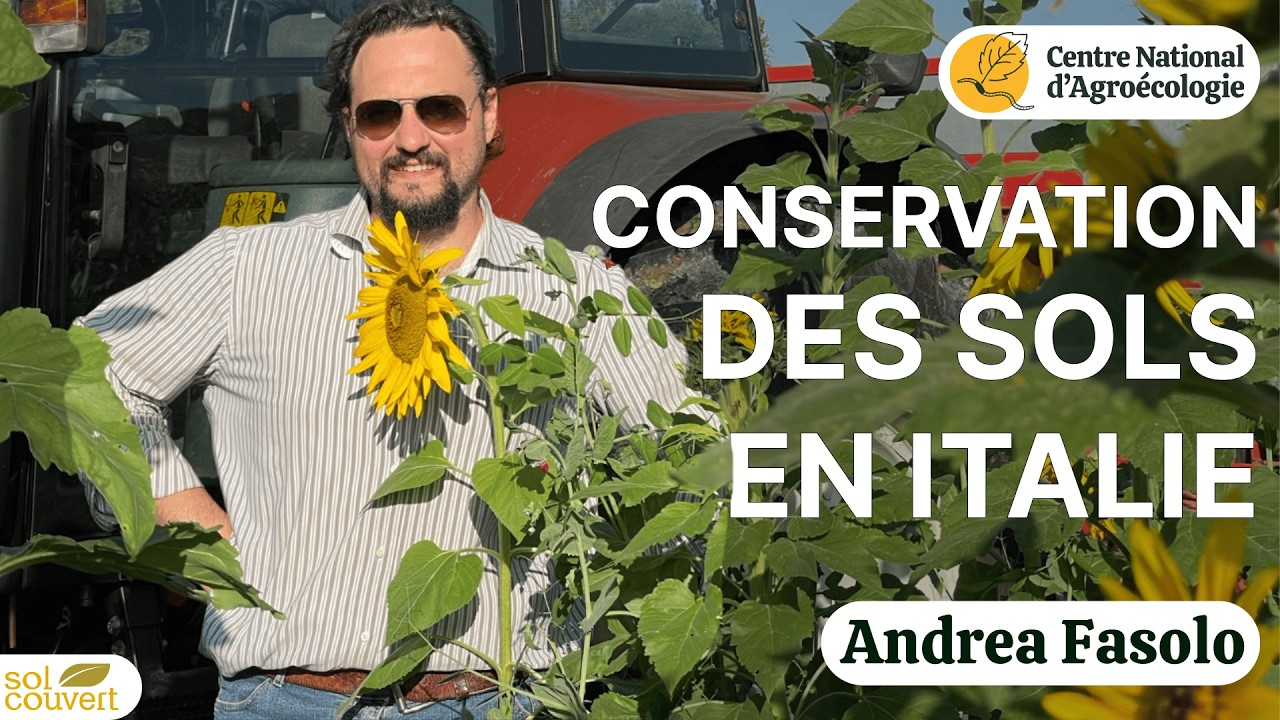
In this webinar, we welcome Andrea Fazolo, a field agronomist and passionate farmer, for a deep dive into his farm in Italy. From theory to practice, he reveals his cropping system, how he manages his soils, and his direct-seeding crop management practices.
Introducing Andrea Fazolo
This talk welcomes Andrea Fazolo, an Italian agronomist based near Padua, in the Veneto region. He advises farmers in the field, also runs a small conservation agriculture farm, and completed a scientific PhD on this same subject. His own farm served as a study site to observe the effects of soil conservation practices on yields and soil biological life.
One of the important points of this meeting is that Andrea Fazolo speaks fluent French and knows the French farming context well. He comes to present his work, his field observations and the lessons he draws from the Italian experience of no-till, cover crops, biological fertility and soil regeneration.
The farming context of north-eastern Italy
Andrea Fazolo works mainly in north-eastern Italy, around Padua, in the Veneto region, that is, the territory of Venice and its large agricultural plain.
He explains that the soils in his area are often heavy, with a texture dominated by silt, few stones, and marked structural weaknesses. These soils are particularly sensitive:
- to compaction;
- to capping;
- to excess water;
- to lack of water in summer;
- to loss of organic matter.
According to him, the central issue is soil fertility, which cannot be reduced to a single factor. It results from the combination of several dimensions:
- the mineral fraction;
- organic matter;
- soil structure;
- porosity;
- biological activity;
- the dynamics of water and air movement.
He points out that a fertile soil is a well-structured soil, with a balance between the solid fraction and porosity. Even though organic matter often represents only 2 to 4 % of the soil, its role is central to fertility.
A very worrying organic matter situation
Andrea Fazolo shows that in much of Veneto, organic carbon and organic matter contents are very low.
He stresses that a large share of lowland farmland is at very low levels, often around:
- 1.2 %;
- 1.5 %;
- sometimes less than 2 %.
He recalls that at university, some former professors already considered that below 2 % organic matter, a soil is close to desertification. Yet, according to him, much of the farmland in his region is already in this situation.
This picture should, in his view, make farmers and advisers think hard, but he believes awareness is still far too low. The problem is not only agronomic: it is also becoming climatic, economic and strategic for the long-term future of agriculture.
Climate change reveals the decline in soil fertility
For Andrea Fazolo, recent years have made the fragility of soils visible. The decline in fertility accumulated over decades now shows up as soils being unable to withstand climate extremes.
The 2022 drought
2022 was marked by a very severe drought. In the region, maize and soybean crops, which are very widespread, suffered enormously.
For maize, he recalls that there had already been very difficult years such as 2003 or 2012. For soybean, however, 2022 was a particularly striking situation, with some fields where emergence did not even take place properly.
He also describes fields that looked good at the end of June but deteriorated sharply in the following weeks for lack of water. Even small wheat fields he was growing showed this gradual deterioration.
Excess water in 2023 and 2024
Conversely, 2023 brought an almost opposite situation, with abundant and violent rain. In several areas of the plain, maize suffered from excess water; farmers had to resow. Weed control problems also got worse, as operations became difficult or ineffective.
The situation continued:
- in autumn 2023;
- during winter 2023-2024;
- in spring 2024;
- and again in the first part of 2025.
Andrea Fazolo remembers in particular a period when, within a week, wheat went from about 18–20 % moisture to 11–12 %, with very rapid shrivelling. In May 2025, he was still seeing great difficulties in sowing.
According to him, this alternation of severe droughts and violent excess water shows that soils have lost their buffering capacity.
Deep ploughing is still the norm on many farms
Despite these findings, Andrea Fazolo explains that deep ploughing is still very often seen in Italy, sometimes deeper than 35 cm, and even down to 50 cm. He specifies that these are not exceptional ploughings, but a completely normal practice on many farms.
He shows the recent example of a farmer ploughing with a small tractor and a single-furrow plough on very wet soil. Even with a small operation, the damage to structure can be very significant.
He highlights several consequences of these practices:
- destruction of structure;
- disturbance of porosity;
- compaction and plough pans;
- difficulty in then preparing a proper seedbed;
- burial of fresh biomass in an oxygen-poor environment;
- unfavourable fermentation;
- microbiological imbalances;
- bringing poor, poorly structured soil low in organic matter up to the surface.
According to him, this logic remains deeply rooted culturally. Many farmers still closely associate farming with tillage, as if agriculture had been born with the plough and could not exist without it.
The fragility of soil is underestimated
Andrea Fazolo strongly insists on the need to look at soil differently. He shows an image of the wine region to recall that soil is only a thin, very fragile film on the scale of the planet, and that farmers have the honour but also the responsibility of cultivating it and passing it on to future generations.
He compares this attention to the care given to farm machinery in winter. Tractors, implements and equipment are maintained, but he asks: what management is really applied to the farm's other great capital, the soil?
He criticises the fact that a lot of land still stays bare all winter, exposed:
- to frost;
- to rain;
- to breakdown of structure;
- to erosion.
Historically, this made soils easier to work in spring, but he believes this logic is no longer appropriate today, especially with modern machinery that is much heavier and disturbance that is much more intense than in the past.
Heavier machinery masks soil degradation
Andrea Fazolo recalls that, over the long history, tillage used to be shallower and done with much lighter machines. According to him, the big leap came with the industrial revolution, and above all with the rapid increase in machinery power and weight over the last forty years.
Today:
- machines are heavier;
- working depths are greater;
- the intensity of disturbance bears no comparison with the past.
This produces soils that are less and less fertile and less and less easy to work. But paradoxically, this degradation is masked by the increase in available power. Land continues to be worked with ever bigger implements, without always seeing that the soil has lost its natural friability.
The central role of soil biology
A major theme of the talk is soil life. Andrea Fazolo cites work carried out in France comparing organic farming, conventional farming and conservation agriculture. This work shows that soil management systems strongly influence the abundance and diversity of soil organisms.
Earthworms as major players
He particularly emphasises earthworms, which he considers central players in fertility:
- they bury organic matter;
- they build structure;
- they create porosity;
- they promote water infiltration;
- they contribute to mixing horizons and organic residues.
He recalls the ecological distinction, well known in France, between:
- epigeic earthworms;
- endogeic earthworms;
- anecic earthworms.
For him, what matters as an agronomist is not so much recognising each species as understanding their behaviour and functions.
He shows photos taken in one of his fields, in front of his house, where maize residues left on the surface are quickly covered with soil by biological activity. Even within a few days, casts and soil ingestion make this work visible.
The earthworm QBS index
In Italy, at the University of Padua, an indicator has been developed: the QBS, for biological soil quality. There is a version based on arthropods, and another adapted to earthworms.
In one of his fields:
- last ploughing in 2012;
- then reduced tillage until 2019;
- then a gradual move to direct seeding.
A first assessment in 2022 showed about 230 earthworms per m². Then, in November 2024, he measured about 450 earthworms per m². The population therefore keeps increasing.
For him, these levels are comparable to those sometimes found in orchards, or even in woods, much more than in conventional farmland.
Very telling visual tests: infiltration, stability, moisture
Andrea Fazolo uses several field demonstrations that he considers very educational.
The rainfall simulator
With farming partners, the university and the city of Padua, he took part in developing a small rainfall simulator. The aim is to compare how different soils react.
On a conservation soil with a dead mulch, he observes:
- very little runoff;
- very little soil carried away;
- good infiltration.
On the neighbouring conventional soil:
- a lot of water at the surface;
- runoff laden with soil;
- limited infiltration.
He explains that a good soil must work like a sponge:
- withstand the impact of raindrops;
- remain porous;
- let water in;
- store it;
- move it down deep.
He also notes that after rain, some soils look waterlogged at the surface while remaining dry underneath. This reveals an inability to really absorb the rain received.
Slake tests
He regularly carries out slake tests, or structural stability tests. These tests consist of dipping clods in water to see whether they stay aggregated or collapse.
He often compares his conservation fields with neighbouring tilled fields:
- in covered, little-disturbed fields, the clod remains stable;
- in bare, tilled fields, the clod quickly falls apart.
He has been using these tests since 2017, because they are very effective at making farmers think about soil structure.
Moisture conservation
Another important observation concerns soil moisture. In March 2021, in a comparison between his field and his neighbour's:
- his field, direct-drilled on soybean stubble with a cover crop, still retained some moisture;
- the neighbouring field, ploughed in autumn and then left bare, was very dry and had no porosity.
He insists on a point that is often misunderstood: even though vegetation uses water, a living, covered and structured soil retains moisture better than a bare soil, which loses almost all its water through evaporation and can no longer store it properly.
Soil regenerates quickly if practices change
On several experimental platforms, in particular the ValleVecchia experimental farm of the regional agency Veneto Agricoltura, Andrea Fazolo was able to observe that differences in structure become very visible after only a few years.
In trials set up as part of the European Life HelpSoil project, comparisons between:
- conventional systems;
- systems with cover crops and tillage;
- conservation agriculture systems;
showed clear differences in structural stability after a few years.
According to him, with soil that is always covered, protected by residues and cover crops, and with a sharp reduction in tillage, not only fertility is preserved, but the soil itself.
Erosion also exists on the plain
Andrea Fazolo points out that even in a very flat region, erosion exists. It is less spectacular than on sloping land, as in some French regions, but it is very real.
He estimates that 3 to 4 tonnes of soil per hectare can still be lost on the plain through surface erosion.
The problem is twofold:
- the most fertile layer, the richest in clay and organic matter, is lost;
- pollutants linked to farming activities are also carried off into the landscape and surface water.
More broadly, he recalls that at European level, about one billion tonnes of soil are lost every year, which in his view is an impressive figure that is not given enough attention.
Cover crops at the heart of the strategy
For Andrea Fazolo, cover crops are a central lever. They are not just a complementary tool, but a key to regeneration.
He emphasises several functions:
- physical protection of the soil;
- feeding soil biology;
- adding biomass;
- recycling fertility;
- improving structure;
- competing with weeds;
- storing carbon;
- stimulating the rhizosphere.
He recalls that living plants are needed in the soil for as long as possible. Around the roots, in the rhizosphere, biological activity is much more intense. Plants communicate with micro-organisms through root exudates and stimulate a whole series of processes.
We must therefore go beyond a simplified view in which the field contains only widely spaced rows of maize: the system must be biologically intensified, with more diversity and longer periods of cover.
Producing a lot of biomass
Andrea Fazolo shows many examples of very productive cover crops. He has been using the MERCI methods since 2017, probably among the first in Italy to do so, notably with the support of Sébastien Minette.
In some cases he measured:
- more than 10 tonnes of dry matter per hectare;
- sometimes 12 or 13 tonnes in certain situations.
For example, in a cover crop sown in early August 2021 and observed about 80 days later, he describes a mix including:
- sorghum;
- sunflower;
- biomax;
- pea;
- faba bean;
- radish;
- fenugreek;
- and other species.
On 20 October 2021, he came back to direct-drill wheat into this cover crop, without rolling, without shredding, without prior weed control.
He also stresses the need to choose carefully:
- the species;
- the varieties;
- the sowing date;
- the soil and climate context.
In Italy, summer harvests often take place at the end of June, followed by very hot and dry periods. Summer cover crops therefore do not always establish easily, unlike in some French situations.
The great Italian misunderstanding: burying cover crops
Andrea Fazolo devotes an important part of his talk to what he considers a common mistake in Italy and elsewhere in Europe: burying cover crops and, more generally, fresh biomass.
He explains that in Italy, many farmers still use the term sovescio (green manure) for these practices, but that this often leads them to buy cover crop seed only to bury it by ploughing or heavy tillage.
Results of a long-term trial
With Veneto Agricoltura and the University of Padua, a major experiment compared three approaches over seven years:
- conventional farming: tillage, no cover crop;
- conservation agriculture: no tillage, with cover crops;
- an intermediate approach: tillage + cover crops.
For the first four years, the rotation was wheat-soybean-maize-rapeseed, with all crops present on the three experimental farms.
The results showed that the tillage + cover crops system added the most carbon to the soil overall, thanks to:
- productive cash crops;
- additional biomass produced by the cover crops;
- roots.
But despite this higher carbon input, it was this system whose organic carbon stock fell the most. After seven years, about 2 tonnes of organic carbon were missing from the soil.
Andrea Fazolo's conclusion is very clear: tillage, and ploughing in particular, is the most effective way to burn organic matter and send it back into the atmosphere.
According to him, the plough should almost be relegated to the status of an old memory of past agriculture.
Feed the soil so that the soil feeds the crop
Andrea Fazolo sums up his philosophy in one simple idea: first feed the soil, so that the soil is then able to feed the crop.
He believes it is necessary to move beyond a logic in which fertilisers are applied only to meet the immediate needs of the cash crop. The goal must be to move towards systems that are:
- more self-fertile;
- more autonomous;
- more biologically active.
From this perspective, cover crops play a central role. They must produce biomass, feed micro-organisms, recycle nutrients and increase the fertility of the system.
Weed management must become ecological
Another common thread of the talk is weed management.
Andrea Fazolo believes that tillage often gives the illusion of controlling weeds, but that this effect is temporary. Even after deep ploughing, fields can be very weedy again a few months later.
He therefore proposes a more ecological approach:
- permanent cover;
- competition from cover crops;
- rotations;
- anticipating weed emergence;
- reducing weed biomass rather than seeking complete eradication.
He explains that with cover crops, not all weeds are necessarily eliminated, but their biomass is greatly reduced, particularly that of broadleaf weeds. They then become easier to manage, chemically or mechanically.
He also stresses the importance of anticipating:
- if weeds are already established when the cover crop is sown, they can severely penalise the biomass produced;
- a poorly established cover crop then loses part of its agronomic effect.
Technical limits exist, especially at the start
Andrea Fazolo does not idealise the transition. He repeatedly says that these systems:
- are not easy;
- require learning;
- demand technical adaptations;
- sometimes involve some light tillage at the beginning.
On some soils, particularly fragile silty soils, it may be necessary at the start:
- to do some light shallow tillage;
- to help the cover crop establish;
- to correct occasional compaction or plough pans.
But he insists: be careful not to work the soil too much, or the benefits sought will be cancelled out.
He also notes that in Italy:
- precision drills suited to direct seeding are not widespread;
- farms are often small;
- fields are fragmented;
- cooperation between farmers is less developed than in France;
- access to machinery is more complicated.
Personal trials on fertility and nitrogen
In the fields used for his PhD, Andrea Fazolo studied the links between soil fertility, cover crops and crop performance.
He continued these trials after completing his PhD in 2023, in particular on:
- different nitrogen application methods;
- different forms of nitrogen;
- the use of micro-organisms that can help fix nitrogen;
- the comparison between fields with or without a previous cover crop.
The aim is to understand how the soil responds to changes in practices, and how part of the mineral nitrogen can be replaced or better used thanks to soil biology.
Cover crop mixes and home-produced seed
Andrea Fazolo carries out many trials of cover crop mixes. He also seeks to produce a large part of his own cover crop seed.
In several trials, he shows that:
- farm-made mixes can produce more biomass;
- they can capture more nitrogen;
- they cost much less than ready-made commercial mixes.
He gives the example of a trial in which the mixes he prepared produced more biomass than three other mixes tested, with seed costs divided by almost three.
For him, this is part of the work of supporting farmers: testing, comparing, simplifying and reducing costs without losing effectiveness.
Direct seeding into heavy biomass: promises and difficulties
Andrea Fazolo also presents several experiences of direct seeding into very well-developed cover crops, especially for soybean.
These situations are promising, but technically tricky:
- sowing into 12 or 13 tonnes of biomass becomes very difficult;
- some sensitive crops, such as soybean, can suffer;
- slugs or moisture can cause problems;
- it is sometimes necessary to reduce biomass before sowing or to fine-tune cover crop management.
He mentions in particular trials carried out in 2023 with different cover crop species and different management methods, where soybean development was not always perfect. He believes, however, that the more recent trials are helping him better understand how to improve these practices.
Integrating animals: a further step
In the logic of regenerative agriculture, Andrea Fazolo sees integrating livestock and grazing as an important step.
In his context, this remains difficult:
- small fields;
- fragmented farms;
- few opportunities for direct grazing.
But he believes that integrating animals would be a particularly smart and ecological way of closing cycles, making use of biomass and supporting fertility.
He also shows examples of forage crops or regrowth used for hay, which make it possible to observe how soil fertility responds and is "remembered" from one year to the next.
Visible effects on crop health
One of the most striking results of his approach is, according to him, the improvement in crop health.
Fewer diseases
He shows comparisons of wheat in spring 2023:
- on one side, fields with probable fungal problems, notably septoria;
- on the other, crops performing much better in better-managed soil.
He also cites French experiments showing that soil well managed with cover crops and direct seeding can help reduce foliar diseases.
Fewer treatments
On his own fields, Andrea Fazolo states that he:
- has never used foliar insecticides;
- has stopped using fungicides on wheat;
- uses untreated farm-saved seed;
- has also stopped the treatments aimed at managing fusarium.
He links this to a coherent whole:
- diversity of cover crops;
- rotation;
- soil fertility;
- structure;
- biological activity.
Regenerative agriculture: overall principles
Andrea Fazolo also describes himself as a member of the European Alliance for Regenerative Agriculture. For him, this approach is based on a few main principles:
- deal with the real local context;
- minimise soil disturbance;
- keep living roots for as long as possible;
- keep the soil covered;
- biologically intensify systems;
- diversify species;
- observe and adapt.
He insists that these principles must always be adapted to the territory:
- field size;
- level of equipment;
- farm structure;
- climate;
- soil type;
- crops present.
He also mentions a kind of opportunistic approach, which consists of keeping the soil permanently covered and then making use of this biomass depending on conditions:
- as forage;
- as seed;
- as a cover crop returned to the soil;
- as the next crop.
Inspiration from France
Throughout his talk, Andrea Fazolo thanks and cites several French sources of inspiration.
He explains that he uses many tools, references and resources from France:
- software and resources for designing mixes;
- the MERCI methods;
- feedback from farmers and advisers;
- work on agroecology and cover crops.
He cites in particular:
- Sébastien Minette;
- Konrad Schreiber;
- Magellan;
- Hubert Charpentier;
- the work of Sky Agriculture;
- the resources of Ver de Terre Production and then of the Centre National d'Agroécologie.
He says he is very impressed by the French ability to:
- raise awareness;
- share knowledge;
- produce practical tools;
- bring science and practice into dialogue.
Vineyards as another testing ground
Andrea Fazolo also works in viticulture.
In this sector, he observes that very good cover crops can be obtained, particularly between crops before replanting, but also in established vineyards. He even believes it is sometimes easier to manage biomass there without burying it than in annual crops.
He recounts that in 2016 a winegrower from the east of the region asked him whether there were any experiences of direct seeding or seeding with very little tillage in vineyards. They then drew inspiration from French experiences and developed a prototype drill with a local manufacturer.
This machine then evolved over the years:
- first in 2.30 m;
- then in 4.45 m;
- then in a semi-mounted version.
Andrea Fazolo has been using it since 2017 to sow cover crops in vineyards. He also notes that France has often been among the first to test and improve this type of equipment.
Concluding messages
In conclusion, Andrea Fazolo insists on several strong ideas.
We already know a great deal
According to him, we now have:
- a great deal of scientific knowledge;
- a lot of field experience;
- practical references;
- successful examples.
In other words, agriculture no longer really has the excuse of saying it does not know how to do it. Some mechanical means may still be lacking locally, but the knowledge exists.
A change of outlook is essential
According to him, it is necessary to:
- consider soil as a living capital;
- understand its fragility;
- reduce tillage;
- promote cover crops;
- feed soil biology;
- rebuild structure;
- think about practices as a whole.
Soil fertility is the basis of everything
Finally, Andrea Fazolo points out that the goal is not only ecological. Regenerating soils also makes it possible:
- to maintain productivity;
- to improve climate resilience;
- to reduce some diseases;
- to manage water better;
- to limit soil losses;
- to support agriculture that is sustainable over time.
He ends by warmly thanking the French players who share this knowledge, as well as the Italian farmers, researchers and partners he works with.
How to contact Andrea Fazolo
At the end of the discussion, it is mentioned that Andrea Fazolo can easily be found on Facebook under his name:
- Andrea Fazolo
It is also mentioned that he can reply via YouTube comments.
