
Nice Mowing

The "friendly mowing" refers to a set of practices aimed at reducing the negative effects of agricultural machinery, especially the mechanical impact of mowing and harvesting on small wildlife.
Principle
Meadows provide a habitat rich in food resources as well as a refuge for the protection and reproduction of many species. However, the harvesting periods of meadows (such as silage, wrapping or haymaking) often coincide with the reproduction phases and rearing of young nesting in agricultural plots. Faced with danger, some animals do not flee, either due to incapacity (such as nidicolous chicks that remain in the nest after hatching), slowness (such as nidifugous chicks that leave the nest but move slowly), or by a strategy of immobility, as is the case with leverets and fawns. Mowing also impacts insect populations[1].
Species observation
To understand which type of fauna completes its cycle in our meadows, it is important to observe the environment before, during, and after mowing. Pay attention to the behavior of animals on the meadow and its surroundings; you may be able to observe the presence of young or nests. The aggressiveness of a bird towards a potential intruder can indicate the presence of its nest. Similarly, if a doe flees and stops to look back, the presence of a fawn hidden in the vegetation is very likely[1].
Adapted mowing pattern
Many species fall victim to machines when mowing is done following a centripetal path, that is, from the outside towards the inside of the plot. Conversely, strip mowing or following a centrifugal path, from the inside towards the outside, limits the risk of trapping wildlife (including insects) in the center of the plot and facilitates their escape to refuge areas[1].
-
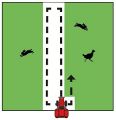 Strip mowing
 -
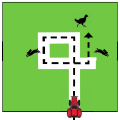 Centrifugal mowing


Equipment

It is preferable to use a sickle bar mower, with a scaring bar, which encourages animals to flee. Adapting a speed of less than 10 km/h will give them more time to escape, especially at the edge of the field. Wildlife is active at night, so mowing is not recommended then. Cutting your meadow at a height of 7-8 cm helps reduce losses of animals present at the time of mowing. If possible, it is recommended to leave unmowed refuge zones on the plot (10% of the surface) so that insects can complete their entire life cycle there[1].
Benefits
- The preservation of wildlife and insects promotes bioregulation services for crops, as well as the services provided by pollinators.
Drawback
- Reducing speed to 6-8 km/h can result in an increase of 5 minutes per hectare mowed.
La technique permet de favoriser la présence des auxiliaires et bioagresseurs suivants
La technique est complémentaire des techniques suivantes
Cette technique utilise le matériel suivants
- ↑ 1.0 1.1 1.2 1.3 Biodiversity sheet no. 3: Friendly mowing, AGROBIO 35, 2023 https://www.agrobio-bretagne.org/voy_content/uploads/2023/12/4_Fiche-tech_fauche-sympa.pdf