
Let your soil speak: new DNA analyses for farmers
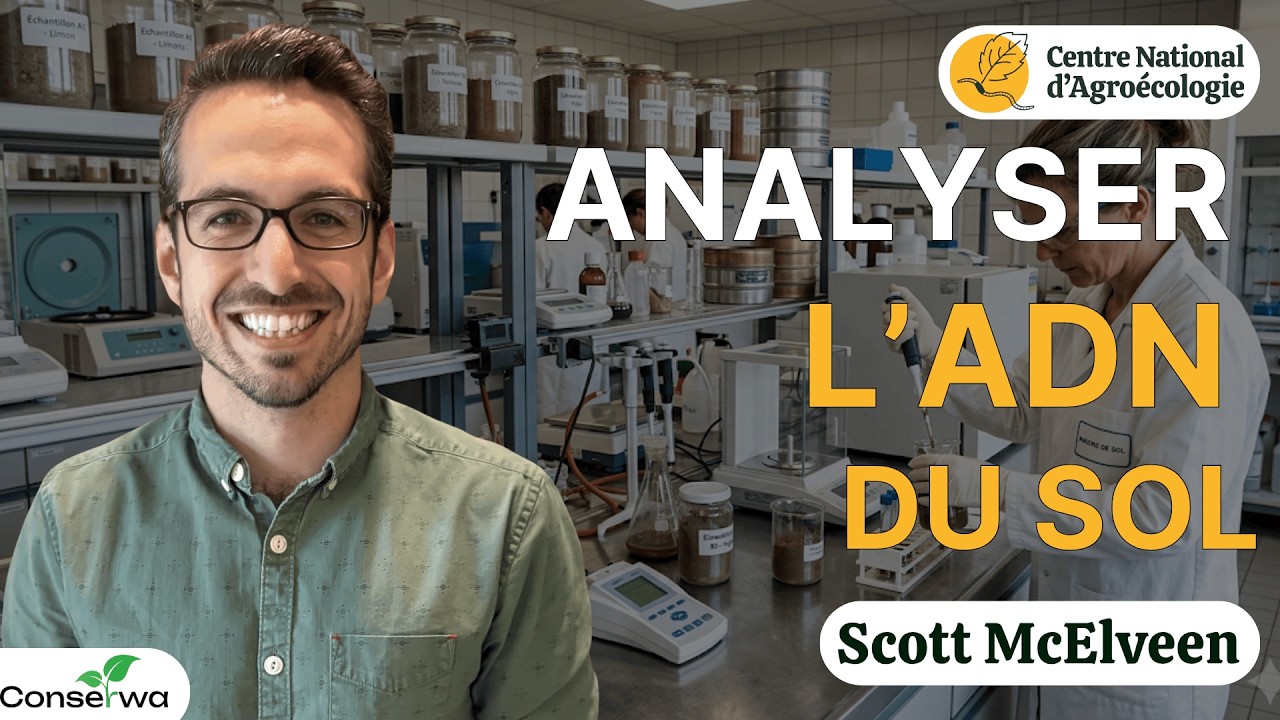
Scott McElveen works at BiomeMakers, a laboratory specialising in soil DNA. He presents the benefits of this type of analysis and the interpretations the company has been able to draw from it.
Introduction
This live webinar, broadcast on the YouTube channel of the Centre National d'Agroécologie, is devoted to soil analysis and soil biology, with a focus on new DNA analyses applied to agriculture.
The speaker is Scott McElveen, in charge of customer relations, partnerships with distributor laboratories and technical support at Biomakers, a laboratory based in Spain that has been working on soil DNA analysis for more than ten years. The company says it has analysed more than 100,000 samples from 56 countries, on more than 200 crops and in more than 400 field trials.
The aim of the presentation is to show how DNA analyses now make it possible to better understand soil biology, identify the groups of micro-organisms present, estimate their agronomic functions and, more recently, map these biofunctions at field scale.
Why take an interest in soil biology
Soil can be understood through three main dimensions:
- physical characteristics;
- chemical characteristics;
- biological characteristics.
Physical characteristics include:
- texture, i.e. the proportions of sand, silt and clay;
- structure and aggregation;
- porosity;
- water infiltration and retention capacity;
- mineral composition;
- permeability.
Chemical characteristics include, for example:
- levels of macronutrients and trace elements;
- their availability to plants;
- relative cation levels;
- cation exchange capacity;
- pH;
- redox potential;
- organic matter content.
Scott McElveen uses a business metaphor to explain these three dimensions:
- soil physics is the workplace;
- soil chemistry is the stock or assets;
- soil biology is the workforce.
In this picture, micro-organisms are the workers who organise and maintain the workplace, turn immobile stocks into biological activity and make the soil function. Without them, the soil cannot effectively support life.
Historically, agronomy has focused mainly on the physical and chemical dimensions, largely because the tools for assessing soil biology remained limited for a long time. Yet you can only manage properly what you can measure.
Microbial life is everywhere
To illustrate how widespread microbial life is, Scott McElveen shows a scanning electron microscope image of the surface of a soil particle covered with micro-organisms of various shapes, with their stringy, sticky exudates.
The striking point is that the sample shown is not a rich agricultural soil, but salty beach sand, collected in winter on the coast near Boston, Massachusetts. Despite apparently poor conditions, this material is already teeming with microbial life.
The idea put forward is that every square centimetre of a farm is home to millions of microbial individuals. Depending on conditions, they can:
- work in favour of crops;
- harm them;
- remain inactive.
In all cases, it is useful to know this invisible "workforce", in order to try to make it work for production rather than against it.
The limits of conventional approaches to measuring biology
Several approaches already exist for assessing soil biology, but each has its limits.
Microbial biomass
Biomass data give an idea of the total amount of microbial life or of the soil's capacity to support an active workforce. Methods cited include:
- combustion, which gives information on total biomass;
- phospholipid fatty acids, which allow a little more detail by major microbial groups.
Soil respiration
Respiration measures the level of microbial activity when water is available. But it is highly variable over time, sometimes over just 24 hours, and it does not tell whether the observed activity is productive or destructive.
Scott McElveen insists on this point: high respiration does not necessarily mean good agronomic functioning. A chaotic situation can respire strongly, like a battlefield, without being beneficial to crops.
Microscopy
Microscopy mainly makes it possible to observe some microbial predators and roughly estimate the relative abundance of fungi and bacteria. However, it remains limited to general morphological distinctions.
Soil enzymes
Enzyme activity is an excellent way to monitor certain biological functions, particularly those linked to the carbon, nitrogen or phosphorus cycles. However:
- these measurements can vary over time;
- they depend on the enzymes monitored;
- they often remain limited to a few indicators, partly for economic reasons.
Why DNA changes the game
DNA is presented as a particularly interesting molecular target, because it is:
- stable enough not to change radically from one day to the next;
- responsive enough to measure changes over a few weeks;
- able to provide information on a wide range of biological functions.
DNA contains the instructions needed to carry out an organism's biological functions. If you can read and interpret this genetic code, you can know what an organism is and what it is potentially capable of.
How soil DNA analysis works
The analysis follows several main steps.
DNA extraction
DNA is extracted from the soil using a protocol that chemically weakens the cell walls of microbes, then the cells are broken mechanically using glass beads.
Targeting marker genes
It is impossible, in practice and in cost, to sequence all the DNA of all the organisms present in a soil sample. The approach therefore targets marker genes common to large groups of organisms:
- a gene common to bacteria and archaea;
- another gene common to fungi.
These genes act like a fingerprint: they make it possible to identify an organism or link it to close relatives in the tree of life.
Using databases
Identification relies on large reference databases. Biomakers uses in particular:
- NCBI;
- Silva;
- Unite.
According to the presentation, these databases have been enriched by Biomakers with data accumulated over ten years, specifically from agricultural soils.
Functional inference
Once the micro-organisms have been identified, their presence is linked to what is known about their genetic and functional capabilities. This makes it possible to estimate, at sample level, functions such as:
- pathogen risk;
- biocontrol;
- nitrogen mineralisation;
- phosphorus solubilisation;
- nutrient immobilisation;
- phytohormone production;
- stress mitigation;
- soil structuring.
The general principle of interpretation
According to the explanation given during the discussion, the results are expressed as indices from 0 to 100. Level 100 corresponds to the highest levels observed, for a given crop, in the global database of soils already studied; level 0 corresponds to the lowest.
For pathogens, the indexing follows a logarithmic logic: very high risk levels correspond to orders of magnitude above simply high levels, which are themselves above light levels.
This approach therefore amounts to positioning the sample analysed in relation to an existing reference database.
Pathogens and disease suppression
Pathogens are the group of micro-organisms most immediately familiar to farmers. Soil DNA analysis makes it possible to identify the pathogens present that are likely to affect a given crop, and to rank them according to a risk level based on their relative abundance.
This information can be used before planting to guide prevention strategies, such as:
- crop rotation;
- variety choice;
- targeted use of biocontrol;
- other prophylactic measures.
The disease triangle
Scott McElveen recalls that disease depends on three elements:
- the presence and abundance of the pathogen;
- an environment favourable to its virulence;
- the susceptibility of the plant.
So a high pathogen score does not automatically mean that disease will appear, but it signals a serious risk.
The role of natural biocontrol
In a healthy soil, crops are not alone. They are surrounded by micro-organisms that can:
- compete with pathogens for space and resources;
- disrupt their life cycles;
- scramble their infection strategies;
- attack them directly.
The example given is that of two soil aggregates inoculated with Fusarium oxysporum:
- in the sterilised aggregate, the pathogen develops freely;
- in the non-sterilised aggregate, the beneficial organisms present resist its establishment.
Other examples illustrate this biocontrol:
- Trichoderma attacking Pythium;
- fungi such as Beauveria bassiana infecting insects;
- fungi trapping plant-parasitic nematodes.
The main scenarios proposed
The presentation distinguishes several situations:
- open ground: few pathogens and little biocontrol; if a pathogen arrives, there is little resistance;
- uncontrolled disease: abundant pathogens and weak biocontrol;
- suppressive soil: strong biocontrol capacity and low pathogen pressure;
- besieged soil: simultaneous presence of pathogens and biocontrol agents, indicating an active struggle.
Micro-organisms involved in plant nutrition
The presentation then addresses mineral nutrition, not from the angle of the quantity of nutrients present in the soil, but of the micro-organisms that mobilise, transform, immobilise or make them available.
It is pointed out that this is not a chemical soil analysis, but a reading of the "workforce" that moves nutrients around.
The nitrogen cycle
Scott McElveen recalls that plants mainly take up nitrates, but that every major transformation in the nitrogen cycle is governed by micro-organisms:
- decomposition of nitrogen-containing organic matter;
- ammonification;
- nitrification;
- denitrification;
- fixation of atmospheric nitrogen.
The test presented makes it possible to monitor:
- nitrogen supply pathways;
- nitrogen fixation;
- the transformation of organic forms into ammonium;
- nitrate production;
- gaseous losses through denitrification;
- losses through volatilisation;
- immobilisation in microbial biomass.
Nitrogen immobilisation and rhizophagy
An important point of the presentation concerns immobilisation. It is often seen as competition between microbes and plants. However, Scott McElveen qualifies this interpretation by referring to the rhizophagy cycle.
According to this concept, microbes alternate between:
- a free-living phase in the soil, where they acquire nutrients;
- an intracellular phase in root cells, where the plant extracts these nutrients by oxidation.
The microbes are then expelled at the root hairs, rebuild their walls and return to the soil to acquire new resources.
The idea put forward is that roots can thus "harvest" nutrients from microbes that had immobilised them. It is even stated that the presence of microbes is essential for the formation of root hairs. In this logic, part of immobilisation can be considered beneficial, provided that nitrogen supply pathways are also strong.
Phosphorus
The presentation stresses that the directly available phosphorus fraction revealed by a chemical analysis generally represents only a small share of total soil phosphorus, around 5 % according to the speaker.
Soluble phosphorus is quickly adsorbed onto the mineral surfaces of the soil, notably onto iron, aluminium or calcium compounds depending on pH and mineralogy.
Scott McElveen cites a compilation of 987 field observations from 274 articles, according to which only about 2.6 % of the phosphate fertilisers applied are taken up by plants.
In this context, soil biology plays a central role. All the natural processes that make phosphorus available to plants depend on micro-organisms, in particular:
- solubilisation of inorganic phosphorus bound to minerals;
- mineralisation of organic phosphorus contained in residues, manures or microbial biomass.
The DNA test therefore takes into account:
- solubilisers of bound phosphorus;
- mineralisers of organic phosphorus;
- organisms involved in the immobilisation of available phosphorus.
Potassium
Similar reasoning is applied to potassium.
According to the orders of magnitude given:
- the soluble fraction represents about 0.1 to 0.2 % of total potassium;
- the exchangeable fraction 1 to 2 %;
- the fixed fraction 1 to 10 %;
- the structural mineral fraction 90 to 98 %.
The soil therefore contains large quantities of potassium, but most of it is not directly accessible to plants. Micro-organisms can help release this reserve, either by solubilising structural potassium or by promoting its dissolution.
Here again, if release pathways are weak and immobilisation dominates, there may be competition between microbes and plants.
Trace elements
The same functional logic is applied to eight trace elements. The presentation does not go into this point in detail, but stresses that in many cases, the microbial agents involved in nutrient cycling influence the actual uptake of some elements by plants more than the simple chemical availability measured in the soil.
The carbon cycle
The test also makes it possible to assess functions linked to the carbon cycle, in particular:
- microbial carbon fixation capacity;
- organic matter decomposition capacity.
Decomposition is presented as particularly important for releasing nutrients from green manures and cover crops.
Scott McElveen points out, however, that microbial carbon fixation remains far below the power of plant photosynthesis. He therefore insists on the importance of keeping living roots and optimising photosynthesis.
Aerobes, anaerobes and soil structure
DNA analysis can also provide information on the oxygen preferences of microbial communities:
- aerobic organisms, favoured in oxygenated environments;
- fermenters or anaerobes;
- methanogens, strictly associated with oxygen-poor conditions.
A high proportion of fermenters and methanogens, combined with few aerobes, is interpreted as a sign of poor soil respiration, linked for example to:
- compaction;
- poor drainage;
- poor structure.
As most plants prefer well-aerated soils, oxygen is presented as a real "fertiliser". At the same time, a certain diversity of niches, including less oxygenated zones, remains necessary for certain functions such as nitrogen fixation.
Phytohormones produced by microbes
The presentation then addresses a less well-known area: the influence of micro-organisms on the hormonal system of plants.
Root-associated micro-organisms can produce phytohormones and thus promote plant growth. Two main ideas are put forward:
- microbes can produce certain molecules very efficiently in metabolic terms;
- they are part of a sensitive intelligence network, communicating about threats and opportunities in the rhizosphere.
Three main categories of phytohormones are cited.
Auxins
They are associated in particular with:
- seeking light;
- growth;
- root branching;
- upward elongation.
Cytokinins
They promote:
- cell division;
- cell multiplication;
- shoot branching;
- chlorophyll maintenance;
- delayed ageing.
Gibberellins
They are associated with major transitions in the plant's cycle:
- germination;
- bolting;
- flowering;
- fruiting.
Interpretation depending on the season
Scott McElveen specifies that interpretation must take into account whether or not living roots are present. Out of season, low scores are not necessarily a problem. In season, however, the absence of these microbes can be a significant weakness.
High scores out of season can be interpreted as a positive sign: the beneficial organisms are already established and ready to support crops when growth resumes.
Microbes that help tolerate stress
The last major functional category presented concerns micro-organisms that help plants withstand different stresses.
Exopolysaccharide producers
Exopolysaccharides are sugar chains located outside cells. The microbes that produce them are described as "soil gluers":
- they form microaggregates;
- they retain nutrients;
- they preserve moisture;
- they contribute to protective root sheaths;
- they help build more stable soils.
Heavy metal tolerance
Some growth promoters help plants tolerate metals that would otherwise be toxic, through different mechanisms:
- sequestration;
- complexation;
- precipitation;
- transformation;
- chelation.
Salt tolerance
Other groups help plants withstand excess sodium by:
- restoring ionic and osmotic homeostasis;
- limiting damage from reactive oxygen species;
- supporting growth through hormonal regulation.
Siderophore producers
Iron is often poorly soluble in soil, especially at high pH. Siderophore producers can chelate it, that is, capture it with specialised molecules, which makes it easier:
- for plants to take it up;
- or to access nutrients bound to it.
ACC-deaminating microbes
ACC is the precursor of ethylene, a plant stress hormone. In excess, ethylene slows down photosynthesis and growth and can lead to premature senescence.
Some microbes remove an amine group from ACC, which reduces ethylene production and helps the plant maintain growth in difficult conditions.
Salicylic acid and abscisic acid
Salicylic acid, a close relative of aspirin, plays an important role in plant defence against certain pathogens and in the response to various abiotic stresses: drought, salinity, heat, cold, heavy metals, UV radiation, etc.
Abscisic acid is presented as the hormone of austerity: when water runs short, it notably leads to stomatal closure to limit water loss.
The general idea is that, for a given stress, it is possible to assess both:
- the likely importance of that stress in the soil ecosystem;
- whether biological resources able to help plants cope with it are present.
High scores in some categories can also reveal stresses that are not very visible or are overlooked, for example salinity or metal stress that has not been sufficiently identified in the field.
The overall biosustainability index
Beyond the functional groups taken separately, the presentation mentions an overall index of soil biological health, based on analysis of the microbial ecology network.
This index aims to assess to what extent the microbial community of a sample is:
- well ordered;
- connected;
- integrated;
or, on the contrary:
- disjointed;
- competitive;
- not very cooperative.
According to the speaker, this index has been validated in the field to predict the level of disturbance caused by management practices. It is called biosustainability.
From one-off analysis to mapping biofunctions
The last part of the presentation covers what is presented as the most important advance of recent years: mapping biofunctions at field scale.
Two comments frequently came up among farmers and agronomists:
- the analyses are interesting, but what practical recommendations can be drawn from them?
- how many samples should be taken on a large farm, and where?
To answer this, Biomakers explains that it has cross-referenced:
- the origin of the samples;
- soil characteristics;
- climate;
- satellite data on crops.
This made it possible to model not only how, but above all where the composition of the microbiome varies across the landscape.
How it works
Fields are assessed on the basis of:
- a landscape analysis;
- environmental data;
- satellite spectral data collected over the previous season.
A clustering algorithm then predicts distinct biological zones and determines the optimal sampling coordinates. The samples are then taken, the DNA analysed, and each biological index can be turned into a map.
Value of this approach
The first benefit is economic: it makes it possible to assess biological functions at a finer spatial scale without multiplying samples at random.
The second benefit is that, thanks to taking the environmental context into account, each field can be compared with a database of more than 400 trials on biological inputs. According to Scott McElveen, this makes it possible to offer trial-based recommendations, without reference to any particular brand, adapted to the biological needs of each field.
Questions and discussion with the host
Several points are clarified during the discussion with the host.
How are risk thresholds defined?
The indices are built from a global reference database, crop by crop. The sample's scores are positioned in relation to the lowest and highest levels observed. For pathogens, the scale is logarithmic.
Which databases are used?
The databases cited are NCBI, Silva and Unite, supplemented by Biomakers' own data from ten years of work, focused on agricultural soils.
What question does this type of analysis answer?
According to Scott McElveen, the analysis answers above all a simple question: what is my microbial workforce capable of?
It makes it possible to identify:
- the biological strengths of a soil;
- its weaknesses;
- factors likely to explain yield gaps or persistent malfunctions.
It can also be used to check whether a strategy based on bio-inputs is coherent and profitable.
Can fertilisation be managed on the basis of these analyses?
The answer is nuanced. There may be links between biological results and fertilisation, but the two readings are different. In some systems, especially where practices have strongly decoupled biological functioning and chemical status, the results do not directly overlap.
The idea defended is that, in the most functional systems, plant nutrition should ideally go through biological pathways as much as possible.
How can non-symbiotic nitrogen fixation be encouraged?
The answer highlights the importance of soil structure. Even though oxygen is beneficial to the soil as a whole, nitrogen fixation requires low-oxygen niches. Stable aggregates create these anaerobic microzones at their centre, where nitrogen fixers can operate.
Bioturbation, particularly by earthworms, then helps make these reserves accessible to roots.
Who mainly uses these analyses?
Three main groups of users are mentioned:
- companies developing bio-inputs, to validate the modes of action of their products in field trials;
- agronomists and advisers, to improve their recommendations;
- input suppliers and organisations close to cooperatives, when they wish to integrate the biological dimension into their services.
In addition:
- researchers;
- some farmers who use the tool themselves.
Practical advice given during the webinar
For a first use, Scott McElveen recommends comparing two samples:
- a reference sample from an area of soil considered very healthy;
- a sample from a weak area of the farm.
This comparison should make it easier to identify the relevant biological factors to improve.
For mapping, the company indicates that support is needed to select the fields to zone and test via its online portal.
At the time of the webinar, samples from French-speaking contexts are sent to the Biomakers laboratory in Valladolid, Spain.
Prices mentioned
The prices announced during the webinar are as follows:
- €199 for an individual BeCrop test on one soil sample, with a functionality report and access to comparison tools;
- €15 per hectare for the BeCrop Farm mapping approach, including the associated tests.
It is specified that reduced prices may be available for farm advisers or agronomists who then offer this service to farmers.
Conclusion
This presentation shows how soil DNA analysis seeks to make visible a part that has long been difficult to measure: the functional biology of the soil.
The approach proposed by Biomakers does not replace physical and chemical analyses, but provides a complementary reading focused on micro-organisms and their agronomic functions: diseases, biocontrol, nutrient cycles, soil structuring, phytohormone production, stress tolerance and the overall organisation of the microbiome.
One of the central messages of the webinar is that, to manage a soil better, you need to know its microbial "workforce" better. DNA analyses are presented as a way of objectively measuring this biological component, comparing fields with one another and, increasingly, integrating this information into operational mapping at farm scale.
Practical information and contact
At the end of the webinar, Scott McElveen specifies that Biomakers has:
- a laboratory in Spain, in Valladolid;
- a laboratory in California;
- partner laboratories using the company's technology.
He also indicates that Biomakers is looking for a partner laboratory in Canada for national distribution of the technology.
The Biomakers website is mentioned as an access point to other webinars and resources, in English, Spanish and Portuguese, with this webinar presented as one of the first in French.
