
Indicators of Soil Chemical Properties

Chemical fertility means that the plant finds and absorbs all the elements it needs to grow. To ensure that the mineral nutrition of the crop is optimal, it is important to know the chemical balances, the pH and the biological state of its soil. Here are several tests allowing access to an indicative result on the chemical properties of a soil.
Soil chemistry
Soil chemistry is defined by the composition, the properties and the chemical reactions of soils. Chemical soil is in constant interaction with the physical soil and the biological soil. Indeed, the chemical properties of the soil correspond to the contents and availabilities of mineral elements for plants and to the chemical parameters of the soil related to their return or their availability.
The chemical properties of the soil can be estimated by studying its pH, its content in nitrogen, carbon and water.
Complete soil analysis kit
The method
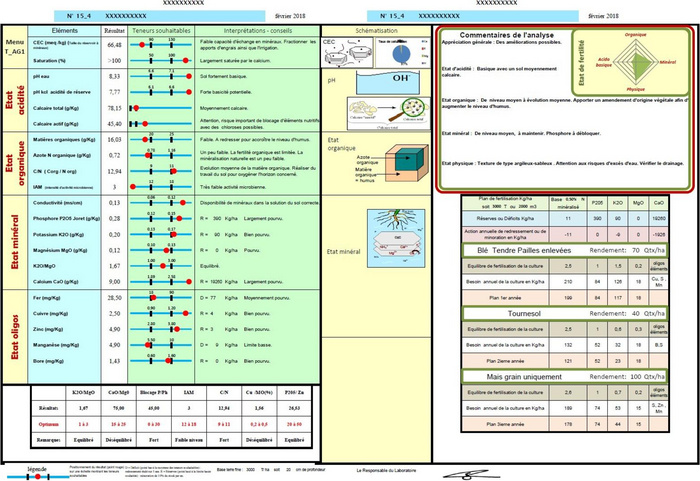
The principle of these kits is to measure the different chemical indicators of a soil:
- The cation exchange capacity.
- The acid-base status: pH water, pH KCl, total and active lime.
- The organic status: organic matter, organic N, C/N, IAM.
- The mineral status: conductivity, P2O5, K2O, MgO, CaO.
- The trace elements: iron, copper, zinc, manganese and boron.
Most of these kits consist of an information sheet, sampling bags, a sampling advice sheet and a pre-stamped tracked letter box for the shipment of the soil sample. After sending the sample to an analysis laboratory, the results will be available in 15 days. These results are presented in the form of a radar diagram of the state of soil fertility. For some kits, you can at this point contact the engineer responsible for the interpretations to make an assessment with him of the fertilization tables and the advice given.
Interests
The results of this analysis are a good support for the development of a long-term fertilization plan.
The advantages are:
- Its ease of use: the chemical analysis is done in laboratories by professionals.
- Its accessibility: they are sold in stores or on the web. However, other more specific analysis kits are available for self-service and allow to target a chemical element of the soil (nitrogen analysis kit, pH…).
pH analysis
These tests are very simple and allow to assess the acidity or alkalinity of a soil, that is the pH of a soil. They are used when one wants to identify soil pollution or determine the type of crop to plant. These methods are simple and inexpensive but do not allow to obtain precise measurements on the pH of a soil but provide information on the acidic or basic nature of it. Note:
- A limestone soil is an alkaline soil.
- Soils very rich in humus or in sand are probably acidic.
Determination of acidity
Baking soda test
Observation of a chemical reaction due to contact between baking soda and the soil.
Material: Baking soda, a container.
Context: On field and imprecise.
- Mix a soil sample with demineralized water to form a mud. Then pour the baking soda.
- If the solution fizzes, then the soil is acidic.
Determination of alkalinity
Vinegar test
Observation of a chemical reaction due to contact between white vinegar and the soil.
Material: White vinegar, a container.
Context: On field and imprecise.
- Pour white vinegar on the soil sample.
- If the vinegar reacts, then the soil is alkaline.
Determination of acidity or alkalinity
Red cabbage method
Observation of a color change.
Material: Distilled water, a cabbage red, containers.
Context: In the laboratory and imprecise.
- Slice the red cabbage. Boil pure distilled water. Then place the red cabbage in the water and let the pieces soak for about ten minutes before removing them. Keep the purple juice which, logically, has a neutral pH (7). Then place some juice in a clean container, and add two tablespoons of soil. Let this mixture rest for half an hour before checking the color.
- If desired, you can first check the colors by testing the juice with baking soda (alkaline) and lemon juice (acidic): the first turns the solution blue-green and the second bright pink. This allows having comparable solutions to the results found.
- If the solution is purple, then the soil has a neutral pH.
- If the solution is pink, the soil has an acid pH.
- If the solution is blue/green, the soil has an alkaline pH.
pH determination method
Measurement of pH using an instrumental method.
Material: Containers, a pH meter, KCl or CaCl2, buffer solutions.
Context: On field or in laboratory. The test is quick and it is a reference method.
- Let a defined amount of soil dry at room temperature for at least 12 hours. Prepare a soil suspension (containing at least 5g of soil) in five times its volume, either with a 1M potassium chloride (KCl) solution of analytical grade, or a 0.01 M calcium chloride (CaCl2) solution of analytical grade. Shake the suspension vigorously for five minutes. Let the suspension rest for at least two hours, but no more than 24 hours. Measure the pH of the liquid phase using a pH meter, calibrated before each measurement with an appropriate series of buffer solutions (pH 4 and pH 7 for example).
- If the solution shows a pH between 0 and 6, then it is acidic.
- If the solution shows a pH of 7, then it is neutral.
- If the solution shows a pH between 8 and 14, then it is alkaline.
Optical soil analysis
The chemical composition of soil samples through their absorption and reflectance properties of light can be studied using two tests:
- The Near InfraRed Spectroscopy (NIRS) which measures and analyzes reflection spectra in the wavelength range 780 to 2500 nm. This technique is mainly used for the detection of carbon atoms, oxygen, sulfur, nitrogen and hydrogen.
- The Mid InfraRed Spectroscopy (MIRS) which measures and analyzes reflection spectra in the wavelength range 2500 to 25000 nm.
They are used to analyze the water content of seeds, analyze the quality of fodder, soybean and wheat.
Equipment
It is necessary to have a light source, a monochromator, a near infrared filter, a cuvette, a detector, a computer.
Technique
For each analysis, a calibration phase is necessary. NIRS and MIRS consist of exposing a sample to radiation located in the near IR domain, the sample is thus scanned.
For each wavelength, the portion of radiation reflected (reflectance) by the sample is measured using detectors and converted into absorbance. All these absorbances constitute the spectrum which can be considered as a global fingerprint, reflecting the chemical composition of the analyzed object. Results:
Results:
- The NIR spectra provide information mainly from organic compounds and clays.
- In mid IR, absorption is intense and the obtained bands are sharp and assignable to chemical groups. The peaks are mainly due to variations of CC (carbon-carbon), CN (carbon-nitrogen) and CO (carbon-oxygen) bonds. The MIR spectra contain information both on organic matter and on minerals.
Advantages
- Fast method (spectrum obtained in a few seconds).
- Easy to implement and non-destructive method (no alteration of the sample).
- The cost of an analysis is low.
Disadvantages
- The level of analysis required is expert.
- The NIRS does not allow the detection of constituents present at trace levels. The measurement of mineral matter is in principle not possible in NIRS because mineral elements generally do not have bonds in this spectral domain. Water has a strong absorption capacity, which can be a disadvantage for fresh (wet) samples because its signal can mask that of other constituents of the sample.
Carbon content analysis
These tests allow to determine the amount of organic matter, the organic carbon rate, the total carbon rate of a soil. With these data, one can assess the impact of different agricultural practices on soil quality.
Potassium permanganate test
Observation of the oxidation capacity of organic matter quantifying the labile carbon compartment of the soil, that is the fresh organic matter, easily degraded by soil fauna. This test allows to assess the proportion of organic matter in a soil sample.
Material: A bottle of potassium permanganate, a pipette, an empty bottle, a color scale for diagnosis.
- Dry a soil sample in the sun on a black tarp for example. Put a soil sample in a bottle previously filled with a diluted permanganate solution. Wait 10 minutes before interpreting the result which manifests as a color change.
- If the solution above the soil sample (deposited at the bottom of the bottle) remains red to purple, then the soil contains very little organic matter. If the solution becomes lighter, then the soil has a high organic matter content.
.jpg)
Dumas method or dry combustion method
Measurement of the amount of carbon dioxide formed during the process.
Material: An analytical balance, common laboratory glassware, a 250 µm mesh sieve, a total carbon measuring device, crucibles, reagents (standard substance, demineralized water, hydrochloric acid).
- The sample is heated to a temperature of at least 900°C in a gas flow containing O2 and free of carbon dioxide. The carbon present in the sample is then oxidized and desorbed as CO2. The amount of CO2 released is measured by titrimetry, gravimetry, conductimetry, gas chromatography or by an infrared detection method. At 900°C, carbonates are completely decomposed. The organic carbon measurement consists of first eliminating carbonates by treating the sample with HCl or by subtracting the carbonate content from the total carbon.
- This gives the total carbon content and the organic carbon content. Be careful to calibrate the device.
Calcimetry
Measurement of mineral carbon contained in the sample mainly in the form of calcium carbonate or magnesium.
Material: An analytical balance, common laboratory glassware, a calcimeter, reagents.
- A soil sample is placed in an acidic medium to decompose carbonates and release mineral carbon as CO2.
- The volume of CO2 thus released is measured using a calcimeter or Scheibler apparatus and the carbonate content of the sample can thus be calculated. Be careful to calibrate the device.
Walkley-Black method
Measurement of the oxidation of organic matter by an excess amount of potassium dichromate in sulfuric medium.
Material: A dichromate solution, a sulfuric acid solution, a stirrer, test tubes, a centrifuge, a
spectrocolorimeter, glucose.
- Same procedure as the Anne method (below) except that samples should not be heated.
Anne method or wet oxidation method
Measurement of the oxidation of organic matter by an excess amount of potassium dichromate in sulfuric medium.
Material: A dichromate solution, a sulfuric acid solution, a stirrer, test tubes, a heating block, a centrifuge, a spectrocolorimeter, glucose.
- Place the test sample in a tube (the organic carbon present in the soil sample). Using dispensers, add respectively 5 mL of dichromate solution then 7.5 mL of sulfuric acid. Mix carefully with the stirrer. Place the tubes in the heating block at 135°C and let react for 30 min. Remove the tubes and add 50 mL of water. Cool in a water bath and adjust to 75 mL with water. Mix and let settle for 1 hour. Centrifuge part of the supernatant at 2000 rpm for 10 min. Calibrate the spectrocolorimeter with glucose. Set the spectrocolorimeter to a wavelength of 585 nm. Run the calibration range, then the tests.
- Determine the calibration function and calculate the carbon concentrations of each test.
- Chromium VI (orange) is reduced by organic matter to chromium III (green). Then, the formed chromium III is measured by colorimeter. Indeed, the amount of chromium III is proportional to the organic carbon content present in the soil.
| Method | 
|

|
|---|---|---|
| Potassium
permanganate |
Low cost.
Fast. On field. Easy. |
Not precise :
visual expertise of the color. A portable spectrophotometer can reduce this limitation but it is more expensive. |
| Dumas
method |
Fast.
Many analyses in one day. No pollution. Automated method. Results archived. |
Poorly suited for
highly carbonated and poor in organic matter soils. Expensive (equipment + reagents). Laboratory. Expert level. |
| Calcimetry | Low cost
(equipment + reagents). Easy and fast. Many analyses in one day. |
Requires
a lot of experience. Laboratory. Expert level. |
| Anne
method |
Adapts to
almost all soil types. Low cost (equipment + reagents). Many analyses in one day. |
Risk of
burns and allergic reactions (due to handling concentrated sulfuric acid and potassium dichromate). Laboratory. Expert level. |
Nitrogen content analysis
The Nitrachek kit allows to determine on site, the nitrate level of a soil by measuring the available nitrogen content in the soil (in nitric nitrogen form). This then allows to manage as precisely as possible the nitrogen applications of the current crop.
Equipment
A test kit (reader, 100 strips, 100 filters, standard solution and an auger) costing €380 is required.
Technique
Before any measurement, nitrogen must be extracted in an extracting solution (such as distilled water). Then proceed to measurement with the Nitrachek. A common protocol must be followed throughout the AAC (Catchment Area), work in relative mode rather than absolute value, remember that the values obtained differ from a laboratory result, and do not hesitate to make repetitions.
Advantages
- It is a simple method that can be repeated.
- No expertise level is required.
A still partial view
To determine the overall quality of a soil, the analysis of a single indicator is not relevant. Indeed, soil is a very complex environment and in constant interaction with the surrounding ecosystem. It is therefore perfectly logical to reason on a larger scale by looking at several indicators at once, both indicators on the biology of soils, on the physical properties and on the chemical properties.
A soil analysis can also be carried out by experts. There is, for example, a methodology developed by researchers from IRD and Cirad to assess soil health by studying their biological activity: Biofunctool®. This method is based on a multi-criteria evaluation of the three essential functions for soil life and the organisms composing it: the carbon dynamics, the nutrient cycle and the maintenance of soil structure.
This analysis can be carried out either by experts from Cirad and IRD (as part of services or research and development projects), or by agronomic experts who have received training (2023).
Sources
INRAE, SOLAE, Mégane PEREZ (2021), Contribution to the appropriation and generalization of the use of soil quality evaluation indicators in Provence –Alpes – Côte d’Azur, rd-agri, https://opera-connaissances.chambres-agriculture.fr/doc_num.php?explnum_id=163817
