False seedbed: does it work or not? Jérôme Labreuche, ARVALIS
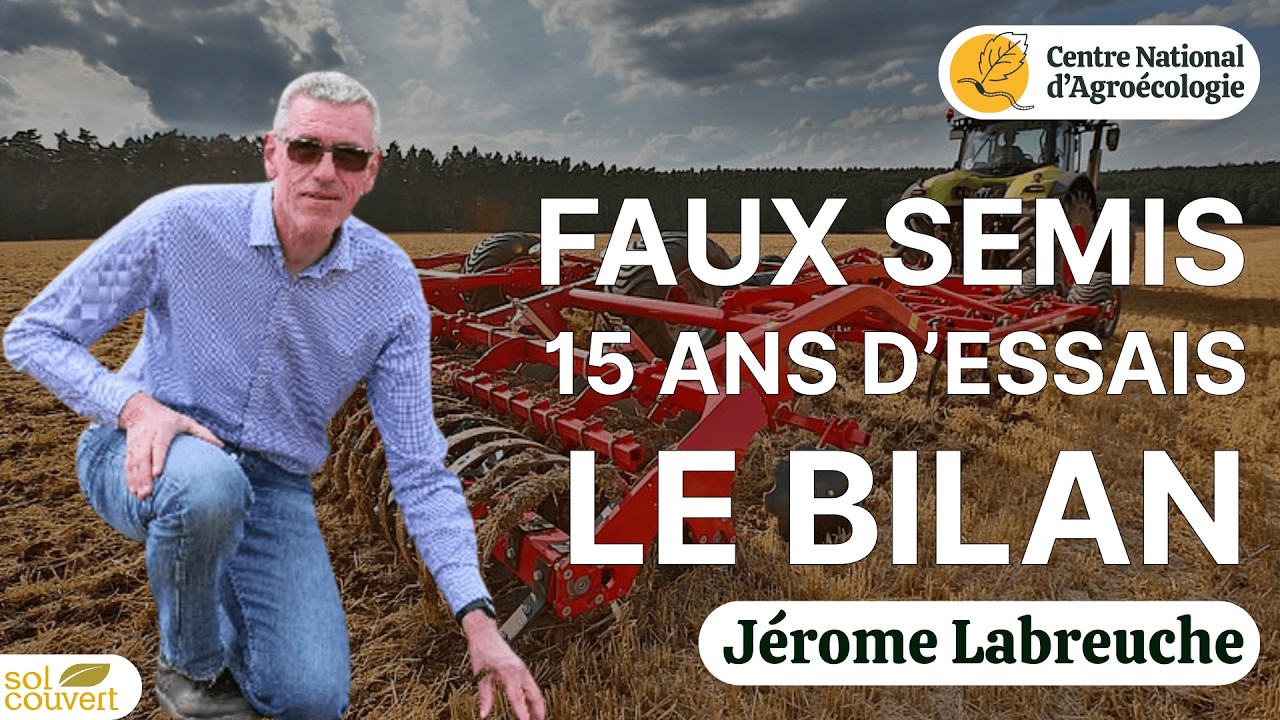
Jérôme Labreuche, head of tillage and intercropping at ARVALIS - Institut du végétal, presents the research carried out on false seedbeds.
A synthesis of 56 trials on false seedbeds
Jérôme Labreuche explains that ARVALIS recently compiled, in Phytoma, a set of about 56 trials on false seedbeds. This volume of data is considered significant, as it covers several years, with the oldest trials dating from around 2005 and others much more recent.
These trials come from different organisations:
- ARVALIS
- Terres Inovia
- ITB, particularly on sugar beet
- ACTA
- other partners
The two crops best documented in this synthesis are:
- wheat
- sunflower
This work was carried out as part of a project called Comberpic, with the aim of gathering all the available data on the subject.
An important limitation: annual trials
The main limitation of this synthesis is that the trials are annual. In other words, they compare tillage treatments during the intercrop period, then observe the consequences in the following crop, but without extending the observation over several years.
Jérôme Labreuche stresses this point: these are not trials run for 5 years, which limits the scope of the conclusions, particularly for a lever such as the false seedbed, whose effect could in theory build up over time through a gradual action on the seed bank.
He also announces that new medium-term trials will be relaunched to confirm or refute the current observations.
The false seedbed stimulates emergence, but not as much as one might think
The first lesson of the synthesis is that tillage between crops does increase weed emergence, but not always to the expected extent.
Indeed, some weeds are able to emerge spontaneously without tillage. Jérôme Labreuche cites, for example:
- situations after rapeseed, where "it comes up on its own"
- the case of cranesbill (geranium), for which work by Terres Inovia showed that stubble cultivation could even reduce emergence compared with no tillage
So, in general, the false seedbed stimulates emergence a little, but the difference with a no-tillage situation is not always huge. You do not start from zero when you do not till the soil.
According to him, this alone may partly explain why the final results with and without a false seedbed are not so different.
What a "real" false seedbed is
Jérôme Labreuche points out that a false seedbed must be a pass that is:
- very shallow
- at most 5 cm deep
- as fine as possible
- well firmed
The aim is to create ideal emergence conditions, "as if you were sowing a lawn". For seeds such as ryegrass, you need:
- a shallow burial depth
- no clods
- fine soil
- good firming
He also stresses that several passes may be needed, depending on the climate and the trial conditions, because not everything will emerge at once.
Many stubble cultivations are not real false seedbeds
A strong point of Jérôme Labreuche's reasoning is that, in practice, many farmers think they are making false seedbeds when in fact they are doing stubble cultivations that are poorly suited to this purpose.
According to him, many stubble cultivators actually work:
- at 5 to 8 cm, or even 7 to 8 cm
- with often somewhat cloddy soil
- with sometimes insufficient firming, particularly with light cage rollers
Put together, these factors lead to weed emergence that is "not really very good".
In other words, if we are talking about a false seedbed, the aim should be ultra-shallow work. After harvest, residues and straw also have to be managed, which sometimes requires a minimum depth, but the shallower the work, the better from a false seedbed point of view.
A simple drill pass can sometimes stimulate emergence almost as much
In some trials, researchers observed that simply establishing a cover crop with a drill could stimulate emergence almost as much as a shallow stubble cultivation.
The case cited is that of a disc direct drill. The slight soil disturbance caused by the drill, even localised on or near the row, could be enough to trigger emergence close to that observed after stubble cultivation.
This reinforces the idea that, for false seedbeds, it is above all the ultra-shallow nature of the disturbance that matters.
A synthesis carried out on clean soil before sowing
To analyse the effects of the false seedbed in the following crop, the trials selected for the synthesis were conducted with sowing on clean soil.
Jérôme Labreuche specifies that trials without glyphosate were excluded from the synthesis when he considered that sowing had not been carried out on clean soil.
The reason is methodological: if you sow into weeds that are already alive, you can no longer distinguish between:
- plants that re-rooted or were not destroyed
- weeds that emerged before sowing
- weeds that actually emerged in the crop
Destroying weeds already present and the emergence of new weeds involve different mechanisms. Mixing the two completely blurs the interpretation.
Glyphosate was therefore used, in this synthesis, as a way of starting from a clean situation and not mixing the effects.
Weed control in the trials: some heterogeneity
After sowing, weed control was not strictly identical in all trials. Depending on the crops and sites, there may have been:
- a pre-emergence herbicide
- or not
Jérôme Labreuche cites the example of sunflower, where it is sometimes difficult to do without a pre-emergence herbicide.
This variability is another limitation of the trial network. But it also reflects reality in the field: not all farmers control weeds in the same way, and strategies also adapt to the weed flora present.
Disturbed or undisturbed soil at sowing
In the trials, the researchers also compared sowing on disturbed and undisturbed soil.
This covers several cases:
- disc direct drilling on untilled soil
- sowing without tillage on soil already stubble-cultivated earlier
- seedbed preparation with a rotavator, power harrow or other implement
- comparison of disturbing modules fitted or not on a drill
In the synthesis, situations were classified as "undisturbed" when there had been no tillage at sowing or in the previous 10 days.
Jérôme Labreuche cites in particular:
- situations with a rotavator on untilled stubble or on already tilled soil
- disc direct drilling
- a trial in Normandy with a Lemken Solitaire disc drill, used with or without independent discs at the front (preparation module)
In the following crop, very little effect of the false seedbed
The main result of the synthesis is very clear: in autumn crops, especially wheat, no effect of false seedbeds on weed infestation of the following crop was observed.
Jérôme Labreuche insists: over a large number of trials, he saw "absolutely nothing". The results are not significant.
In spring crops, there were sometimes slight effects, but:
- they were not significant
- or some trials did not allow sound statistics, for lack of blocks or replicates
In summary:
- in autumn crops: no effect demonstrated
- in spring crops: at best a slight effect, but very small
A lever to be demystified
For Jérôme Labreuche, this synthesis at least has the merit of demystifying the false seedbed.
In technical discourse, the false seedbed is often presented as an important lever, on the same level as:
- crop rotation
- ploughing
- delaying the sowing date
Yet the results of the synthesis show that, while it is indeed a lever, its effect seems extremely small, at least in the short term.
He qualifies this by pointing out that there is still uncertainty about medium-term effects, in the absence of multi-year trials. But on the basis of the available data, he believes this lever should not be overestimated.
He even goes further: a no-plough farmer who changes neither rotation nor sowing date, but relies mainly on false seedbeds, risks, in his view, "pleasing themselves for very little" and deluding themselves without really improving their situation.
This synthesis should therefore be read as a warning: relying mainly on false seedbeds, without other associated levers, leads to serious disappointment.
Two possible explanations for this low effectiveness
Jérôme Labreuche puts forward two main explanations.
Summer conditions that are sometimes too dry
In summer, conditions can be very dry. In this case, a false seedbed simply does not bring much up.
Even when the false seedbed triggers emergence, the proportion of the total seed bank concerned is probably very small.
He explains that, in wild weeds, the seed bank is not designed to emerge all at once. It is a survival strategy for the species:
- if all the seeds emerged at the same time and conditions became unfavourable, the species could disappear locally
- by spreading emergence over time, the species always keeps a chance of producing new seeds
So even well-executed tillage would never bring up a very large share of the seed bank in a single pass.
Soil disturbance at sowing: a much stronger effect
For Jérôme Labreuche, the most important lesson of the trials is ultimately not so much the effect of the false seedbed as that of soil disturbance at sowing.
In his view, it is even a point that is insufficiently taken into account in the farming world, outside the conservation agriculture community.
In the trials, disturbing the soil at sowing or in the days before had a major effect on weed emergence.
Examples observed in wheat and sunflower
In sunflower, for example, in situations where the soil had been prepared in advance, the researchers compared:
- sowing without final seedbed preparation
- final preparation with a spring-tine cultivator
- more aggressive final preparation with a power harrow
The results show that:
- the power harrow, which refines the soil more, stimulates the emergence of weeds such as ryegrass the most
- the spring-tine cultivator also stimulates it, but a little less
- no final preparation stimulates emergence the least
The same phenomenon was observed overall in wheat.
Not disturbing the soil at sowing reduces emergence
The technical message put forward is therefore the following: on soil already prepared in advance, simply not carrying out any seedbed preparation in the three weeks before sowing reduces weed emergence.
Jérôme Labreuche estimates that not disturbing the soil at sowing roughly halves the number of weeds that emerge.
He specifies that:
- it is not 100 % effective
- nor even 80 %
- but about 50 %
And this 50 % can become very interesting when combined with other levers.
A point rarely heard despite results that are already old
Jérôme Labreuche says he is struck by the fact that the farming world talks a lot about false seedbeds, but very little about soil disturbance at sowing, even though results on this subject exist and have been disseminated for about 15 years.
According to him, this point is fairly well known in the conservation agriculture community, but much less so outside it.
A possible consequence: having to use glyphosate
Not disturbing the soil at sowing does, however, have an important counterpart: it may require a glyphosate application beforehand in order to sow on clean soil.
Indeed, if you choose not to rework the soil just before sowing, you cannot afford to sow into weeds that are already established, especially problematic grass weeds such as ryegrass, which is often resistant.
Jérôme Labreuche mentions a few cases where volunteers can be managed after sowing:
- rapeseed sown into wheat volunteers, with the possibility of a follow-up graminicide
- wheat into rapeseed volunteers, sometimes manageable afterwards
But as soon as difficult grass weeds are involved, he believes this risk should definitely not be taken.
A regulatory limit after ploughing
Finally, he points out that there is also a regulatory limit: after ploughing, the use of glyphosate is in principle not authorised, except in the particular case of very early summer ploughing on waterlogged clay soils.
Conclusion
The synthesis presented by Jérôme Labreuche leads to a fairly clear message:
- the false seedbed does stimulate weed emergence between crops, but often quite modestly
- in the following crop, its effect appears very small, or even nil in many cases, especially in wheat
- its effectiveness is probably overestimated in technical discourse
- conversely, soil disturbance at sowing has a much clearer effect on emergence
- avoiding this disturbance can halve weed emergence, provided the crop is sown on clean soil
In other words, the false seedbed should not be considered a major lever on its own. If it has a place, it seems limited, and it must be placed within a broader strategy combining other agronomic levers such as rotation, delayed sowing or managing soil disturbance at sowing.

Cette page a été conçue dans le cadre du projet SOL Couvert, qui bénéficie du soutien financier de l’Office Français de la Biodiversité dans le cadre d’ECOPHYTO II+, avec la participation du Centre National d'Agroécologie, de Ver de Terre Production et de Neayi