

Bioremediation
.png)
Bioremediation is a process that uses living organisms, such as bacteria, fungi, or plants (phytoremediation), to decontaminate polluted soil, water, or air. These organisms degrade, neutralize, or transform pollutants into compounds that are less toxic or harmless to the environment.
Why decontaminate soils?
With the rapid development of the global economy, the overexploitation and extraction of natural resources are leading to the constant release of heavy metals into the environment, particularly from activities such as mining and the combustion of fossil fuels. These metals are toxic to the environment and the health of ecosystems, animals, and humans. According to the European Commission, it is estimated that 2.8 million European sites are potentially contaminated.[1].
Main Pollutants
Hydrocarbons and metals (and metalloids) are the two main families of pollutants affecting soils and groundwater in France.
Hydrocarbons
They contaminate 61% of the soils and 64% of the groundwater at polluted sites listed in the "Basol" database. Overall, different hydrocarbon families (minerals, chlorinated hydrocarbons, PAHs (polycyclic aromatic hydrocarbons)) are involved in 65% of all soil and groundwater pollution.
Metals and metalloids
They pollute 48% of soils and 44% of groundwater at polluted sites, and represent nearly 25% of pollutants found in soils and waters. Lead, chromium, and copper are the most frequently detected metals. Lead is present in 17% of soils and 9% of groundwater. Chromium and copper are present in 14% of soils and 7% of groundwater.[2].
Where are the polluted sites?
-
![Exceeding limits for heavy metals in sewage sludge (in green)[3]](https://wiki.tripleperformance.fr/images/fr/thumb/f/f8/M%C3%A9taux_lourds_sols_fran%C3%A7ais.jpg/120px-M%C3%A9taux_lourds_sols_fran%C3%A7ais.jpg) Exceeding limits for heavy metals in sewage sludge (in green)[3]
Exceeding limits for heavy metals in sewage sludge (in green)[3] -
![Threshold exceedances for cadmium, copper, mercury, and zinc (in red)[4]](https://wiki.tripleperformance.fr/images/fr/thumb/7/76/Cadmium%2C_cuivre%2C_mercure%2C_zinc.jpg/120px-Cadmium%2C_cuivre%2C_mercure%2C_zinc.jpg) Threshold exceedances for cadmium, copper, mercury, and zinc (in red)[4]
Threshold exceedances for cadmium, copper, mercury, and zinc (in red)[4] -
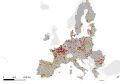
![Exceeding limits for heavy metals in sewage sludge (in green)[3]](/wiki/File:M%C3%A9taux_lourds_sols_fran%C3%A7ais.jpg)
![Threshold exceedances for cadmium, copper, mercury, and zinc (in red)[4]](/wiki/File:Cadmium,_cuivre,_mercure,_zinc.jpg)

Interactive maps from the same report are available here.
Traditional Methods
Soil remediation can be carried out through:
- Excavation: Contaminated soil is excavated (removed) and transported to specialized treatment centers.
- Containment: Pollutants are isolated or immobilized in the soil to prevent their dispersion (solid matrix, impermeable layer). Used when excavation is not possible.
- Thermal Treatment:
- Incineration: The soil is heated to very high temperatures to decompose organic compounds.
- Thermal Desorption: Volatile pollutants are heated to evaporate and then captured.
- Soil Washing: The soil is washed with water, solvents, or chemical solutions to extract the pollutants. Fine particles or soluble contaminants are separated by agitation or centrifugation. The wastewater is then treated separately.
- Chemical extraction or stabilization: Use of chemical reagents to solubilize or transform pollutants and extract them from the soil or make them less mobile/toxic.
Half of the polluted soil is excavated or stored in specialized sites (excavation: 29%; storage: 19%), but 25% of this soil is treated biologically[6].
Bioremediation
Different types of bioremediation exist.
Stimulate or add microorganisms?
Biostimulation (or intrinsic bioremediation)
It consists of increasing the activity of the indigenous microflora of a given environment by compensating for the deficiency of a fundamental element for the biodegradation of a hydrocarbon, via a supply of nutrients and/or final electron acceptors (oxygen, nitrate, sulfate), such as:
- Water-soluble mineral fertilizers for agricultural or horticultural use composed of nitrogen and phosphorus,
- Slow-release solid media: N and P combined with a solid carbon element,
- Liquid oleophilic media developed to ensure nutrient supply as close as possible to bacterial activity (at the water-hydrocarbon interface)[7].
Bioaugmentation
It consists of adding exogenous microorganisms to an environment characterized by the absence or lack of abundance of bacteria hydrocarbonoclasts. They are generally implemented by spraying a rehydrated lyophilizate.
Different Bioremediation Techniques
Biopiles or Biopiles

This is an ex situ treatment technique that stimulates the activity of aerobic or facultative aerobic microorganisms responsible for the biodegradation of contaminants in soils. Essentially, contaminated soils are excavated and piled into piles (biopiles), typically 0.91 to 3.05 m high, with relatively limited width and length. The biopile must be designed and operated to provide optimal temperature, humidity, aeration, and nutrient conditions to promote the biodegradation of the targeted contaminants. Biodegradation is generally carried out by indigenous microorganisms, but the addition of specific microorganisms may sometimes be necessary. The addition of structuring agents such as wood chips and amendments may be necessary to improve air circulation within the biofuel cell and promote biodegradation processes.[8].
Bioreactors

The technique involves mixing polluted soil with water and various additives to suspend the soil particles in the water and form a sludge mixture. The resulting sludge is biologically treated in bioreactors and then dewatered.[9]. The goal is to increase the contact surface between contaminants and the microorganisms responsible for their biodegradation in a controlled environment[10].
Natural Attenuation
Natural attenuation is not strictly considered a remediation technique but rather a pollution management measure. It takes place without direct human intervention (except for monitoring) and aims to reduce the mass, toxicity, mobility, volume, or concentration of contaminants. Monitoring devices, mainly piezometers, allow the control of a number of parameters: pollutant concentrations, dissolved gas concentrations, electron acceptor concentrations, TOC concentrations, bacterial counts, physicochemical parameters, and the rebound effect.[11].

Bioventilation
Bioventing involves stimulating indigenous microorganisms by adding a gas (usually air) to degrade organic contaminants (usually petroleum hydrocarbons) present in unsaturated soil. Air is most often injected into the vadose zone (unsaturated zone), but on some sites, it can be extracted from the vadose zone. The most common application of bioventing involves introducing air to increase the oxygen concentration above 5% in order to stimulate the biodegradation of petroleum hydrocarbon contamination.[12].

Biosparging
Biosparging involves stimulating biodegradation by increasing dissolved oxygen levels through injection wells into the soil or water. The injected air primarily enables the growth of the aerobic microbial population but also facilitates contact between the air, water, and the aquifer, which promotes the desorption of pollutants. Biosparging is often confused with sparging. Biosparging is used when biodegradation is greater than volatilization. [13].

Landfarming
The principle consists of spreading polluted soils over a thin layer (30 cm) and large areas, which allows interaction between the polluted matrix and the atmosphere. The goal is to promote aeration and therefore aerobic degradation. Tilling the soil allows for regular aeration. Biodegradation can be promoted by adding nutritional supplements. Contaminated soil must be spread on impermeable substrates (asphalt, geomembrane, or more rarely, concrete) to avoid soil and groundwater pollution.

Composting
Composting involves mixing excavated soil with organic amendments (compost) and arranging it in regularly spaced trapezoidal piles (also called windrows) to promote biodegradation. The organic matter can be of animal or plant origin. Compost acts on biostimulation (supply of nutrients, carbon, nitrogen, etc.), bioaugmentation (supply of bacteria), and aeration (supply of structuring agents and rigid elements that increase porosity).[14].
Summary
| In situ techniques | Targeted pollutants |
|---|---|
| Bioventilation |
|
| Biosparging |
|
| Ex situ techniques | Targeted pollutants |
| Biopiles or biopiles |
|
| Bioreactors |
|
| Composting |
|
| Landfarming |
|
Practical Application
- Beach Cleanup After the Exxon Valdez Oil Spill: In Alaska, an oil spill contaminated the coastline with approximately 41 million liters of crude oil. Scientists added nutrients, nitrogen and phosphorus (biostimulation), to stimulate bacteria naturally present in the environment and capable of breaking down hydrocarbons[15]. The biodegradation of polycyclic aromatic hydrocarbons (PAHs) has been significant, with a decrease ranging from 13% to 70% per year. [16].
- Mycoremediation of pesticides in agricultural soils: Projects in Belgium and elsewhere have demonstrated that the mycelium of fungi such as oyster mushrooms can degrade polycyclic aromatic hydrocarbons (PAHs) and pesticides, using enzymes such as laccases and peroxidases. These processes transform toxic molecules into harmless compounds, reducing pollution by up to 90% in pilot tests.
Benefits and Risks
Benefits
- Ecological Solution:
- Uses microorganisms (bacteria, fungi), plants, or their enzymes to transform or degrade pollutants into non-toxic compounds, thus avoiding the use of harsh chemicals.
- Minimizes the impact on the surrounding ecosystem compared to traditional methods such as incineration or landfilling.
- Relatively Low Cost:
- Bioremediation techniques are often less expensive than mechanical or chemical methods, especially over large areas or for complex organic pollution (hydrocarbons, solvents).
- Improves Soil Health:
- Certain approaches, such as adding organic matter to stimulate microorganisms, can improve soil quality and its ability to retain water and nutrients.
- Flexibility and specificity:
- Adaptable to various types of pollutants: hydrocarbons, heavy metals, pesticides, solvents, etc. Furthermore, techniques such as phytoremediation or mycoremediation allow for the treatment of specific environments.
- Higher social acceptability than thermal and chemical solutions.
Limitations and Risks
- Long Time:
- Biological processes can be slow and require several months or even years to obtain significant results, which can be problematic in an emergency.
- Limitation to Biodegradable Pollutants:
- Some pollutants, such as heavy metals or highly stable chemicals (persistent pesticides, PCBs), cannot be degraded but only immobilized or partially transformed.
- Dependence on Environmental Conditions:
- The effectiveness of bioremediation is highly dependent on local conditions: temperature, pH, nutrient availability, and oxygen content. If conditions are not optimal, the process may be ineffective.
- Risk of bioaccumulation:
- In phytoremediation, plants can accumulate heavy metals, requiring management of contaminated plants (incineration or secure storage).
- Risk of microorganism dissemination:
- Bioaugmentation techniques, which introduce specific microorganisms, can lead to ecological imbalances or unanticipated impacts on local biodiversity.
- Pollutant resistance:
- Some complex or mixed contaminants (heavy hydrocarbons combined with metals, for example) may require combined approaches, which increases complexity and costs.
Sources
- ↑ European Parliament, 2024, page consulted on 11/26/2024: https://www.europarl.europa.eu/news/fr/press-room/20240408IPR20304/le-parlement-prevoit-des-mesures--assainir-les-sols-d-ici-2050
- ↑ https://www.statistiques.developpement-durable.gouv.fr/sites/default/files/2018-10/ed97-sols-pollues-05112013.pdf
- ↑ The state of soils in Europe, European Environment Agency, 2024; Report available for download at: https://publications.jrc.ec.europa.eu/repository/handle/JRC137600
- ↑ The state of soils in Europe, European Environment Agency, 2024; Report available for download at: https://publications.jrc.ec.europa.eu/repository/handle/JRC137600
- ↑ The state of soils in Europe, European Environment Agency, 2024; The report can be downloaded from this address: https://publications.jrc.ec.europa.eu/repository/handle/JRC137600
- ↑ ADEME, https://www.notre-environnement.gouv.fr/themes/sante/la-pollution-des-sols-ressources/article/les-sites-et-sols-pollues#:~:text=La%20d%C3%A9pollution%20des%20sols,-Les%20techniques%20de&text=La%20pollution%20peut%20%C3%AAtre%20trait%C3%A9e,limiter%20la%20migration%20des%20polluants.
- ↑ Bioremediation, Cedre, 2015, https://wwz.cedre.fr/content/download/8120/file/4-cedre-bioremediation.pdf
- ↑ Fact Sheet: Aerobic Biofuel Cell, Government of Canada, [page consulted on 18/11/2024] https://gost.tpsgc-pwgsc.gc.ca/tfs.aspx?ID=6&lang=eng
- ↑ Bioréacteur, SelecDEPOL, 2023, https://selecdepol.fr/fiche-technique/bioreacteur
- ↑ Fact sheet: Bioreactor, Government of Canada, 2019, [page consulted on 19/11/2024] https://gost.tpsgc-pwgsc.gc.ca/tfs.aspx?ID=7&lang=eng
- ↑ Controlled Natural Attenuation, SelecDEPOL, 2023 [page consulted on 11/19/2023] https://selecdepol.fr/fiche-technique/attenuation-naturelle-controlee
- ↑ Bioventing, Federal Remediation Technologies Roundtable, https://frtr.gov/matrix/Bioventing/
- ↑ SelecDEPOL, 2023, [page consulted on 19/11/2024] https://selecdepol.fr/fiche-technique/biosparging
- ↑ Composting, SelecDEPOL, 2023, https://selecdepol.fr/fiche-technique/compostage
- ↑ http://www.marees-noires.com/fr/lutte/lutte-a-terre/biorestauration.php
- ↑ Bioremediation of the Exxon Valdez oil in Prince William Sound beaches, Michel C. Boufadel et al., 2016, https://www.sciencedirect.com/science/article/abs/pii/S0025326X16307214

Cette page a été rédigée dans le cadre du projet NBSOIL avec le soutien financier de l'Union Européenne, avec la participation du Centre National d'Agroécologie, de Ver de Terre Production et de Neayi